I lost a tournament match last spring that I should have won. We were up 5-2 in the second set after winning the first. My partner and I were playing well. Then I missed an easy bandeja into the net. Then I missed another one. Then I started gripping the pala harder. Then I started moving slower because my brain was trying to think through every shot instead of trusting my training. We lost 7-5 in the second and the third went 6-1 against us.
Walking off the court, I was furious at myself. Then I started analyzing what had happened. The technical mistake on the first miss was minor. The cascade after it had nothing to do with technique. It was entirely mental.
I'd been training my body for years. I'd never trained my mind.
I spent the months after reading what the sports psychology research actually says about performance under pressure. Some of it I knew. Most of it I didn't. Below is what I've learned, what works, and what most amateur padel players are skipping completely.
Why the mental game matters in padel
Padel is unusual among amateur sports in how mentally exposed players are.
You're on the court with three other people you'll see every week. Your mistakes are visible to your partner, your opponents, anyone watching from the bar. Unlike running or cycling where mental struggles happen in private, padel struggles happen in front of an audience of people you know.
The decisions happen fast. Every point requires reading the ball, predicting bounce off walls, choosing a shot, executing it, then immediately preparing for the next exchange. Mental load is constant. There's no equivalent of jogging through an easy patch.
The game is partnership-based. Your mental state affects your partner. Their mental state affects you. The doubles dynamic amplifies emotional contagion in both directions.
Pressure builds across points. A bad service game leads to defensive playing. Defensive playing makes errors more likely. Errors increase pressure. The downward spiral is faster in padel than in many sports because games are short and momentum shifts visibly.
Most amateur improvement plateaus aren't technical. They're mental. I've watched players hit thousands of clean smashes in practice then miss them in matches. The body knows how. The brain interferes.
You're on the court with three other people you'll see every week. Your mistakes are visible to your partner, your opponents, anyone watching from the bar. Unlike running or cycling where mental struggles happen in private, padel struggles happen in front of an audience of people you know.
The decisions happen fast. Every point requires reading the ball, predicting bounce off walls, choosing a shot, executing it, then immediately preparing for the next exchange. Mental load is constant. There's no equivalent of jogging through an easy patch.
The game is partnership-based. Your mental state affects your partner. Their mental state affects you. The doubles dynamic amplifies emotional contagion in both directions.
Pressure builds across points. A bad service game leads to defensive playing. Defensive playing makes errors more likely. Errors increase pressure. The downward spiral is faster in padel than in many sports because games are short and momentum shifts visibly.
Most amateur improvement plateaus aren't technical. They're mental. I've watched players hit thousands of clean smashes in practice then miss them in matches. The body knows how. The brain interferes.
The physiology of competition stress
Before you can manage match nerves, it helps to know what's actually happening in your body.
Sympathetic nervous system activation. The fight-or-flight response. Increases heart rate, raises blood pressure, releases stress hormones, redirects blood to large muscles. Useful in measured doses for performance. Overwhelming in high doses.
Reduced executive function. The prefrontal cortex (decision-making) becomes less efficient under stress. Tactical thinking deteriorates. Working memory shrinks. Players default to ingrained habits, both good and bad.
Tunnel vision. Visual attention narrows. You stop seeing the whole court. Awareness of your partner's position drops. Anticipation of opponent positioning degrades.
Increased muscle tension. Particularly in shoulders, forearms, and grip. Tight muscles move slower and execute techniques worse. The death grip on the pala is a classic example.
Faster breathing. Shallow chest breathing replaces diaphragmatic breathing. Less oxygen efficiency. Faster onset of fatigue.
These changes happen automatically. Most amateurs don't notice them happening. The mental game is largely about noticing these changes and intervening before they cascade.
Sympathetic nervous system activation. The fight-or-flight response. Increases heart rate, raises blood pressure, releases stress hormones, redirects blood to large muscles. Useful in measured doses for performance. Overwhelming in high doses.
Reduced executive function. The prefrontal cortex (decision-making) becomes less efficient under stress. Tactical thinking deteriorates. Working memory shrinks. Players default to ingrained habits, both good and bad.
Tunnel vision. Visual attention narrows. You stop seeing the whole court. Awareness of your partner's position drops. Anticipation of opponent positioning degrades.
Increased muscle tension. Particularly in shoulders, forearms, and grip. Tight muscles move slower and execute techniques worse. The death grip on the pala is a classic example.
Faster breathing. Shallow chest breathing replaces diaphragmatic breathing. Less oxygen efficiency. Faster onset of fatigue.
These changes happen automatically. Most amateurs don't notice them happening. The mental game is largely about noticing these changes and intervening before they cascade.
Pre-match anxiety: what to do about it
Anxiety in the hour before a match is normal. The question is whether it works for you or against you.
A moderate level of arousal improves performance. Too low and you're flat and slow. Too high and the physiology above takes over. The sweet spot varies by person.
For most amateurs facing competitive matches, the problem is too high, not too low. Here's what helps.
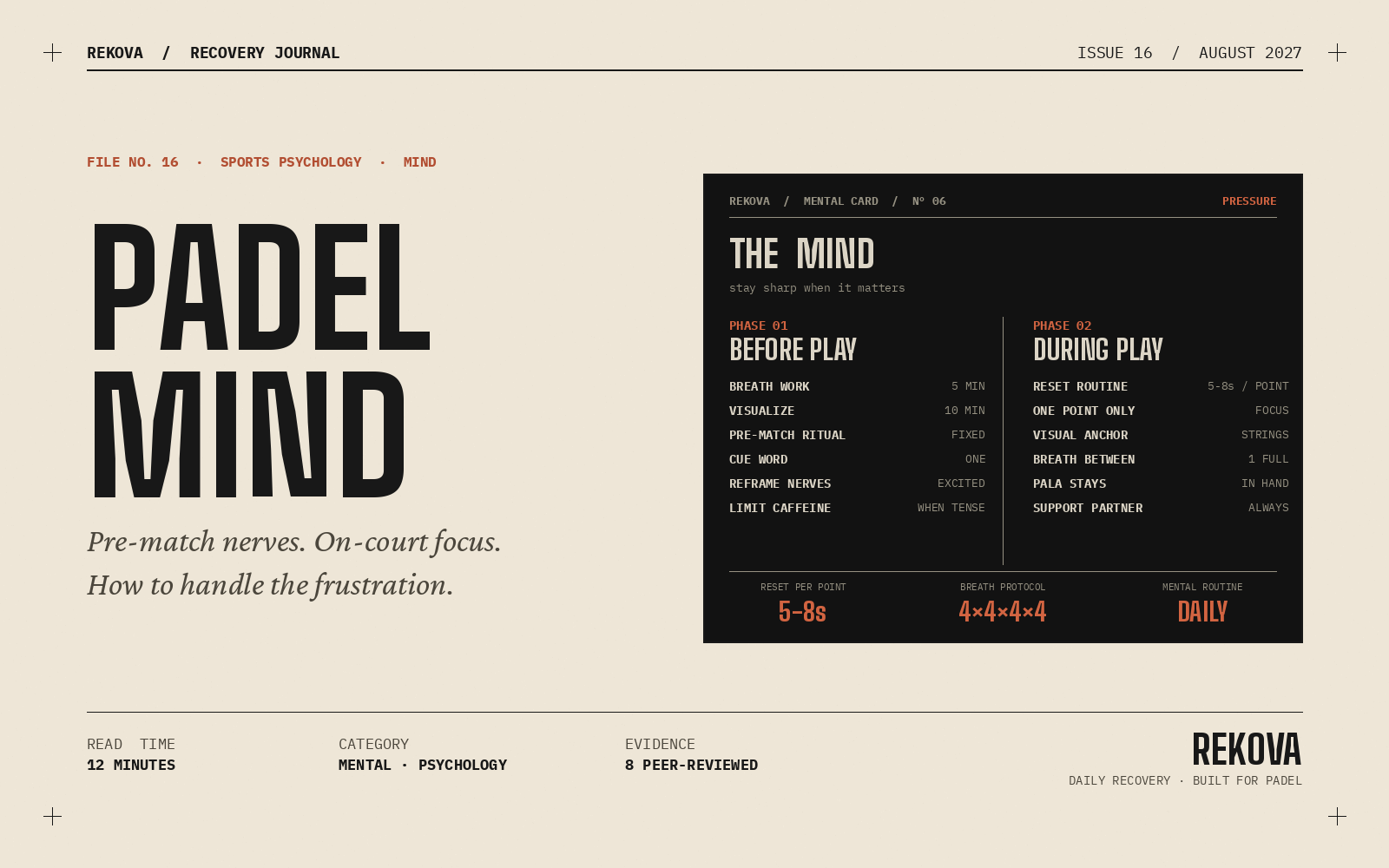
Breathing protocols. The simplest tool. Slow nasal breathing for 5 to 10 minutes activates the parasympathetic nervous system. Box breathing (4 seconds in, 4 hold, 4 out, 4 hold) works well. Cyclic sighing (double inhale through nose, long exhale through mouth) is more effective for fast downregulation according to recent research.
Pre-match routine. The same predictable sequence before every match. Equipment check, walking warm-up, mobility work, pala swings, breath work, court entry. Routines reduce anxiety by creating familiarity. Don't change the routine on important match days.
Reframing. Anxiety and excitement have nearly identical physiology. Tell yourself you're excited. Sounds stupid. Works better than trying to calm down. Multiple studies on athletic anxiety show reframing as more effective than relaxation attempts.
Avoiding stimulants before tense matches. Coffee before a match where you're already nervous can push you past the optimal arousal point. If you usually have coffee before play but feel jittery on match days, skip it on those days.
Pre-sleep visualization the night before. Spending 10 minutes the evening before a match mentally rehearsing the kinds of shots and situations you'll face primes the brain for the next day. The research on this is actually solid.
For my 41-year-old friend Patricia (from my padel for women article), pre-match anxiety used to derail her tournament play. She built a 20-minute routine she does in her car before arriving at the club. Breath work, a specific playlist, two short positive memory reps. Her tournament results changed within months.
A moderate level of arousal improves performance. Too low and you're flat and slow. Too high and the physiology above takes over. The sweet spot varies by person.
For most amateurs facing competitive matches, the problem is too high, not too low. Here's what helps.
Breathing protocols. The simplest tool. Slow nasal breathing for 5 to 10 minutes activates the parasympathetic nervous system. Box breathing (4 seconds in, 4 hold, 4 out, 4 hold) works well. Cyclic sighing (double inhale through nose, long exhale through mouth) is more effective for fast downregulation according to recent research.
Pre-match routine. The same predictable sequence before every match. Equipment check, walking warm-up, mobility work, pala swings, breath work, court entry. Routines reduce anxiety by creating familiarity. Don't change the routine on important match days.
Reframing. Anxiety and excitement have nearly identical physiology. Tell yourself you're excited. Sounds stupid. Works better than trying to calm down. Multiple studies on athletic anxiety show reframing as more effective than relaxation attempts.
Avoiding stimulants before tense matches. Coffee before a match where you're already nervous can push you past the optimal arousal point. If you usually have coffee before play but feel jittery on match days, skip it on those days.
Pre-sleep visualization the night before. Spending 10 minutes the evening before a match mentally rehearsing the kinds of shots and situations you'll face primes the brain for the next day. The research on this is actually solid.
For my 41-year-old friend Patricia (from my padel for women article), pre-match anxiety used to derail her tournament play. She built a 20-minute routine she does in her car before arriving at the club. Breath work, a specific playlist, two short positive memory reps. Her tournament results changed within months.
On-court focus: staying in each point
The actual match is where the mental game matters most. The physiology described above happens whether or not you have tools to interrupt it.
Point-by-point focus. The most-repeated cliche in sports psychology. Also the most useful. Each point is its own entity. The last point is over. The next point doesn't exist yet. The current point is the only one that exists. Constantly bringing attention back to this point is the mental discipline of high-level players.
The reset routine between points. A 5 to 8 second routine you do after every point regardless of the outcome. Could be wiping the pala on your leg, looking at the strings, taking one deep breath, repeating a one-word cue to yourself. The specific actions matter less than doing them consistently. This is the on-court version of the pre-match routine.
The cue word. A single word that triggers the right state. Could be focus, breathe, smooth, ready. Pick one that resonates. Say it to yourself between points. The brain attaches the word to the desired state with practice.
Visual focus reset. After a bad point, fix your eyes on a specific spot (a logo on your shoe, a corner of the glass) for 2 seconds. Breaks the rumination cycle. Resets visual attention for the next point.
Breath as anchor. When you notice your mind running away (replaying a missed shot, anticipating losing), one full breath brings attention back to the body. The body is always in the present. The mind isn't.
Acceptance over fighting. Trying to force yourself not to be nervous often makes it worse. Acknowledging the nerves and playing anyway works better. Yes I'm nervous. Yes I missed that one. Now this point.
Point-by-point focus. The most-repeated cliche in sports psychology. Also the most useful. Each point is its own entity. The last point is over. The next point doesn't exist yet. The current point is the only one that exists. Constantly bringing attention back to this point is the mental discipline of high-level players.
The reset routine between points. A 5 to 8 second routine you do after every point regardless of the outcome. Could be wiping the pala on your leg, looking at the strings, taking one deep breath, repeating a one-word cue to yourself. The specific actions matter less than doing them consistently. This is the on-court version of the pre-match routine.
The cue word. A single word that triggers the right state. Could be focus, breathe, smooth, ready. Pick one that resonates. Say it to yourself between points. The brain attaches the word to the desired state with practice.
Visual focus reset. After a bad point, fix your eyes on a specific spot (a logo on your shoe, a corner of the glass) for 2 seconds. Breaks the rumination cycle. Resets visual attention for the next point.
Breath as anchor. When you notice your mind running away (replaying a missed shot, anticipating losing), one full breath brings attention back to the body. The body is always in the present. The mind isn't.
Acceptance over fighting. Trying to force yourself not to be nervous often makes it worse. Acknowledging the nerves and playing anyway works better. Yes I'm nervous. Yes I missed that one. Now this point.
Managing frustration and anger
Padel makes me angry more than any other sport I've played. The error rate is high. The walls create unpredictable bounces. Your partner's mistakes affect you. The frustration management challenge is real.
What works.
Recognize the trigger. Most anger episodes follow a pattern. Bad partner shot, bad call, lucky opponent point, your own unforced error. Knowing your triggers lets you intervene earlier.
Physical release between points. The 5 to 8 second reset routine includes a deliberate physical action. Walking back to position. Bouncing slightly. Adjusting wristbands. This burns off the immediate stress response.
The pala stays in your hand. Throwing pales, hitting them on the ground, kicking the wall. Don't. Beyond the visible immaturity, these actions reinforce the emotional response. Practice the discipline of staying composed even when frustrated.
Your partner needs your support, not your judgment. Even when your partner is playing badly. Especially when. Visible frustration toward your partner makes them play worse. Visible support, even fake support, often makes them play better. The team dynamic is real.
Reframe the frustration. Bad bounces aren't unfair. They're part of the game. Your partner's errors aren't your problem. They're your partner. The opponents getting lucky shots aren't out to get you. They're playing their match.
Long-term anger management. If you find yourself consistently angry on the court across matches, look at the pattern. Are you playing above your level routinely? Are you choosing partners you don't respect? Are you bringing outside stress to the court? The anger is information about something deeper.
What works.
Recognize the trigger. Most anger episodes follow a pattern. Bad partner shot, bad call, lucky opponent point, your own unforced error. Knowing your triggers lets you intervene earlier.
Physical release between points. The 5 to 8 second reset routine includes a deliberate physical action. Walking back to position. Bouncing slightly. Adjusting wristbands. This burns off the immediate stress response.
The pala stays in your hand. Throwing pales, hitting them on the ground, kicking the wall. Don't. Beyond the visible immaturity, these actions reinforce the emotional response. Practice the discipline of staying composed even when frustrated.
Your partner needs your support, not your judgment. Even when your partner is playing badly. Especially when. Visible frustration toward your partner makes them play worse. Visible support, even fake support, often makes them play better. The team dynamic is real.
Reframe the frustration. Bad bounces aren't unfair. They're part of the game. Your partner's errors aren't your problem. They're your partner. The opponents getting lucky shots aren't out to get you. They're playing their match.
Long-term anger management. If you find yourself consistently angry on the court across matches, look at the pattern. Are you playing above your level routinely? Are you choosing partners you don't respect? Are you bringing outside stress to the court? The anger is information about something deeper.
The role of physical preparation
The mental game isn't only mental. Physical preparation directly affects mental resilience.
Sleep affects everything. Poor sleep means worse anxiety, worse focus, worse anger control. I covered sleep in detail in my sleep article. The mental benefits of consistent 7-plus hour sleep are significant.
Nutrition affects mood and focus. Stable blood sugar through the day prevents irritability and crashes. Adequate hydration prevents the cognitive degradation of dehydration. I covered nutrition in my padel nutrition article.
Strength training builds psychological resilience too, not just physical. The research on this is consistent. People who lift regularly handle stress better. Mechanism unclear, effect real.
Mobility and warm-up reduce stress before play. A proper 10-minute warm-up downregulates the nervous system. Walking onto the court relaxed and prepared is half the mental battle.
The point. You can't separate the mental game from the rest of your training. They reinforce each other. A player who eats badly, sleeps 5 hours, never strength trains, and skips warm-up is fighting a mental battle they've already lost half of.
Sleep affects everything. Poor sleep means worse anxiety, worse focus, worse anger control. I covered sleep in detail in my sleep article. The mental benefits of consistent 7-plus hour sleep are significant.
Nutrition affects mood and focus. Stable blood sugar through the day prevents irritability and crashes. Adequate hydration prevents the cognitive degradation of dehydration. I covered nutrition in my padel nutrition article.
Strength training builds psychological resilience too, not just physical. The research on this is consistent. People who lift regularly handle stress better. Mechanism unclear, effect real.
Mobility and warm-up reduce stress before play. A proper 10-minute warm-up downregulates the nervous system. Walking onto the court relaxed and prepared is half the mental battle.
The point. You can't separate the mental game from the rest of your training. They reinforce each other. A player who eats badly, sleeps 5 hours, never strength trains, and skips warm-up is fighting a mental battle they've already lost half of.
Tournament-specific mental preparation
Tournaments amplify everything covered above. Stakes are higher. People are watching. Results matter more. Mental preparation matters more.
The week before. Sleep banking (an extra hour or two per night). Avoid major life decisions or stressful conversations. Reduce caffeine slightly. Visualize playing well a few times.
The day before. Light practice only. Eat your normal foods. Avoid alcohol. Sleep at your normal time, not earlier. Going to bed too early often results in worse sleep than going at the usual time.
Morning of. Normal breakfast around 3 hours before your first match. Light hydration. Avoid checking phone or social media excessively (the constant input raises baseline arousal).
Arrival. Get there 60 to 90 minutes before the match. Walk around the venue calmly. Do your normal warm-up routine. Drink and snack as you would for any match.
Between matches in same-day tournaments. The 30 to 90 minutes between matches is a recovery period, not a vacation. Replenish fluids and food. Light mobility. Stay warm. Don't watch other matches obsessively. Avoid drama with other players or partners.
After elimination. Whether you won or lost, the post-tournament debrief is for the next day, not for tonight. Tonight is recovery. Eat well, hydrate, sleep. Tomorrow you can analyze what happened.
The week before. Sleep banking (an extra hour or two per night). Avoid major life decisions or stressful conversations. Reduce caffeine slightly. Visualize playing well a few times.
The day before. Light practice only. Eat your normal foods. Avoid alcohol. Sleep at your normal time, not earlier. Going to bed too early often results in worse sleep than going at the usual time.
Morning of. Normal breakfast around 3 hours before your first match. Light hydration. Avoid checking phone or social media excessively (the constant input raises baseline arousal).
Arrival. Get there 60 to 90 minutes before the match. Walk around the venue calmly. Do your normal warm-up routine. Drink and snack as you would for any match.
Between matches in same-day tournaments. The 30 to 90 minutes between matches is a recovery period, not a vacation. Replenish fluids and food. Light mobility. Stay warm. Don't watch other matches obsessively. Avoid drama with other players or partners.
After elimination. Whether you won or lost, the post-tournament debrief is for the next day, not for tonight. Tonight is recovery. Eat well, hydrate, sleep. Tomorrow you can analyze what happened.
Where Rekova fits
Brief.
Magnesium contributes to normal psychological function (EFSA confirmed). Vitamin B6 contributes to normal psychological function (EFSA confirmed). Folate contributes to normal psychological function (EFSA confirmed).
These are baseline nutrients that get depleted under combined training and life stress. The Rekova daily formula includes them. This doesn't make Rekova a mental health intervention. It does mean that the baseline nutrient support helps the rest of your mental game work better.
The order of operations for mental performance. Sleep first. Nutrition second. Hydration third. Training and mental skills fourth. Supplements fifth. Get the foundation right.
Magnesium contributes to normal psychological function (EFSA confirmed). Vitamin B6 contributes to normal psychological function (EFSA confirmed). Folate contributes to normal psychological function (EFSA confirmed).
These are baseline nutrients that get depleted under combined training and life stress. The Rekova daily formula includes them. This doesn't make Rekova a mental health intervention. It does mean that the baseline nutrient support helps the rest of your mental game work better.
The order of operations for mental performance. Sleep first. Nutrition second. Hydration third. Training and mental skills fourth. Supplements fifth. Get the foundation right.
FAQ: questions about the mental game
Is sports psychology only for serious athletes? No. Amateur padel players benefit too. The methods scale down. You don't need a sports psychologist for basic mental skills.
Should I get a sports psychologist? If you can afford it and play seriously, yes. Even 4 to 6 sessions can shift your mental game significantly. Look for one with athletic experience, not just clinical.
What if I get nervous warming up before a match? Use the breath protocols. Don't try to suppress the nerves. Acknowledge them and continue your routine. The nerves usually decrease once play starts.
How do I handle a partner who's playing badly? Support them. Encourage them. Stay calm. Visible frustration makes them play worse. If they need a tactical reset, suggest one calmly. Don't blame them mid-match for errors.
What about a partner who's blaming me? Don't engage. Make your reset routine even more deliberate. Focus on the next point only. Address it after the match, not during.
Should I watch sports psychology content from professional athletes? Useful but be selective. Pros face different pressures. Amateur-focused content is often more practical.
What about meditation? Helpful as a general practice. 10 to 20 minutes daily of basic meditation improves focus and emotional regulation broadly. Specific sport applications take longer to develop.
Does alcohol help with pre-match nerves? Bad strategy. Affects performance directly and disrupts sleep. Many amateurs use a beer to relax. The price comes the next day.
Can performance anxiety become a clinical issue? Yes. If anxiety is severely affecting your enjoyment of play or your daily life, talk to a mental health professional. The line between competitive nerves and clinical anxiety isn't always obvious.
How long does it take to develop mental skills? Months. The basic skills can be learned in weeks. Internalizing them so they show up automatically in pressure situations takes longer.
Should I get a sports psychologist? If you can afford it and play seriously, yes. Even 4 to 6 sessions can shift your mental game significantly. Look for one with athletic experience, not just clinical.
What if I get nervous warming up before a match? Use the breath protocols. Don't try to suppress the nerves. Acknowledge them and continue your routine. The nerves usually decrease once play starts.
How do I handle a partner who's playing badly? Support them. Encourage them. Stay calm. Visible frustration makes them play worse. If they need a tactical reset, suggest one calmly. Don't blame them mid-match for errors.
What about a partner who's blaming me? Don't engage. Make your reset routine even more deliberate. Focus on the next point only. Address it after the match, not during.
Should I watch sports psychology content from professional athletes? Useful but be selective. Pros face different pressures. Amateur-focused content is often more practical.
What about meditation? Helpful as a general practice. 10 to 20 minutes daily of basic meditation improves focus and emotional regulation broadly. Specific sport applications take longer to develop.
Does alcohol help with pre-match nerves? Bad strategy. Affects performance directly and disrupts sleep. Many amateurs use a beer to relax. The price comes the next day.
Can performance anxiety become a clinical issue? Yes. If anxiety is severely affecting your enjoyment of play or your daily life, talk to a mental health professional. The line between competitive nerves and clinical anxiety isn't always obvious.
How long does it take to develop mental skills? Months. The basic skills can be learned in weeks. Internalizing them so they show up automatically in pressure situations takes longer.
The short version
The mental game in padel matters more than most amateurs realize. Pre-match anxiety, on-court focus, frustration management, and tournament preparation all benefit from structured approaches. The physiology of stress is real and predictable. Breath work, reset routines, cue words, and acceptance work better than trying to force calm. Mental preparation overlaps with physical preparation. Sleep, nutrition, and strength training all support mental resilience. Tournament play amplifies everything. Most amateurs ignore the mental game entirely and pay for it in lost matches.
The boring fundamentals beat fancy padel-specific drills nine times out of ten. Mental fundamentals included.
The boring fundamentals beat fancy padel-specific drills nine times out of ten. Mental fundamentals included.
Sources
Gross JJ. Emotion regulation in athletes: a critical review. Sport Psychology Review. 2024 update.
Brooks AW. Get Excited: Reappraising Pre-Performance Anxiety as Excitement. Journal of Experimental Psychology: General. 2014, multiple follow-ups through 2024.
Jansen J. et al. Sport psychology in racquet sports. International Journal of Sport Psychology. 2024.
Hardy J et al. Self-talk and sports performance: a meta-analytic review. Perspectives on Psychological Science. 2023.
Williams SR et al. Sleep and emotional regulation in athletes. Sports Medicine. 2024.
International Society of Sport Psychology. Position statement on stress and recovery in sport. 2024.
International Olympic Committee. Consensus statement on mental health in elite athletes. British Journal of Sports Medicine. 2023.
EFSA. Scientific Opinions on the substantiation of health claims related to magnesium, vitamin B6, and folate for psychological function. EFSA Journal, various years.
This article shares general guidance on the mental aspects of sport. It is not psychological treatment or a substitute for mental health care. If anxiety, depression, anger issues, or other mental health concerns are affecting your daily life, please consult a qualified mental health professional. Sports psychology is one specific field. General mental health is another. Both matter.
Rekova does not treat mental health conditions and is not a substitute for mental health care. It is a daily functional drink with electrolytes, magnesium, hydrolyzed collagen, B vitamins, vitamin C, CoQ10, Acetyl-L-Carnitine, and supporting nutrients, formulated as nutritional support for people who play padel regularly.
Brooks AW. Get Excited: Reappraising Pre-Performance Anxiety as Excitement. Journal of Experimental Psychology: General. 2014, multiple follow-ups through 2024.
Jansen J. et al. Sport psychology in racquet sports. International Journal of Sport Psychology. 2024.
Hardy J et al. Self-talk and sports performance: a meta-analytic review. Perspectives on Psychological Science. 2023.
Williams SR et al. Sleep and emotional regulation in athletes. Sports Medicine. 2024.
International Society of Sport Psychology. Position statement on stress and recovery in sport. 2024.
International Olympic Committee. Consensus statement on mental health in elite athletes. British Journal of Sports Medicine. 2023.
EFSA. Scientific Opinions on the substantiation of health claims related to magnesium, vitamin B6, and folate for psychological function. EFSA Journal, various years.
This article shares general guidance on the mental aspects of sport. It is not psychological treatment or a substitute for mental health care. If anxiety, depression, anger issues, or other mental health concerns are affecting your daily life, please consult a qualified mental health professional. Sports psychology is one specific field. General mental health is another. Both matter.
Rekova does not treat mental health conditions and is not a substitute for mental health care. It is a daily functional drink with electrolytes, magnesium, hydrolyzed collagen, B vitamins, vitamin C, CoQ10, Acetyl-L-Carnitine, and supporting nutrients, formulated as nutritional support for people who play padel regularly.
