A 13 minute read. Updated March 2027.
For the first eighteen months I played padel I didn't lift anything heavier than my groceries. My logic was simple. I was already playing four times a week. I was getting plenty of exercise. Why would I need to add boring gym sessions on top of the sport I actually enjoyed?
Then I started getting hurt. Small things at first. Sore elbow after matches. A tweaky knee. A back that complained on Monday mornings. Each injury sent me to physiotherapists who all said variations of the same thing. Your padel game is fine. The body around it isn't strong enough to support what you're asking it to do.
I started strength training at 33 with a lot of resistance and not much knowledge. I tried a few different approaches. I made most of the obvious mistakes. Two years in, the injuries are mostly gone, my game has improved noticeably, and I've worked out a routine that actually fits around playing padel 3 times a week.
Below is what I learned. What the research says. What actually works for amateur padel players. And what's not worth your time.
Why padel-only players keep getting injured
I've referenced this pattern across several previous articles. It deserves its own treatment.
Padel is an intermittent high-intensity sport with very specific movement patterns. Lateral lunges into corners. Rotational shots. Explosive jumps for smashes. Sudden direction changes. Walls that change ball direction unpredictably.
Your sport-specific muscles get worked. The muscles not directly involved in those movements weaken progressively. Imagine a body where the muscles needed for padel are well-conditioned but the supporting muscles around them are atrophied. That's a recipe for injury.
The Smith Palacio 2024 paper on amateur padel injuries found that one of the largest predictors of injury wasn't age, gender, or playing volume. It was the presence or absence of complementary strength training. Players who did regular strength work had significantly lower injury rates across all categories.
The Dahmen BMJ systematic review from 2023 reached similar conclusions about the broader racquet sports literature. Strength training reduces injury risk by something like 40 to 60 percent compared to playing without it.
This isn't optional information. This is the single most important thing most amateur padel players are missing.
Padel is an intermittent high-intensity sport with very specific movement patterns. Lateral lunges into corners. Rotational shots. Explosive jumps for smashes. Sudden direction changes. Walls that change ball direction unpredictably.
Your sport-specific muscles get worked. The muscles not directly involved in those movements weaken progressively. Imagine a body where the muscles needed for padel are well-conditioned but the supporting muscles around them are atrophied. That's a recipe for injury.
The Smith Palacio 2024 paper on amateur padel injuries found that one of the largest predictors of injury wasn't age, gender, or playing volume. It was the presence or absence of complementary strength training. Players who did regular strength work had significantly lower injury rates across all categories.
The Dahmen BMJ systematic review from 2023 reached similar conclusions about the broader racquet sports literature. Strength training reduces injury risk by something like 40 to 60 percent compared to playing without it.
This isn't optional information. This is the single most important thing most amateur padel players are missing.
What strength training actually does for padel
Specific to the demands of the sport, here's what consistent strength work delivers.
Improved force production. You hit harder smashes and have more pop on your bandejas without losing precision. Stronger muscles also work at lower intensity during normal play, so you're less fatigued at the same effort level.
Better deceleration and direction changes. Lateral and forward lunges into corners require eccentric strength (the lowering phase of a movement). Strong eccentric muscles act as shock absorbers. Weak eccentric muscles let the impact transfer to joints.
Injury prevention through tissue resilience. Tendons, ligaments, and connective tissue adapt to load. Without progressive loading, they become brittle. With it, they become tough. Most padel injuries are tendon and ligament issues that wouldn't happen with stronger surrounding tissue.
Better recovery between sessions. More muscle mass means better insulin sensitivity, more efficient glycogen storage, and faster recovery overall. The same number of weekly padel sessions feels less punishing when you're stronger.
Better aging trajectory. I covered this in my padel after 40 article. Without strength training, you lose 3 to 5 percent of muscle mass per decade after 30. With it, you can hold or even gain muscle into your fifties. This compounds dramatically over years.
These benefits don't require becoming a bodybuilder. They require consistent strength work at moderate intensity for the right movements.
Improved force production. You hit harder smashes and have more pop on your bandejas without losing precision. Stronger muscles also work at lower intensity during normal play, so you're less fatigued at the same effort level.
Better deceleration and direction changes. Lateral and forward lunges into corners require eccentric strength (the lowering phase of a movement). Strong eccentric muscles act as shock absorbers. Weak eccentric muscles let the impact transfer to joints.
Injury prevention through tissue resilience. Tendons, ligaments, and connective tissue adapt to load. Without progressive loading, they become brittle. With it, they become tough. Most padel injuries are tendon and ligament issues that wouldn't happen with stronger surrounding tissue.
Better recovery between sessions. More muscle mass means better insulin sensitivity, more efficient glycogen storage, and faster recovery overall. The same number of weekly padel sessions feels less punishing when you're stronger.
Better aging trajectory. I covered this in my padel after 40 article. Without strength training, you lose 3 to 5 percent of muscle mass per decade after 30. With it, you can hold or even gain muscle into your fifties. This compounds dramatically over years.
These benefits don't require becoming a bodybuilder. They require consistent strength work at moderate intensity for the right movements.
The minimum effective dose
Most amateurs imagine strength training as 90-minute gym sessions five days a week. That isn't what we're talking about.
The research is consistent on this. Two strength sessions per week, 45 to 60 minutes each, focused on compound movements with progressive loading, delivers most of the benefits available from this kind of training.
Three sessions per week is better if you have time. Two is enough if you don't. One per week is too infrequent to produce meaningful adaptations.
Less than 30 minutes per session is usually not enough volume to drive adaptation, unless you're already very strong and doing very heavy work.
For most amateur padel players: 2 sessions, 45 to 60 minutes each, focused on the right exercises. That's the prescription.
For my 52-year-old doubles partner, this has been the routine for 20 years. Twice a week. Same gym. Same basic exercises with slow progression. The compound effect over 20 years is the difference between him outlasting me on the court and most 50-something men complaining about back pain.
The research is consistent on this. Two strength sessions per week, 45 to 60 minutes each, focused on compound movements with progressive loading, delivers most of the benefits available from this kind of training.
Three sessions per week is better if you have time. Two is enough if you don't. One per week is too infrequent to produce meaningful adaptations.
Less than 30 minutes per session is usually not enough volume to drive adaptation, unless you're already very strong and doing very heavy work.
For most amateur padel players: 2 sessions, 45 to 60 minutes each, focused on the right exercises. That's the prescription.
For my 52-year-old doubles partner, this has been the routine for 20 years. Twice a week. Same gym. Same basic exercises with slow progression. The compound effect over 20 years is the difference between him outlasting me on the court and most 50-something men complaining about back pain.
The exercises that actually matter for padel
Strength training for padel doesn't need to be complicated. Six movement patterns cover almost everything that matters.
Squat pattern. Targets the entire lower body, especially quads, glutes, and core stabilizers. Critical for lunging power and lateral movements. Barbell back squats, goblet squats, split squats, and Bulgarian split squats all work.
Hip hinge pattern. Targets the posterior chain (hamstrings, glutes, lower back). Critical for deceleration and explosive movement. Romanian deadlifts, conventional deadlifts, kettlebell swings, and hip thrusts all work.
Horizontal push. Targets chest, shoulders, triceps. Important for smash power. Bench press, push-ups, dumbbell presses all work.
Horizontal pull. Targets back muscles. Critical for posture and shoulder stability. Rows in all variations, including barbell rows, dumbbell rows, and cable rows.
Vertical push or pull. Targets shoulders and lats. Pull-ups, lat pulldowns, overhead presses. Important for shoulder health and smash technique.
Core and rotation. Targets the trunk that connects everything. Critical for shot power and lower back health. Planks, dead bugs, Pallof presses, rotational med ball throws, anti-rotation exercises.
That's it. Six movement categories. Each session should include one exercise from at least four of these categories.
The marketing-driven approach to gym training adds dozens of isolation exercises, fancy equipment, complicated splits. Most of it doesn't add much over a basic compound-movement program.
Squat pattern. Targets the entire lower body, especially quads, glutes, and core stabilizers. Critical for lunging power and lateral movements. Barbell back squats, goblet squats, split squats, and Bulgarian split squats all work.
Hip hinge pattern. Targets the posterior chain (hamstrings, glutes, lower back). Critical for deceleration and explosive movement. Romanian deadlifts, conventional deadlifts, kettlebell swings, and hip thrusts all work.
Horizontal push. Targets chest, shoulders, triceps. Important for smash power. Bench press, push-ups, dumbbell presses all work.
Horizontal pull. Targets back muscles. Critical for posture and shoulder stability. Rows in all variations, including barbell rows, dumbbell rows, and cable rows.
Vertical push or pull. Targets shoulders and lats. Pull-ups, lat pulldowns, overhead presses. Important for shoulder health and smash technique.
Core and rotation. Targets the trunk that connects everything. Critical for shot power and lower back health. Planks, dead bugs, Pallof presses, rotational med ball throws, anti-rotation exercises.
That's it. Six movement categories. Each session should include one exercise from at least four of these categories.
The marketing-driven approach to gym training adds dozens of isolation exercises, fancy equipment, complicated splits. Most of it doesn't add much over a basic compound-movement program.
A sample two-session weekly routine
This is what I actually do. Adjust for your level.
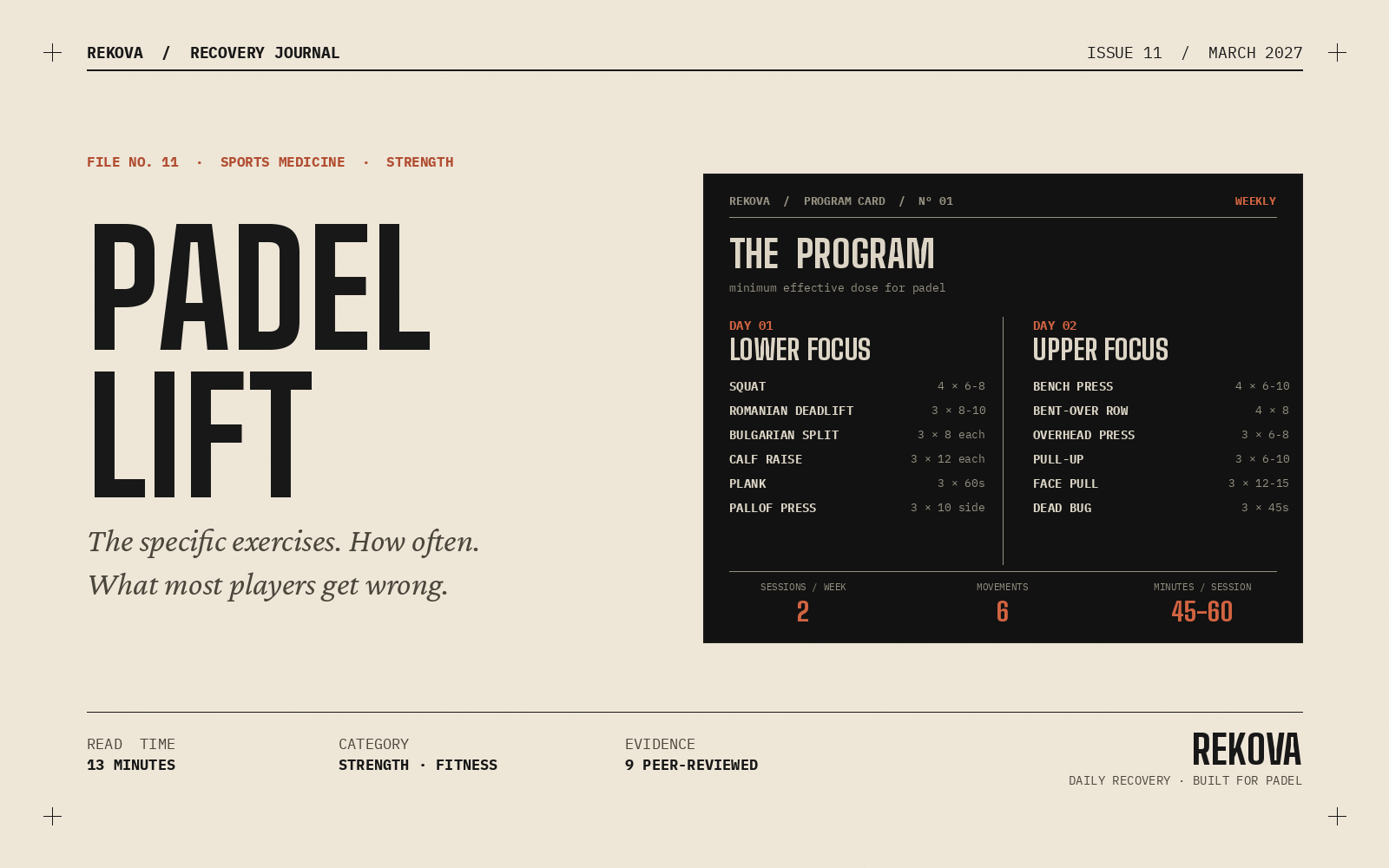
Day 1 (lower body focused). Goblet squat or barbell squat, 4 sets of 6 to 8 reps. Romanian deadlift, 3 sets of 8 to 10 reps. Bulgarian split squat, 3 sets of 8 per leg. Single leg calf raise, 3 sets of 12 per leg. Plank or side plank, 3 sets of 30 to 60 seconds. Pallof press, 3 sets of 10 per side.
Day 2 (upper body focused). Bench press or push-ups, 4 sets of 6 to 10 reps. Bent over row or dumbbell row, 4 sets of 8 reps. Overhead press, 3 sets of 6 to 8 reps. Pull-ups or lat pulldown, 3 sets of 6 to 10 reps. Face pulls or rear delt flyes, 3 sets of 12 to 15 reps. Dead bug or hollow hold, 3 sets of 30 to 45 seconds.
45 to 60 minutes per session if you don't waste time between sets. Add 2.5 to 5 percent more weight every couple of weeks when the current weight feels comfortable.
This isn't gospel. Plenty of other programs work. The principles matter more than the specific exercises.
Day 1 (lower body focused). Goblet squat or barbell squat, 4 sets of 6 to 8 reps. Romanian deadlift, 3 sets of 8 to 10 reps. Bulgarian split squat, 3 sets of 8 per leg. Single leg calf raise, 3 sets of 12 per leg. Plank or side plank, 3 sets of 30 to 60 seconds. Pallof press, 3 sets of 10 per side.
Day 2 (upper body focused). Bench press or push-ups, 4 sets of 6 to 10 reps. Bent over row or dumbbell row, 4 sets of 8 reps. Overhead press, 3 sets of 6 to 8 reps. Pull-ups or lat pulldown, 3 sets of 6 to 10 reps. Face pulls or rear delt flyes, 3 sets of 12 to 15 reps. Dead bug or hollow hold, 3 sets of 30 to 45 seconds.
45 to 60 minutes per session if you don't waste time between sets. Add 2.5 to 5 percent more weight every couple of weeks when the current weight feels comfortable.
This isn't gospel. Plenty of other programs work. The principles matter more than the specific exercises.
Equipment: home vs gym
You can do effective strength training at home or at a gym. Each has tradeoffs.
Home setup with adjustable dumbbells, a bench, and resistance bands (around 400 to 600 euros total) gets you 80 percent of what you'd get at a gym for years. The convenience factor helps consistency.
Gym membership (typically 30 to 60 euros per month) gives you access to barbells, racks, machines, and progressively heavier loads. Better for serious strength development. The accountability of leaving the house helps some people stick with it.
I started at home for the first year. I went to a gym after that because I'd outgrown the adjustable dumbbells. Both work. The question is what you'll actually use consistently.
Bodyweight only training works for beginners but plateaus relatively quickly without progressive overload. If you do bodyweight only, you need to keep increasing difficulty (harder variations, more reps, slower tempo) to keep progressing.
Home setup with adjustable dumbbells, a bench, and resistance bands (around 400 to 600 euros total) gets you 80 percent of what you'd get at a gym for years. The convenience factor helps consistency.
Gym membership (typically 30 to 60 euros per month) gives you access to barbells, racks, machines, and progressively heavier loads. Better for serious strength development. The accountability of leaving the house helps some people stick with it.
I started at home for the first year. I went to a gym after that because I'd outgrown the adjustable dumbbells. Both work. The question is what you'll actually use consistently.
Bodyweight only training works for beginners but plateaus relatively quickly without progressive overload. If you do bodyweight only, you need to keep increasing difficulty (harder variations, more reps, slower tempo) to keep progressing.
Common mistakes I see
Skipping leg day. The most common mistake. People do upper body work and skip the lower body. Most padel power comes from legs and hips. Train them.
Avoiding heavy compound lifts because of internet videos showing injuries. Properly performed compound lifts with appropriate weight are among the safest exercises you can do. The risk is in poor form and ego lifting, not the exercises themselves.
Switching programs every two weeks. Strength adaptations take 8 to 12 weeks to manifest. If you change your program every two weeks based on the latest YouTube video, you'll never see the benefits.
Doing strength training the same day as hard padel. Bad scheduling. If you must do both same day, do strength first when your legs are fresh, and a moderate padel session second. Or do strength on padel rest days.
Treating strength training like cardio. High reps, short rests, focus on getting tired. This is conditioning, not strength. You need actual strength work with appropriate weight and full rest between sets (2 to 3 minutes between hard sets).
Avoiding overhead pressing because of shoulder concerns. Most shoulder pain is from imbalance and weakness, not from doing the exercise. Strengthening the overhead press correctly usually resolves shoulder issues, not causes them. Start light if you have existing problems and consider working with a physiotherapist initially.
Doing isolation exercises before compound exercises. Wrong order. Always do the hardest movements first when you're fresh. Save the curls and lateral raises for the end if you do them at all.
Avoiding heavy compound lifts because of internet videos showing injuries. Properly performed compound lifts with appropriate weight are among the safest exercises you can do. The risk is in poor form and ego lifting, not the exercises themselves.
Switching programs every two weeks. Strength adaptations take 8 to 12 weeks to manifest. If you change your program every two weeks based on the latest YouTube video, you'll never see the benefits.
Doing strength training the same day as hard padel. Bad scheduling. If you must do both same day, do strength first when your legs are fresh, and a moderate padel session second. Or do strength on padel rest days.
Treating strength training like cardio. High reps, short rests, focus on getting tired. This is conditioning, not strength. You need actual strength work with appropriate weight and full rest between sets (2 to 3 minutes between hard sets).
Avoiding overhead pressing because of shoulder concerns. Most shoulder pain is from imbalance and weakness, not from doing the exercise. Strengthening the overhead press correctly usually resolves shoulder issues, not causes them. Start light if you have existing problems and consider working with a physiotherapist initially.
Doing isolation exercises before compound exercises. Wrong order. Always do the hardest movements first when you're fresh. Save the curls and lateral raises for the end if you do them at all.
Scheduling: how to fit strength and padel and life
This is where most amateurs give up. Time pressure.
Reality check. Two strength sessions plus three padel sessions is 5 days of activity per week with 2 rest days. That's a sustainable load for most healthy adults under 50.
If you can only manage 3 total days per week, do 2 padel sessions and 1 strength session. The strength session matters more than the third padel day for long-term progress.
If you can do 4 total days, do 2 padel and 2 strength.
If you can do 5 plus days, do 3 padel and 2 strength.
For me, the schedule is Monday strength (full body, lower-focused), Tuesday padel, Wednesday rest or light walk, Thursday strength (full body, upper-focused), Friday padel, Saturday padel (often a tournament or longer session), Sunday rest.
I covered the recovery considerations in detail in my padel recovery article. The general principle is alternating hard days and easier days, with at least one full rest day per week.
Reality check. Two strength sessions plus three padel sessions is 5 days of activity per week with 2 rest days. That's a sustainable load for most healthy adults under 50.
If you can only manage 3 total days per week, do 2 padel sessions and 1 strength session. The strength session matters more than the third padel day for long-term progress.
If you can do 4 total days, do 2 padel and 2 strength.
If you can do 5 plus days, do 3 padel and 2 strength.
For me, the schedule is Monday strength (full body, lower-focused), Tuesday padel, Wednesday rest or light walk, Thursday strength (full body, upper-focused), Friday padel, Saturday padel (often a tournament or longer session), Sunday rest.
I covered the recovery considerations in detail in my padel recovery article. The general principle is alternating hard days and easier days, with at least one full rest day per week.
Considerations by age and gender
Younger players under 35. Recovery is fast. You can handle higher volume. Two to three strength sessions per week with progressive overload works well.
Players 35 to 50. Recovery slows somewhat. Quality over quantity. Two sessions per week, well-executed, with adequate warm-up. Pay extra attention to mobility work.
Players over 50. Strength training becomes more important, not less. The research is consistent that resistance training is one of the most effective interventions for healthy aging. Two sessions per week, slightly lighter loads with full controlled movements, longer warm-up periods. I covered this in detail in my padel after 40 article.
Women specifically. Strength training is even more important for women athletes given the higher risk of ACL injuries and the importance of bone density. Same exercises, same principles. The marketed women-specific routines focused on toning are not what your body needs. You need to lift weights that challenge you. Patricia from my padel for women article has been doing barbell-based strength work for years and credits it for keeping her injury-free at 41.
Players 35 to 50. Recovery slows somewhat. Quality over quantity. Two sessions per week, well-executed, with adequate warm-up. Pay extra attention to mobility work.
Players over 50. Strength training becomes more important, not less. The research is consistent that resistance training is one of the most effective interventions for healthy aging. Two sessions per week, slightly lighter loads with full controlled movements, longer warm-up periods. I covered this in detail in my padel after 40 article.
Women specifically. Strength training is even more important for women athletes given the higher risk of ACL injuries and the importance of bone density. Same exercises, same principles. The marketed women-specific routines focused on toning are not what your body needs. You need to lift weights that challenge you. Patricia from my padel for women article has been doing barbell-based strength work for years and credits it for keeping her injury-free at 41.
Nutrition for strength and padel combined
Two demands on the body means slightly different nutrition than padel alone.
Protein becomes more important. The 1.6 to 2 grams per kg body weight per day from my padel nutrition article is a reasonable target. Lean toward the higher end if you're doing serious strength work. EFSA confirms protein contributes to growth in muscle mass and maintenance of muscle mass.
Total calories matter. If you're trying to build muscle, you need a slight surplus or at least maintenance. If you're in a calorie deficit for fat loss while strength training, your strength gains will be slower but you'll preserve muscle better than with cardio alone.
Recovery between sessions matters more. Sleep, hydration, micronutrients. I covered these in my recovery article and my electrolytes article.
Magnesium contributes to normal muscle function (EFSA confirmed). Calcium contributes to normal muscle function (EFSA confirmed). Vitamin D contributes to normal muscle function (EFSA confirmed). These nutrients matter more under the combined load of strength and padel training.
This is the gap a daily recovery drink fills. The Rekova formula was designed around these specific demands. One sachet daily covers the magnesium, vitamin C, B vitamins, hydrolyzed collagen, and supporting nutrients that get depleted under regular training. Not a replacement for protein from real food. A supplement on top of it.
Protein becomes more important. The 1.6 to 2 grams per kg body weight per day from my padel nutrition article is a reasonable target. Lean toward the higher end if you're doing serious strength work. EFSA confirms protein contributes to growth in muscle mass and maintenance of muscle mass.
Total calories matter. If you're trying to build muscle, you need a slight surplus or at least maintenance. If you're in a calorie deficit for fat loss while strength training, your strength gains will be slower but you'll preserve muscle better than with cardio alone.
Recovery between sessions matters more. Sleep, hydration, micronutrients. I covered these in my recovery article and my electrolytes article.
Magnesium contributes to normal muscle function (EFSA confirmed). Calcium contributes to normal muscle function (EFSA confirmed). Vitamin D contributes to normal muscle function (EFSA confirmed). These nutrients matter more under the combined load of strength and padel training.
This is the gap a daily recovery drink fills. The Rekova formula was designed around these specific demands. One sachet daily covers the magnesium, vitamin C, B vitamins, hydrolyzed collagen, and supporting nutrients that get depleted under regular training. Not a replacement for protein from real food. A supplement on top of it.
FAQ: questions about strength training for padel
Will strength training make me too bulky for padel? No. Significant muscle gain requires years of consistent heavy training plus eating in caloric surplus. You'll get stronger long before you get visibly bigger. Most amateurs gain 2 to 5 kg of muscle over the first year of consistent training, which is barely noticeable visually.
Will I lose speed on the court? No, the opposite. Stronger muscles produce more force, which means more speed for the same effort. Multiple studies on power athletes confirm that strength training improves sprint speed and acceleration.
Can I just do bodyweight exercises? For beginners, yes. After a few months you'll need progressive resistance to keep adapting. Either move to weighted exercises or learn advanced bodyweight progressions.
How long until I see results in my padel game? Strength gains start in 4 to 6 weeks. Noticeable improvements in your padel performance typically come in 3 to 4 months. Injury reduction is usually apparent within 6 months.
Should I train through soreness? Mild soreness is fine. Sharp pain or significantly reduced range of motion is not. Listen to your body.
Should I do cardio in addition to padel? Padel is cardio. Adding additional cardio rarely helps amateurs and can interfere with strength gains. Save the time for strength work and recovery.
What about HIIT and CrossFit? Both can work if you enjoy them. They're more taxing on recovery than traditional strength work, which can compete with your padel training. If you do them, do them on padel rest days and reduce padel volume.
Is creatine worth taking? Yes for strength training. I covered this in my supplements article. EFSA confirms creatine increases physical performance in successive bursts of short-term high-intensity exercise.
How do I know if I'm strong enough? Some rough benchmarks for an amateur adult. Can deadlift your body weight for 5 reps. Can squat 80 percent of your body weight for 5 reps. Can do 5 pull-ups for men or 3 for women. Can hold a plank for 60 seconds. If you can do these, you have a reasonable strength base for padel.
Do I need a personal trainer? Not necessarily, but a few sessions early on to learn proper form is one of the best investments you can make. Bad form for years is hard to correct and increases injury risk.
Will I lose speed on the court? No, the opposite. Stronger muscles produce more force, which means more speed for the same effort. Multiple studies on power athletes confirm that strength training improves sprint speed and acceleration.
Can I just do bodyweight exercises? For beginners, yes. After a few months you'll need progressive resistance to keep adapting. Either move to weighted exercises or learn advanced bodyweight progressions.
How long until I see results in my padel game? Strength gains start in 4 to 6 weeks. Noticeable improvements in your padel performance typically come in 3 to 4 months. Injury reduction is usually apparent within 6 months.
Should I train through soreness? Mild soreness is fine. Sharp pain or significantly reduced range of motion is not. Listen to your body.
Should I do cardio in addition to padel? Padel is cardio. Adding additional cardio rarely helps amateurs and can interfere with strength gains. Save the time for strength work and recovery.
What about HIIT and CrossFit? Both can work if you enjoy them. They're more taxing on recovery than traditional strength work, which can compete with your padel training. If you do them, do them on padel rest days and reduce padel volume.
Is creatine worth taking? Yes for strength training. I covered this in my supplements article. EFSA confirms creatine increases physical performance in successive bursts of short-term high-intensity exercise.
How do I know if I'm strong enough? Some rough benchmarks for an amateur adult. Can deadlift your body weight for 5 reps. Can squat 80 percent of your body weight for 5 reps. Can do 5 pull-ups for men or 3 for women. Can hold a plank for 60 seconds. If you can do these, you have a reasonable strength base for padel.
Do I need a personal trainer? Not necessarily, but a few sessions early on to learn proper form is one of the best investments you can make. Bad form for years is hard to correct and increases injury risk.
The short version
Strength training is the single biggest thing most amateur padel players are missing. Two sessions per week, 45 to 60 minutes each, focused on compound movements covering squats, hinges, pushes, pulls, and core work. The exercises don't need to be exotic. Progressive overload matters more than variety. Avoid the common mistakes of skipping legs, switching programs constantly, and training too light. Strength training reduces injury risk by 40 to 60 percent based on the research and improves performance noticeably within 3 to 4 months.
Combine strength training with proper nutrition, sleep, and recovery and you'll outperform most players who play padel five times a week without ever lifting. The boring fundamentals beat fancy padel-specific training programs nine times out of ten.
Combine strength training with proper nutrition, sleep, and recovery and you'll outperform most players who play padel five times a week without ever lifting. The boring fundamentals beat fancy padel-specific training programs nine times out of ten.
Sources
Smith Palacio E. Epidemiologia de las lesiones en padel y recomendaciones preventivas. Ciencia y Deporte. April 2024.
Dahmen J. et al. Incidence, prevalence and nature of injuries in padel: a systematic review. BMJ Open Sport and Exercise Medicine. 2023.
Lauersen JB et al. The effectiveness of exercise interventions to prevent sports injuries: a systematic review and meta-analysis of randomised controlled trials. British Journal of Sports Medicine. 2014, updated 2023.
International Society of Sports Nutrition. Position stand on protein and exercise. JISSN. 2024.
International Society of Sports Nutrition. Position stand on creatine supplementation and exercise. JISSN. 2021 update.
American College of Sports Medicine. Position stand on progression models in resistance training for healthy adults. 2024.
Phillips SM. et al. Protein requirements in older athletes. International Journal of Sport Nutrition and Exercise Metabolism. 2024.
Marcos Rivero B. et al. Evolution of Physiological Responses and Fatigue Analysis in Padel Matches. Sensors. August 2025.
EFSA. Scientific Opinions on the substantiation of health claims related to protein, creatine, magnesium, vitamin D, and calcium. EFSA Journal, various years.
This article shares my own experience with strength training and reflects current research on resistance training for athletes. It is not medical advice and is not a substitute for individualized program design. If you are new to strength training, have a history of injuries, or have any medical condition, please consult a qualified strength coach or physiotherapist before starting any new program. Form quality matters more than weight lifted, and a good coach can save you years of mistakes.
Rekova does not replace proper training or nutrition. It is a daily functional drink with electrolytes, magnesium, hydrolyzed collagen, B vitamins, vitamin C, CoQ10, Acetyl-L-Carnitine, and supporting nutrients, formulated as nutritional support for people who play padel regularly.
Dahmen J. et al. Incidence, prevalence and nature of injuries in padel: a systematic review. BMJ Open Sport and Exercise Medicine. 2023.
Lauersen JB et al. The effectiveness of exercise interventions to prevent sports injuries: a systematic review and meta-analysis of randomised controlled trials. British Journal of Sports Medicine. 2014, updated 2023.
International Society of Sports Nutrition. Position stand on protein and exercise. JISSN. 2024.
International Society of Sports Nutrition. Position stand on creatine supplementation and exercise. JISSN. 2021 update.
American College of Sports Medicine. Position stand on progression models in resistance training for healthy adults. 2024.
Phillips SM. et al. Protein requirements in older athletes. International Journal of Sport Nutrition and Exercise Metabolism. 2024.
Marcos Rivero B. et al. Evolution of Physiological Responses and Fatigue Analysis in Padel Matches. Sensors. August 2025.
EFSA. Scientific Opinions on the substantiation of health claims related to protein, creatine, magnesium, vitamin D, and calcium. EFSA Journal, various years.
This article shares my own experience with strength training and reflects current research on resistance training for athletes. It is not medical advice and is not a substitute for individualized program design. If you are new to strength training, have a history of injuries, or have any medical condition, please consult a qualified strength coach or physiotherapist before starting any new program. Form quality matters more than weight lifted, and a good coach can save you years of mistakes.
Rekova does not replace proper training or nutrition. It is a daily functional drink with electrolytes, magnesium, hydrolyzed collagen, B vitamins, vitamin C, CoQ10, Acetyl-L-Carnitine, and supporting nutrients, formulated as nutritional support for people who play padel regularly.
