There was a six-month period last year when I was sleeping about 5 hours a night. New job, project deadlines, family stuff at home. The standard middle-management adult catastrophe. I kept playing padel three times a week through all of it. My results dropped off a cliff.
I lost matches I should have won. I forgot the tactical patterns I'd practiced. My footwork was slow. By the third game I'd be making errors that I knew were errors but couldn't seem to stop making. The story I told myself was that I was just going through a rough patch at work and the padel would normalize once things calmed down.
When things did calm down four months later, my game came back almost immediately. Two weeks of sleeping seven hours a night and I was playing better than I'd played in years. The padel hadn't changed. My ability to access the padel had been broken.
I spent the months after that reading about sleep and athletic performance properly. Not the YouTube version. The actual research. What I learned changed how I think about training entirely.
Below is what matters. The evidence. The protocol. And what most amateur padel players are getting catastrophically wrong.
Why sleep matters specifically for padel
Padel requires four things that sleep directly affects.
Reaction time. The split-second between seeing the ball off your opponent's pala and starting your movement. Research consistently shows reaction time slows by 10 to 15 percent after a single night of poor sleep. By 5 to 6 hours, you're functioning at roughly the level of someone with a blood alcohol level above the legal driving limit.
Decision making. Padel is a sport of constant tactical decisions. Do I go for the smash or the bandeja? Do I cover the line or trust my partner? These decisions happen in milliseconds. Sleep deprivation hits the prefrontal cortex (the decision-making part of the brain) harder than almost any other area.
Motor learning. The skills you practice in training only become automatic during sleep. Specifically during REM sleep. If you train hard and sleep poorly, the training largely doesn't stick. This is why you can practice the same shot for hours and never improve if your sleep is broken.
Injury risk. The Milewski 2014 study on adolescent athletes found that those sleeping less than 8 hours had 1.7 times the injury rate of those sleeping more. The pattern holds in adult athletes. Tired bodies move sloppily. Sloppy movement causes injury.
This isn't soft wellness content. This is hard performance data that most amateur athletes ignore.
Reaction time. The split-second between seeing the ball off your opponent's pala and starting your movement. Research consistently shows reaction time slows by 10 to 15 percent after a single night of poor sleep. By 5 to 6 hours, you're functioning at roughly the level of someone with a blood alcohol level above the legal driving limit.
Decision making. Padel is a sport of constant tactical decisions. Do I go for the smash or the bandeja? Do I cover the line or trust my partner? These decisions happen in milliseconds. Sleep deprivation hits the prefrontal cortex (the decision-making part of the brain) harder than almost any other area.
Motor learning. The skills you practice in training only become automatic during sleep. Specifically during REM sleep. If you train hard and sleep poorly, the training largely doesn't stick. This is why you can practice the same shot for hours and never improve if your sleep is broken.
Injury risk. The Milewski 2014 study on adolescent athletes found that those sleeping less than 8 hours had 1.7 times the injury rate of those sleeping more. The pattern holds in adult athletes. Tired bodies move sloppily. Sloppy movement causes injury.
This isn't soft wellness content. This is hard performance data that most amateur athletes ignore.
Sleep architecture: what's actually happening when you sleep
When you sleep well, you cycle through roughly five 90-minute sleep cycles. Each cycle contains different sleep stages.
Light sleep (stages 1 and 2). The bridge between waking and deeper sleep. Not particularly restorative on its own but necessary for the transitions.
Deep sleep (stage 3). Slow wave sleep. This is where physical recovery happens most. Growth hormone release, tissue repair, glycogen restoration, immune function. The first half of the night contains most of your deep sleep.
REM sleep. Rapid eye movement sleep, where most dreaming occurs. This is where motor learning consolidates, memories are processed, and skills you practiced become automatic. The second half of the night contains most of your REM sleep.
If you sleep 5 hours instead of 7, you're not just losing 2 hours of total sleep. You're losing most of your REM sleep because it's concentrated in the later part of the night. Which means most of your skill development.
This is why short-sleepers can feel okay but never quite improve at complex sports. The basic functions still work. The advanced motor learning doesn't happen.
Light sleep (stages 1 and 2). The bridge between waking and deeper sleep. Not particularly restorative on its own but necessary for the transitions.
Deep sleep (stage 3). Slow wave sleep. This is where physical recovery happens most. Growth hormone release, tissue repair, glycogen restoration, immune function. The first half of the night contains most of your deep sleep.
REM sleep. Rapid eye movement sleep, where most dreaming occurs. This is where motor learning consolidates, memories are processed, and skills you practiced become automatic. The second half of the night contains most of your REM sleep.
If you sleep 5 hours instead of 7, you're not just losing 2 hours of total sleep. You're losing most of your REM sleep because it's concentrated in the later part of the night. Which means most of your skill development.
This is why short-sleepers can feel okay but never quite improve at complex sports. The basic functions still work. The advanced motor learning doesn't happen.
How much sleep do you actually need
The research converges on 7 to 9 hours for most adults. Most amateur athletes underestimate their needs by about an hour.
The Stanford basketball sleep extension study (Mah 2011) had varsity basketball players extend their sleep to 10 hours per night for 5 to 7 weeks. Their shooting accuracy improved 9 percent, sprint times improved by 5 percent, and reaction times dropped significantly. These were already highly trained athletes.
For amateur padel players, the realistic target is 7.5 to 8.5 hours on most nights. Less on the occasional night is fine. Less as a pattern is destructive.
The number that matters more than total hours is consistency. Going to bed at midnight one night and 10pm the next confuses your circadian rhythm. Same bedtime and same wake time every day, including weekends, is more important than total hours for most adults.
You don't catch up on lost sleep on weekends. Research on sleep debt is consistent that weekend recovery doesn't restore cognitive function lost to weeknight deprivation. A few good Saturday nights don't undo five bad weekday nights.
The Stanford basketball sleep extension study (Mah 2011) had varsity basketball players extend their sleep to 10 hours per night for 5 to 7 weeks. Their shooting accuracy improved 9 percent, sprint times improved by 5 percent, and reaction times dropped significantly. These were already highly trained athletes.
For amateur padel players, the realistic target is 7.5 to 8.5 hours on most nights. Less on the occasional night is fine. Less as a pattern is destructive.
The number that matters more than total hours is consistency. Going to bed at midnight one night and 10pm the next confuses your circadian rhythm. Same bedtime and same wake time every day, including weekends, is more important than total hours for most adults.
You don't catch up on lost sleep on weekends. Research on sleep debt is consistent that weekend recovery doesn't restore cognitive function lost to weeknight deprivation. A few good Saturday nights don't undo five bad weekday nights.
Sleep timing around padel sessions
Padel timing affects sleep more than people realize.
Evening padel sessions, especially after 8pm, raise cortisol and core body temperature. Both make falling asleep harder. If you play late, you'll often struggle to sleep that night. A win on the court can mean a bad night of sleep.
The compromise that works for many amateurs. Play before 7pm where possible. If you must play later, allow at least 2 hours between finishing and going to bed. Use the post-match wind-down protocol from my mobility article to help downregulate.
Morning padel sessions actually support better sleep that night. The physical activity plus daylight exposure helps consolidate your circadian rhythm. If your schedule allows, morning play is the sleep-optimal time.
Tournaments are a special case. Multi-day tournaments with late matches catastrophically disrupt sleep. Top professionals build in extra sleep on the days before and after tournaments. Amateurs rarely do this. The drop-off from one night of poor sleep is one of the reasons amateur tournament play often disappoints.
Evening padel sessions, especially after 8pm, raise cortisol and core body temperature. Both make falling asleep harder. If you play late, you'll often struggle to sleep that night. A win on the court can mean a bad night of sleep.
The compromise that works for many amateurs. Play before 7pm where possible. If you must play later, allow at least 2 hours between finishing and going to bed. Use the post-match wind-down protocol from my mobility article to help downregulate.
Morning padel sessions actually support better sleep that night. The physical activity plus daylight exposure helps consolidate your circadian rhythm. If your schedule allows, morning play is the sleep-optimal time.
Tournaments are a special case. Multi-day tournaments with late matches catastrophically disrupt sleep. Top professionals build in extra sleep on the days before and after tournaments. Amateurs rarely do this. The drop-off from one night of poor sleep is one of the reasons amateur tournament play often disappoints.
The major sleep disruptors for amateur padel players
Most disrupted sleep comes from a small set of common causes. The Pareto principle applies.
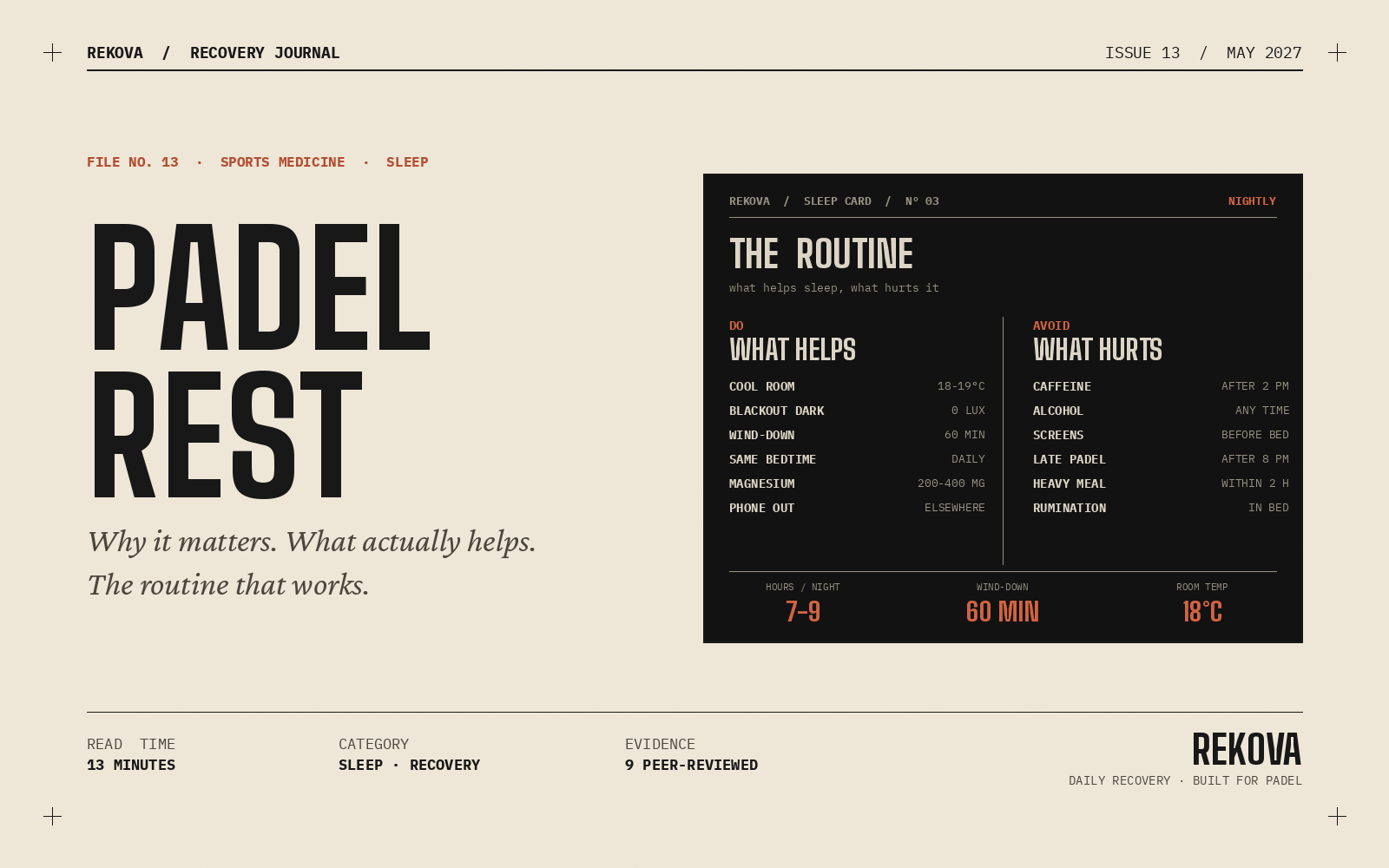
Caffeine after 2pm. Caffeine has a half-life of 5 to 7 hours. A coffee at 4pm means caffeine in your bloodstream until 10pm or later. Even if you fall asleep, the sleep quality suffers. Move your last caffeine to early afternoon. Period.
Alcohol any time. This one hurts to write because I enjoy wine. Alcohol helps people fall asleep but fragments sleep architecture, reduces REM, and worsens sleep quality dramatically. Athletes who drink regularly have worse sleep than non-drinkers, even with equivalent total hours. The Spanish dinner culture (wine with late dinners) is one of the harder lifestyle adjustments for serious amateur athletes.
Screens before bed. Blue light suppresses melatonin production. The more time you spend on phones, tablets, or laptops in the 60 minutes before bed, the harder falling asleep becomes. Night mode on phones helps but doesn't eliminate the problem. Putting the phone in another room is the surgical solution.
Late workouts. Strength training or intense cardio after 8pm raises sympathetic nervous system activation that interferes with sleep onset. Morning or afternoon workouts are sleep-friendly. Late evening workouts aren't.
Heavy meals at night. Large dinners within 2 hours of bedtime impair sleep quality. The Spanish habit of late large dinners is again problematic for sleep optimization. Earlier and lighter dinners help. If you must eat late, eat smaller.
Mental rumination. Lying in bed thinking about work or tomorrow's tasks is a major sleep killer. Brain dump exercises (writing tomorrow's tasks down before bed) help significantly. So does meditation or breathing work.
Caffeine after 2pm. Caffeine has a half-life of 5 to 7 hours. A coffee at 4pm means caffeine in your bloodstream until 10pm or later. Even if you fall asleep, the sleep quality suffers. Move your last caffeine to early afternoon. Period.
Alcohol any time. This one hurts to write because I enjoy wine. Alcohol helps people fall asleep but fragments sleep architecture, reduces REM, and worsens sleep quality dramatically. Athletes who drink regularly have worse sleep than non-drinkers, even with equivalent total hours. The Spanish dinner culture (wine with late dinners) is one of the harder lifestyle adjustments for serious amateur athletes.
Screens before bed. Blue light suppresses melatonin production. The more time you spend on phones, tablets, or laptops in the 60 minutes before bed, the harder falling asleep becomes. Night mode on phones helps but doesn't eliminate the problem. Putting the phone in another room is the surgical solution.
Late workouts. Strength training or intense cardio after 8pm raises sympathetic nervous system activation that interferes with sleep onset. Morning or afternoon workouts are sleep-friendly. Late evening workouts aren't.
Heavy meals at night. Large dinners within 2 hours of bedtime impair sleep quality. The Spanish habit of late large dinners is again problematic for sleep optimization. Earlier and lighter dinners help. If you must eat late, eat smaller.
Mental rumination. Lying in bed thinking about work or tomorrow's tasks is a major sleep killer. Brain dump exercises (writing tomorrow's tasks down before bed) help significantly. So does meditation or breathing work.
The routine that actually works
Here's the wind-down protocol that works for me and is consistent with what the research supports.
90 minutes before target bedtime. Stop work. No more screens for serious focus tasks. Switch the lights to warm tones (lower color temperature). Have your last meal of the day if you haven't already.
60 minutes before. No more phones or tablets if possible. Read a physical book. Have a conversation. Take a warm shower (which paradoxically helps with sleep by lowering core body temperature afterward).
30 minutes before. Bedroom only activities. Light stretching or breathing work. No bright lights. No exciting content of any kind.
In bed. Same time every night within a 30-minute window. Lights off. No phones in the room ideally.
If you can't sleep within 20 minutes, get out of bed. Go to another room. Read until you feel sleepy, then return. Don't lie in bed frustrated. This breaks the bed-sleep association and makes future nights worse.
This routine takes some discipline. The results are within two weeks for most people. Significantly better next-day cognitive function. Better mood. Easier focus during play.
90 minutes before target bedtime. Stop work. No more screens for serious focus tasks. Switch the lights to warm tones (lower color temperature). Have your last meal of the day if you haven't already.
60 minutes before. No more phones or tablets if possible. Read a physical book. Have a conversation. Take a warm shower (which paradoxically helps with sleep by lowering core body temperature afterward).
30 minutes before. Bedroom only activities. Light stretching or breathing work. No bright lights. No exciting content of any kind.
In bed. Same time every night within a 30-minute window. Lights off. No phones in the room ideally.
If you can't sleep within 20 minutes, get out of bed. Go to another room. Read until you feel sleepy, then return. Don't lie in bed frustrated. This breaks the bed-sleep association and makes future nights worse.
This routine takes some discipline. The results are within two weeks for most people. Significantly better next-day cognitive function. Better mood. Easier focus during play.
Bedroom environment
The right bedroom environment makes a measurable difference.
Cool. 18 to 19 degrees Celsius is the optimal range for most people. Core body temperature needs to drop slightly to fall asleep. A warm bedroom fights this.
Dark. Blackout curtains or a sleep mask. Even small amounts of light affect sleep quality. The street light outside your window matters.
Quiet. Or use white noise. Padel players who live near busy streets often benefit from a white noise machine or fan.
Mattress quality. A bad mattress costs you sleep quality every night. If yours is over 10 years old or you wake up with back pain, this is one of the better investments you can make.
Pillow. Often more important than mattress. The right pillow for your sleeping position keeps your neck aligned and prevents wake-ups from discomfort.
Bedding. Breathable fabrics like cotton or linen help with temperature regulation. Avoid synthetic materials that trap heat.
Total bedroom upgrade for someone willing to invest. A good mattress (400 to 1500 euros), good pillow (50 to 150 euros), good bedding (100 to 300 euros). One time investment that pays back for years through better sleep.
Cool. 18 to 19 degrees Celsius is the optimal range for most people. Core body temperature needs to drop slightly to fall asleep. A warm bedroom fights this.
Dark. Blackout curtains or a sleep mask. Even small amounts of light affect sleep quality. The street light outside your window matters.
Quiet. Or use white noise. Padel players who live near busy streets often benefit from a white noise machine or fan.
Mattress quality. A bad mattress costs you sleep quality every night. If yours is over 10 years old or you wake up with back pain, this is one of the better investments you can make.
Pillow. Often more important than mattress. The right pillow for your sleeping position keeps your neck aligned and prevents wake-ups from discomfort.
Bedding. Breathable fabrics like cotton or linen help with temperature regulation. Avoid synthetic materials that trap heat.
Total bedroom upgrade for someone willing to invest. A good mattress (400 to 1500 euros), good pillow (50 to 150 euros), good bedding (100 to 300 euros). One time investment that pays back for years through better sleep.
Sleep and age
Sleep needs and patterns change with age. Worth knowing what's normal and what isn't.
Under 30. Generally easy to sleep, may need 8 to 9 hours, recovery is fast.
30 to 50. Sleep gets more variable. Stress, kids, work pressure all affect it. Maintain consistency and the protocol matters more.
50 to 70. Sleep architecture shifts. Less deep sleep, more fragmented sleep, earlier wake times. This is normal aging. You may need to go to bed earlier to get the same total hours. Some research suggests slightly less sleep is actually needed (7 to 7.5 hours) in this range, but maintaining quality matters more than ever.
Over 70. Continued shift toward earlier sleep, more naps, lighter sleep. Most healthy older adults still need 7+ hours when you count daytime naps.
My 52-year-old doubles partner goes to bed at 10pm and wakes at 6am most days. He's done this for 20 years. The consistency is the secret. He gets 7.5 hours every night and never gets caught short.
Under 30. Generally easy to sleep, may need 8 to 9 hours, recovery is fast.
30 to 50. Sleep gets more variable. Stress, kids, work pressure all affect it. Maintain consistency and the protocol matters more.
50 to 70. Sleep architecture shifts. Less deep sleep, more fragmented sleep, earlier wake times. This is normal aging. You may need to go to bed earlier to get the same total hours. Some research suggests slightly less sleep is actually needed (7 to 7.5 hours) in this range, but maintaining quality matters more than ever.
Over 70. Continued shift toward earlier sleep, more naps, lighter sleep. Most healthy older adults still need 7+ hours when you count daytime naps.
My 52-year-old doubles partner goes to bed at 10pm and wakes at 6am most days. He's done this for 20 years. The consistency is the secret. He gets 7.5 hours every night and never gets caught short.
Supplements for sleep
A few supplements have reasonable evidence for sleep support. Most don't.
Magnesium has decent evidence. Multiple studies show magnesium supplementation improves sleep quality in people with sub-optimal magnesium levels. EFSA confirms magnesium contributes to reduction of tiredness and fatigue and to normal psychological function. The form matters somewhat (citrate, glycinate, or threonate are well-absorbed). 200 to 400 mg in the evening works for many people.
Melatonin is controversial. It works very well for jet lag and shift work but isn't a great general sleep aid. If you take it, low doses (0.3 to 1 mg) work as well as higher doses. The 5 to 10 mg doses in many products are far too high.
L-theanine has modest evidence for promoting relaxation. 100 to 200 mg in the evening can help with mental rumination.
Glycine has some evidence at 3 grams before bed.
Tart cherry juice has small studies showing improved sleep markers in athletes.
What to avoid. Heavy sedatives. Prescription sleep aids unless prescribed for specific clinical reasons. Combinations of multiple sleep supplements at once (the research on these combinations is poor).
The Rekova formula includes magnesium (cited above for fatigue reduction and psychological function) along with B vitamins and other supporting nutrients. EFSA confirms vitamin B6 contributes to normal psychological function. The combination supports overall recovery including the sleep component, though Rekova isn't marketed specifically as a sleep aid.
Magnesium has decent evidence. Multiple studies show magnesium supplementation improves sleep quality in people with sub-optimal magnesium levels. EFSA confirms magnesium contributes to reduction of tiredness and fatigue and to normal psychological function. The form matters somewhat (citrate, glycinate, or threonate are well-absorbed). 200 to 400 mg in the evening works for many people.
Melatonin is controversial. It works very well for jet lag and shift work but isn't a great general sleep aid. If you take it, low doses (0.3 to 1 mg) work as well as higher doses. The 5 to 10 mg doses in many products are far too high.
L-theanine has modest evidence for promoting relaxation. 100 to 200 mg in the evening can help with mental rumination.
Glycine has some evidence at 3 grams before bed.
Tart cherry juice has small studies showing improved sleep markers in athletes.
What to avoid. Heavy sedatives. Prescription sleep aids unless prescribed for specific clinical reasons. Combinations of multiple sleep supplements at once (the research on these combinations is poor).
The Rekova formula includes magnesium (cited above for fatigue reduction and psychological function) along with B vitamins and other supporting nutrients. EFSA confirms vitamin B6 contributes to normal psychological function. The combination supports overall recovery including the sleep component, though Rekova isn't marketed specifically as a sleep aid.
When something might actually be wrong
Most sleep problems are lifestyle-related. Some aren't. Worth knowing when to see a doctor.
Loud snoring with breathing pauses. This is sleep apnea until proven otherwise. Sleep apnea causes massive fatigue, reduces athletic performance, and increases cardiovascular risk. A partner who notices you stop breathing repeatedly during sleep is reporting something serious. Get a sleep study.
Chronic insomnia over 3 months. Persistent difficulty falling or staying asleep that doesn't improve with lifestyle changes warrants medical evaluation. Cognitive behavioral therapy for insomnia (CBT-I) is the gold standard treatment and far superior to sleeping pills.
Restless leg syndrome. Uncomfortable urges to move your legs at night. Often related to iron deficiency. Treatable.
Excessive daytime sleepiness despite adequate sleep time. Could be sleep apnea, narcolepsy, or other conditions. Get evaluated.
Mood changes alongside sleep problems. Persistent insomnia combined with depressed mood or anxiety warrants a conversation with your doctor. Sleep and mental health are deeply interconnected.
Not everything is lifestyle. Some things need professional help. The earlier the better.
Loud snoring with breathing pauses. This is sleep apnea until proven otherwise. Sleep apnea causes massive fatigue, reduces athletic performance, and increases cardiovascular risk. A partner who notices you stop breathing repeatedly during sleep is reporting something serious. Get a sleep study.
Chronic insomnia over 3 months. Persistent difficulty falling or staying asleep that doesn't improve with lifestyle changes warrants medical evaluation. Cognitive behavioral therapy for insomnia (CBT-I) is the gold standard treatment and far superior to sleeping pills.
Restless leg syndrome. Uncomfortable urges to move your legs at night. Often related to iron deficiency. Treatable.
Excessive daytime sleepiness despite adequate sleep time. Could be sleep apnea, narcolepsy, or other conditions. Get evaluated.
Mood changes alongside sleep problems. Persistent insomnia combined with depressed mood or anxiety warrants a conversation with your doctor. Sleep and mental health are deeply interconnected.
Not everything is lifestyle. Some things need professional help. The earlier the better.
FAQ: questions about sleep and padel
How much sleep do I really need? Most adults need 7 to 9 hours. Most amateur athletes underestimate their needs by an hour. Pay attention to how you feel after 8 hours versus 6 for two weeks each. The difference is usually obvious.
Will napping help? Yes, short naps of 20 to 30 minutes can be useful, particularly for athletes. Longer naps may interfere with night sleep. Best between 1pm and 3pm. After tournaments or hard sessions, a 30-minute nap is genuinely restorative.
Is sleeping in on weekends bad? Some catch-up sleep is okay. More than an hour later than your weekday wake time disrupts your circadian rhythm. Consistency matters more than total hours.
Should I track my sleep with a watch or ring? Useful as a rough trend indicator. Don't obsess over the specific numbers. Most consumer wearables overestimate light sleep and underestimate deep sleep compared to lab measurements. Useful for spotting patterns, not for precise diagnosis.
What if I have insomnia before important matches? Common. Try to maintain your normal routine. One bad night before a match isn't a disaster. The night before the night before matters more for performance than the night immediately before. Don't catastrophize about a single rough night.
Can I make up for bad sleep with caffeine on match day? Partially. Caffeine masks fatigue but doesn't restore the cognitive functions you lost. You'll feel awake but your reaction time and decision making will still be impaired.
Should I sleep more before tournaments? Yes. Sleep banking has some evidence. Adding an hour per night for the week before a tournament can help buffer against tournament-night sleep disruption.
What about jet lag for international tournaments? Adjust gradually if possible. Use morning light exposure at your destination. Small doses of melatonin (0.3 to 1 mg) at destination bedtime for 3 to 4 days. Avoid alcohol on travel days.
Is alcohol really that bad for sleep? Yes. Even moderate drinking reduces REM sleep significantly. The relationship is dose-dependent. A small amount occasionally is fine. Daily drinking compounds the cost over time.
How do I deal with rumination at bedtime? Write tomorrow's tasks down before bed. Practice a breathing exercise (5 in, 7 out for 10 minutes). Accept that you can't solve work problems lying in bed at midnight.
Will napping help? Yes, short naps of 20 to 30 minutes can be useful, particularly for athletes. Longer naps may interfere with night sleep. Best between 1pm and 3pm. After tournaments or hard sessions, a 30-minute nap is genuinely restorative.
Is sleeping in on weekends bad? Some catch-up sleep is okay. More than an hour later than your weekday wake time disrupts your circadian rhythm. Consistency matters more than total hours.
Should I track my sleep with a watch or ring? Useful as a rough trend indicator. Don't obsess over the specific numbers. Most consumer wearables overestimate light sleep and underestimate deep sleep compared to lab measurements. Useful for spotting patterns, not for precise diagnosis.
What if I have insomnia before important matches? Common. Try to maintain your normal routine. One bad night before a match isn't a disaster. The night before the night before matters more for performance than the night immediately before. Don't catastrophize about a single rough night.
Can I make up for bad sleep with caffeine on match day? Partially. Caffeine masks fatigue but doesn't restore the cognitive functions you lost. You'll feel awake but your reaction time and decision making will still be impaired.
Should I sleep more before tournaments? Yes. Sleep banking has some evidence. Adding an hour per night for the week before a tournament can help buffer against tournament-night sleep disruption.
What about jet lag for international tournaments? Adjust gradually if possible. Use morning light exposure at your destination. Small doses of melatonin (0.3 to 1 mg) at destination bedtime for 3 to 4 days. Avoid alcohol on travel days.
Is alcohol really that bad for sleep? Yes. Even moderate drinking reduces REM sleep significantly. The relationship is dose-dependent. A small amount occasionally is fine. Daily drinking compounds the cost over time.
How do I deal with rumination at bedtime? Write tomorrow's tasks down before bed. Practice a breathing exercise (5 in, 7 out for 10 minutes). Accept that you can't solve work problems lying in bed at midnight.
The short version
Sleep matters more for athletic performance than most amateurs realize. Reaction time, decision making, motor learning, and injury risk all suffer with poor sleep. Most adults need 7 to 9 hours. Most amateur athletes underestimate their needs by an hour. Consistency of bedtime matters more than total hours for many people. The main disruptors are caffeine after 2pm, alcohol, screens at night, late workouts, and late large meals. Wind-down routine of 60 to 90 minutes before bed. Cool dark quiet bedroom. Magnesium has decent evidence as a supplement. See a doctor for snoring with breathing pauses or chronic insomnia.
The boring fundamentals beat fancy training programs nine times out of ten. Sleep is the most boring fundamental of them all.
The boring fundamentals beat fancy training programs nine times out of ten. Sleep is the most boring fundamental of them all.
Sources
Mah CD et al. The effects of sleep extension on the athletic performance of collegiate basketball players. Sleep. 2011.
Milewski MD et al. Chronic lack of sleep is associated with increased sports injuries in adolescent athletes. Journal of Pediatric Orthopedics. 2014.
Halson SL. Sleep in elite athletes and nutritional interventions to enhance sleep. Sports Medicine. 2014, updated 2024 review.
Watson AM. Sleep and athletic performance. Current Sports Medicine Reports. 2017, updated 2024.
Walker MP. Why We Sleep: Unlocking the Power of Sleep and Dreams. Scribner. 2017. (Reference text, not all claims peer-reviewed)
American Academy of Sleep Medicine. Clinical practice guideline for behavioral and psychological treatments for chronic insomnia. 2024.
International Olympic Committee. Consensus statement on sleep in elite athletes. British Journal of Sports Medicine. 2023.
EFSA. Scientific Opinions on the substantiation of health claims related to magnesium and vitamin B6 for psychological function and reduction of tiredness and fatigue. EFSA Journal, various years.
American College of Sports Medicine. Position stand on physical activity and bone health. 2024.
This article shares my own experience with sleep and reflects current research on sleep and athletic performance. It is not medical advice. If you have persistent insomnia, suspected sleep apnea, or any sleep problem affecting your daily life, please consult a qualified sleep medicine specialist or your general practitioner. Sleep disorders are common, treatable, and often improve dramatically with proper diagnosis and care.
Rekova does not treat sleep disorders and is not a substitute for medical care. It is a daily functional drink with electrolytes, magnesium, hydrolyzed collagen, B vitamins, vitamin C, CoQ10, Acetyl-L-Carnitine, and supporting nutrients, formulated as nutritional support for people who play padel regularly.
Milewski MD et al. Chronic lack of sleep is associated with increased sports injuries in adolescent athletes. Journal of Pediatric Orthopedics. 2014.
Halson SL. Sleep in elite athletes and nutritional interventions to enhance sleep. Sports Medicine. 2014, updated 2024 review.
Watson AM. Sleep and athletic performance. Current Sports Medicine Reports. 2017, updated 2024.
Walker MP. Why We Sleep: Unlocking the Power of Sleep and Dreams. Scribner. 2017. (Reference text, not all claims peer-reviewed)
American Academy of Sleep Medicine. Clinical practice guideline for behavioral and psychological treatments for chronic insomnia. 2024.
International Olympic Committee. Consensus statement on sleep in elite athletes. British Journal of Sports Medicine. 2023.
EFSA. Scientific Opinions on the substantiation of health claims related to magnesium and vitamin B6 for psychological function and reduction of tiredness and fatigue. EFSA Journal, various years.
American College of Sports Medicine. Position stand on physical activity and bone health. 2024.
This article shares my own experience with sleep and reflects current research on sleep and athletic performance. It is not medical advice. If you have persistent insomnia, suspected sleep apnea, or any sleep problem affecting your daily life, please consult a qualified sleep medicine specialist or your general practitioner. Sleep disorders are common, treatable, and often improve dramatically with proper diagnosis and care.
Rekova does not treat sleep disorders and is not a substitute for medical care. It is a daily functional drink with electrolytes, magnesium, hydrolyzed collagen, B vitamins, vitamin C, CoQ10, Acetyl-L-Carnitine, and supporting nutrients, formulated as nutritional support for people who play padel regularly.
