It was a Sunday in early August in Madrid. 38 degrees Celsius in the shade, no shade on our court. We were playing at 1pm because that was the only court available. By the second set my partner started slurring his words slightly. He insisted he was fine. Twenty minutes later he was sitting on the bench unable to stand up properly.
It was heat exhaustion. Mild, fortunately. He recovered in air conditioning with cold fluids over the next two hours. Could have been worse. Heat stroke kills around 600 people a year in Spain. Most of them aren't playing padel, but enough are that this is something every player should understand.
I've changed how I think about summer padel since that day. Below is what I've learned. What the research supports. And what most amateurs are getting wrong about playing in the heat.
Why heat is dangerous for padel specifically
Padel in summer combines several factors that compound heat risk.
Outdoor courts often sit in full sun with no shade. The court surface (artificial turf or concrete underneath) absorbs and radiates heat. Court surface temperatures can reach 50 to 60 degrees Celsius even when air temperature is 35.
Padel is high-intensity intermittent exercise. Your core temperature rises during play and doesn't fully recover between points. After 30 minutes of hard padel in 35-degree heat, your core temperature can be 38.5 to 39 degrees. Heat exhaustion threshold starts around 39.5. Heat stroke begins around 40.5.
The glass walls trap heat. Even with airflow, the enclosed court microclimate runs warmer than the surrounding area. Indoor courts with poor ventilation can be worse than outdoor courts with breeze.
Amateurs underestimate the load. Recreational players often play in conditions that competitive players and tournaments would consider unsafe. Spain has had tournament postponements in the 38-plus degree range. Amateurs play through 38 because they don't know better.
Outdoor courts often sit in full sun with no shade. The court surface (artificial turf or concrete underneath) absorbs and radiates heat. Court surface temperatures can reach 50 to 60 degrees Celsius even when air temperature is 35.
Padel is high-intensity intermittent exercise. Your core temperature rises during play and doesn't fully recover between points. After 30 minutes of hard padel in 35-degree heat, your core temperature can be 38.5 to 39 degrees. Heat exhaustion threshold starts around 39.5. Heat stroke begins around 40.5.
The glass walls trap heat. Even with airflow, the enclosed court microclimate runs warmer than the surrounding area. Indoor courts with poor ventilation can be worse than outdoor courts with breeze.
Amateurs underestimate the load. Recreational players often play in conditions that competitive players and tournaments would consider unsafe. Spain has had tournament postponements in the 38-plus degree range. Amateurs play through 38 because they don't know better.
Heat physiology: what's happening in your body
When you exercise, you generate heat. About 75 percent of the energy your muscles produce becomes heat rather than mechanical work. Your body has to dump this heat or your core temperature rises.
The main dumping mechanisms in order of importance.
Sweat evaporation. Sweating doesn't cool you. Sweat evaporating off your skin cools you. In dry climates this works well. In humid climates (coastal Spain, Italy in August) it works much worse because sweat doesn't evaporate efficiently.
Radiation to cooler surroundings. Works when ambient temperature is below your skin temperature (around 33 degrees). Above this, you actually gain heat from the environment.
Convection. Air moving over your skin carries away heat. Helps when there's breeze. Less help in still humid air.
Conduction. Direct contact with cooler surfaces. Minimal during play.
In high heat with high humidity (the typical Spanish coastal summer), your evaporative cooling is impaired and your radiation actually adds heat. Your body has limited options. Core temperature rises faster than you can dump it.
The main dumping mechanisms in order of importance.
Sweat evaporation. Sweating doesn't cool you. Sweat evaporating off your skin cools you. In dry climates this works well. In humid climates (coastal Spain, Italy in August) it works much worse because sweat doesn't evaporate efficiently.
Radiation to cooler surroundings. Works when ambient temperature is below your skin temperature (around 33 degrees). Above this, you actually gain heat from the environment.
Convection. Air moving over your skin carries away heat. Helps when there's breeze. Less help in still humid air.
Conduction. Direct contact with cooler surfaces. Minimal during play.
In high heat with high humidity (the typical Spanish coastal summer), your evaporative cooling is impaired and your radiation actually adds heat. Your body has limited options. Core temperature rises faster than you can dump it.
Hydration: more than just water
Standard advice to drink water in heat is incomplete and potentially dangerous.
When you sweat heavily, you lose water and electrolytes. Pure water replacement without electrolytes dilutes your blood sodium. This causes a condition called hyponatremia, which can be more dangerous than dehydration itself.
The Healthspan Elite hydration research and EFSA-validated guidance for athletes in heat suggest:
Before play. 500 ml of fluid in the 2 hours before, with appropriate electrolytes.
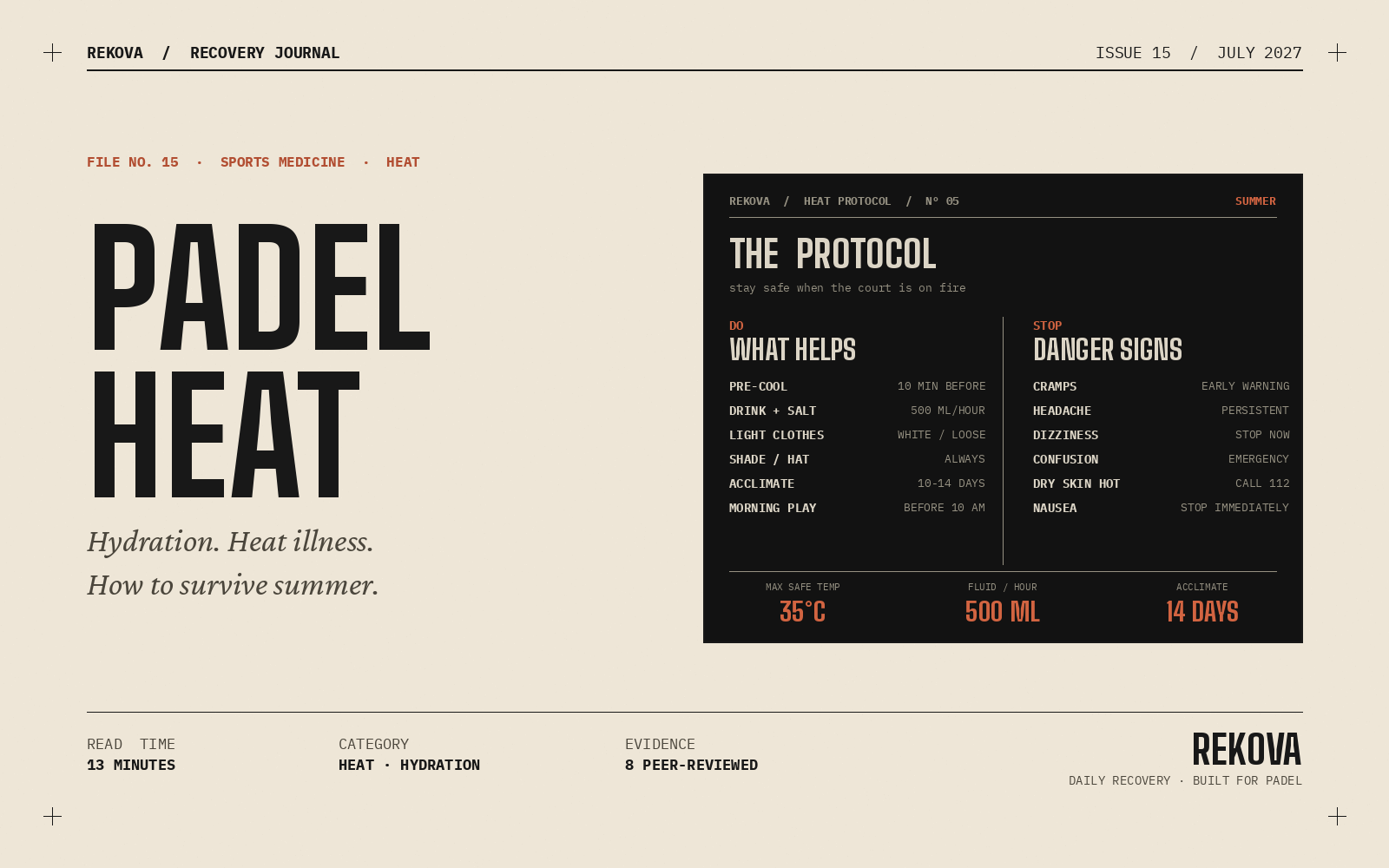
During play. 250 to 500 ml per 30 minutes of play in moderate heat. More in extreme heat. Include electrolytes if playing longer than 60 minutes or in significant heat.
After play. Drink 150 percent of body weight lost during play. Weigh yourself before and after if you want precision. Include sodium with the fluid (salty foods, electrolyte drink, or both).
The simple test for hydration. Pale yellow urine through the day means you're hydrated. Dark yellow means you're behind. The first urination after waking is often dark regardless and isn't a useful indicator.
When you sweat heavily, you lose water and electrolytes. Pure water replacement without electrolytes dilutes your blood sodium. This causes a condition called hyponatremia, which can be more dangerous than dehydration itself.
The Healthspan Elite hydration research and EFSA-validated guidance for athletes in heat suggest:
Before play. 500 ml of fluid in the 2 hours before, with appropriate electrolytes.
During play. 250 to 500 ml per 30 minutes of play in moderate heat. More in extreme heat. Include electrolytes if playing longer than 60 minutes or in significant heat.
After play. Drink 150 percent of body weight lost during play. Weigh yourself before and after if you want precision. Include sodium with the fluid (salty foods, electrolyte drink, or both).
The simple test for hydration. Pale yellow urine through the day means you're hydrated. Dark yellow means you're behind. The first urination after waking is often dark regardless and isn't a useful indicator.
Electrolytes: what you actually lose in sweat
Sweat composition varies between people but typical concentrations matter.
Sodium. The main electrolyte lost. Heavy sweaters can lose 1500 mg or more of sodium per liter of sweat. In a 90-minute hot match losing 1.5 liters, that's 2 grams of sodium. Replenishing only with water means your sodium concentration drops.
Chloride. Lost in similar concentrations to sodium.
Potassium. Lost in smaller amounts but significant.
Magnesium. Lost in smaller amounts again. Low magnesium contributes to cramping.
Calcium. Smaller losses.
I covered electrolytes in detail in my dedicated article. The summary version. Cramping is usually multifactorial but sodium and magnesium deficits in heat contribute. Plain water during heavy sweating makes hyponatremia risk worse, not better.
EFSA confirms magnesium contributes to electrolyte balance. EFSA confirms magnesium contributes to normal muscle function.
Sodium. The main electrolyte lost. Heavy sweaters can lose 1500 mg or more of sodium per liter of sweat. In a 90-minute hot match losing 1.5 liters, that's 2 grams of sodium. Replenishing only with water means your sodium concentration drops.
Chloride. Lost in similar concentrations to sodium.
Potassium. Lost in smaller amounts but significant.
Magnesium. Lost in smaller amounts again. Low magnesium contributes to cramping.
Calcium. Smaller losses.
I covered electrolytes in detail in my dedicated article. The summary version. Cramping is usually multifactorial but sodium and magnesium deficits in heat contribute. Plain water during heavy sweating makes hyponatremia risk worse, not better.
EFSA confirms magnesium contributes to electrolyte balance. EFSA confirms magnesium contributes to normal muscle function.
Heat acclimatization: the 10 to 14 day adaptation
Your body adapts to heat over about 10 to 14 days of repeated exposure. This adaptation is real and significant.
What changes. Your sweat rate increases. You start sweating at a lower core temperature. Your sweat becomes less salty (better sodium conservation). Plasma volume increases. You feel less cardiovascular strain at the same temperature.
How to acclimate. Play or train in heat for 30 to 60 minutes daily for 10 to 14 days. Start at lower intensities and build up. The acclimation effect requires consistent exposure.
Practical implication. The first hot week of summer is the most dangerous. Players who haven't been training in heat suddenly face high temperatures and have no adaptation. By two weeks in, the same conditions feel much more manageable.
If you've been away from heat (winter, indoor play only) and return to summer outdoor play, treat the first 10 days as acclimation. Reduce intensity. Stop earlier than you think you need to. Drink more than feels necessary.
What changes. Your sweat rate increases. You start sweating at a lower core temperature. Your sweat becomes less salty (better sodium conservation). Plasma volume increases. You feel less cardiovascular strain at the same temperature.
How to acclimate. Play or train in heat for 30 to 60 minutes daily for 10 to 14 days. Start at lower intensities and build up. The acclimation effect requires consistent exposure.
Practical implication. The first hot week of summer is the most dangerous. Players who haven't been training in heat suddenly face high temperatures and have no adaptation. By two weeks in, the same conditions feel much more manageable.
If you've been away from heat (winter, indoor play only) and return to summer outdoor play, treat the first 10 days as acclimation. Reduce intensity. Stop earlier than you think you need to. Drink more than feels necessary.
Signs of heat illness: mild to severe
Heat illness exists on a spectrum. Knowing the signs lets you stop before things get serious.
Heat cramps. Muscle cramps during or after play. Calf, quad, or core typically. Sign of electrolyte and fluid imbalance. Stop, replenish, rest.
Heat exhaustion. Heavy sweating, weakness, headache, nausea, dizziness, possible confusion. Body temperature elevated but below 40 degrees. Stop immediately. Move to cool environment. Hydrate with electrolytes. Cool the body with cold towels, fans, or cool water on neck and wrists.
Heat stroke. Core body temperature above 40 degrees. Confusion or altered mental state. Possibly stopped sweating (skin hot and dry). Possible loss of consciousness. Medical emergency. Call 112 immediately. Cool aggressively while waiting (ice water immersion if possible, cold towels everywhere).
The transition from heat exhaustion to heat stroke can happen fast. Within minutes in worst cases. Don't wait to see if symptoms improve. Stop at the first signs of significant heat distress.
Particular warning signs that should immediately end play. Confusion or disorientation. Persistent dizziness or feeling faint. Stopped sweating despite heavy exertion. Severe headache. Nausea or vomiting. Unusual fatigue out of proportion to the play.
Heat cramps. Muscle cramps during or after play. Calf, quad, or core typically. Sign of electrolyte and fluid imbalance. Stop, replenish, rest.
Heat exhaustion. Heavy sweating, weakness, headache, nausea, dizziness, possible confusion. Body temperature elevated but below 40 degrees. Stop immediately. Move to cool environment. Hydrate with electrolytes. Cool the body with cold towels, fans, or cool water on neck and wrists.
Heat stroke. Core body temperature above 40 degrees. Confusion or altered mental state. Possibly stopped sweating (skin hot and dry). Possible loss of consciousness. Medical emergency. Call 112 immediately. Cool aggressively while waiting (ice water immersion if possible, cold towels everywhere).
The transition from heat exhaustion to heat stroke can happen fast. Within minutes in worst cases. Don't wait to see if symptoms improve. Stop at the first signs of significant heat distress.
Particular warning signs that should immediately end play. Confusion or disorientation. Persistent dizziness or feeling faint. Stopped sweating despite heavy exertion. Severe headache. Nausea or vomiting. Unusual fatigue out of proportion to the play.
Pre-cooling: the underused strategy
Pre-cooling before activity in heat is one of the more research-backed interventions. Few amateurs use it.
What it does. Lowers core body temperature before play starts. Buys you more time before reaching dangerous temperatures during exercise.
How to do it.
Cold water immersion if available. Bath in cool water (not ice cold) for 5 to 10 minutes before going to the court. Effective but rarely practical.
Cooling vests or ice towels. Wear during warm-up. Reduces core temperature without limiting movement.
Cold drinks or ice slushies. Drink 200 to 400 ml of cold fluid (close to freezing if tolerable) 15 to 30 minutes before play. Has measurable effects on subsequent core temperature during exercise.
Cooling extremities. Cold water on wrists, hands, and feet before play. Affects core temperature through the venous return.
For amateur padel in summer, the practical approach. Arrive early. Drink a cold electrolyte drink in the car or before walking to the court. Wet a small towel and place on your neck during warm-up. Five minutes of effort. Meaningful effect.
What it does. Lowers core body temperature before play starts. Buys you more time before reaching dangerous temperatures during exercise.
How to do it.
Cold water immersion if available. Bath in cool water (not ice cold) for 5 to 10 minutes before going to the court. Effective but rarely practical.
Cooling vests or ice towels. Wear during warm-up. Reduces core temperature without limiting movement.
Cold drinks or ice slushies. Drink 200 to 400 ml of cold fluid (close to freezing if tolerable) 15 to 30 minutes before play. Has measurable effects on subsequent core temperature during exercise.
Cooling extremities. Cold water on wrists, hands, and feet before play. Affects core temperature through the venous return.
For amateur padel in summer, the practical approach. Arrive early. Drink a cold electrolyte drink in the car or before walking to the court. Wet a small towel and place on your neck during warm-up. Five minutes of effort. Meaningful effect.
Clothing and gear
What you wear matters more in heat than in moderate conditions.
Light colored, loose-fitting, breathable fabrics. White or light gray reflects more sun. Loose fit allows air circulation. Synthetic moisture-wicking fabrics that pull sweat away from skin help with evaporative cooling. Cotton holds sweat and gets heavy.
Hat or visor. Outdoor play. Protects from direct sun on head. Surprisingly effective at reducing perceived heat.
Sunglasses. Reduce eye strain from sun glare. Less critical than clothing but useful.
Sunscreen. SPF 30 plus, reapplied every 90 minutes if heavy sweating. Sun damage compounds over years of weekly outdoor play.
Cold fluid container. Insulated bottle keeping drinks cold for the duration of play. Worth the 15 euros.
Towel. Both for cooling and drying. Wet one for cooling, dry one for sweat management.
Light colored, loose-fitting, breathable fabrics. White or light gray reflects more sun. Loose fit allows air circulation. Synthetic moisture-wicking fabrics that pull sweat away from skin help with evaporative cooling. Cotton holds sweat and gets heavy.
Hat or visor. Outdoor play. Protects from direct sun on head. Surprisingly effective at reducing perceived heat.
Sunglasses. Reduce eye strain from sun glare. Less critical than clothing but useful.
Sunscreen. SPF 30 plus, reapplied every 90 minutes if heavy sweating. Sun damage compounds over years of weekly outdoor play.
Cold fluid container. Insulated bottle keeping drinks cold for the duration of play. Worth the 15 euros.
Towel. Both for cooling and drying. Wet one for cooling, dry one for sweat management.
When to absolutely stop playing
There are conditions when adults should not play padel regardless of how committed they are.
Heat index (temperature plus humidity factor) above 40 degrees Celsius equivalent. Many smartphone weather apps now show this. Above this level, even moderate activity carries serious risk.
Dew point above 24 degrees Celsius. Indicates very high humidity. Evaporative cooling is severely impaired.
Air quality alerts in your area. Heatwaves often coincide with poor air quality, which compounds the cardiovascular load.
After 35 degrees of straight-line temperature with high humidity, save it for indoor courts with air conditioning or move play to early morning or evening.
I won't tell you exactly when to stop because it depends on your fitness, acclimation, age, and other factors. But if you're 50 plus playing in 38 degrees and you don't feel right, walk off the court. There's no padel emergency. Your life isn't.
For my 52-year-old doubles partner, summer means morning padel only. He plays at 8am or 9am from June through August. The afternoon and evening slots get skipped. He's been doing this for 15 years. Hasn't had a heat incident. Has had plenty of summer padel.
Heat index (temperature plus humidity factor) above 40 degrees Celsius equivalent. Many smartphone weather apps now show this. Above this level, even moderate activity carries serious risk.
Dew point above 24 degrees Celsius. Indicates very high humidity. Evaporative cooling is severely impaired.
Air quality alerts in your area. Heatwaves often coincide with poor air quality, which compounds the cardiovascular load.
After 35 degrees of straight-line temperature with high humidity, save it for indoor courts with air conditioning or move play to early morning or evening.
I won't tell you exactly when to stop because it depends on your fitness, acclimation, age, and other factors. But if you're 50 plus playing in 38 degrees and you don't feel right, walk off the court. There's no padel emergency. Your life isn't.
For my 52-year-old doubles partner, summer means morning padel only. He plays at 8am or 9am from June through August. The afternoon and evening slots get skipped. He's been doing this for 15 years. Hasn't had a heat incident. Has had plenty of summer padel.
Where Rekova fits
Daily nutritional support takes on additional importance in summer when you're losing more electrolytes daily through normal sweating, even before playing.
A daily formula with electrolytes (sodium, potassium, magnesium), vitamin C, B vitamins, and supporting nutrients covers the increased baseline losses. The Rekova sachet provides this in one daily dose.
This isn't a substitute for during-play hydration in heat. You still need fluids and electrolytes during play. Rekova covers the daily baseline. Acute hydration during heavy summer play is separate.
For amateur padel players in Spanish summer, the combination that works. Daily Rekova for baseline. Cold electrolyte drinks for during play in heat. Plenty of water and electrolytes after. Salty foods at evening meals.
EFSA confirms magnesium contributes to normal muscle function and electrolyte balance. EFSA confirms vitamin C contributes to normal collagen formation and contributes to reduction of tiredness and fatigue.
A daily formula with electrolytes (sodium, potassium, magnesium), vitamin C, B vitamins, and supporting nutrients covers the increased baseline losses. The Rekova sachet provides this in one daily dose.
This isn't a substitute for during-play hydration in heat. You still need fluids and electrolytes during play. Rekova covers the daily baseline. Acute hydration during heavy summer play is separate.
For amateur padel players in Spanish summer, the combination that works. Daily Rekova for baseline. Cold electrolyte drinks for during play in heat. Plenty of water and electrolytes after. Salty foods at evening meals.
EFSA confirms magnesium contributes to normal muscle function and electrolyte balance. EFSA confirms vitamin C contributes to normal collagen formation and contributes to reduction of tiredness and fatigue.
FAQ: questions about playing padel in heat
What temperature is too hot for padel? Depends on humidity, sun exposure, and your acclimation. Above 35 degrees with high humidity, most people shouldn't play hard. Above 38 degrees in any conditions, find indoor or different timing.
Is morning or evening better for summer padel? Morning is better than evening for heat. The court has cooled overnight. Late evening in Spain often stays hot. 8 to 10 am is typically the coolest practical window.
How much should I drink? Roughly 500 ml per hour of play in heat. More if you sweat heavily. Include electrolytes if playing more than 60 minutes or in extreme heat.
Should I drink cold or warm fluids? Cold is more effective for cooling but small temperature differences matter less than total fluid intake.
Are sports drinks better than water for padel? In extended hot sessions, yes. The electrolytes help significantly. For short cool sessions, water is fine.
Can I drink coffee before hot padel? Caffeine has mild diuretic effects but the dehydration risk from coffee specifically is overstated. The bigger issue is that coffee raises core body temperature slightly. Limit on hot days.
What about beer after summer padel? Bad idea. Alcohol impairs rehydration and worsens recovery. The post-match social culture in Spain often involves beer. If you must, alternate with water and prioritize hydration.
How do I know if I'm acclimated to heat? Sweat starts earlier and is less salty (you'll notice less salt residue on clothes). The same heat feels more manageable. Heart rate at the same intensity is lower. Usually takes 10 to 14 days of consistent exposure.
Should kids play padel in heat? With more caution than adults. Children have less efficient temperature regulation. Limit hard play in temperatures above 32 degrees. More fluid breaks. Watch carefully for symptoms.
What about pregnant women? Particular caution. Core body temperature elevation can affect the pregnancy. Avoid hot conditions entirely if pregnant. I covered women's specific considerations in my padel for women article.
Is morning or evening better for summer padel? Morning is better than evening for heat. The court has cooled overnight. Late evening in Spain often stays hot. 8 to 10 am is typically the coolest practical window.
How much should I drink? Roughly 500 ml per hour of play in heat. More if you sweat heavily. Include electrolytes if playing more than 60 minutes or in extreme heat.
Should I drink cold or warm fluids? Cold is more effective for cooling but small temperature differences matter less than total fluid intake.
Are sports drinks better than water for padel? In extended hot sessions, yes. The electrolytes help significantly. For short cool sessions, water is fine.
Can I drink coffee before hot padel? Caffeine has mild diuretic effects but the dehydration risk from coffee specifically is overstated. The bigger issue is that coffee raises core body temperature slightly. Limit on hot days.
What about beer after summer padel? Bad idea. Alcohol impairs rehydration and worsens recovery. The post-match social culture in Spain often involves beer. If you must, alternate with water and prioritize hydration.
How do I know if I'm acclimated to heat? Sweat starts earlier and is less salty (you'll notice less salt residue on clothes). The same heat feels more manageable. Heart rate at the same intensity is lower. Usually takes 10 to 14 days of consistent exposure.
Should kids play padel in heat? With more caution than adults. Children have less efficient temperature regulation. Limit hard play in temperatures above 32 degrees. More fluid breaks. Watch carefully for symptoms.
What about pregnant women? Particular caution. Core body temperature elevation can affect the pregnancy. Avoid hot conditions entirely if pregnant. I covered women's specific considerations in my padel for women article.
The short version
Padel in heat is more dangerous than most amateurs realize. Heat illness can progress from cramps to exhaustion to stroke quickly. Hydration with electrolytes (not just water) is essential. Acclimatization takes 10 to 14 days. The first hot week is the most dangerous. Pre-cooling before play and proper clothing and gear help significantly. Signs of heat illness mean stopping immediately. Above 35 to 38 degrees with humidity, switch to morning play or indoor courts. The boring advice (drink more, play in cooler times, stop earlier) beats heroics every time.
The boring fundamentals beat fancy padel-specific marketing nine times out of ten.
The boring fundamentals beat fancy padel-specific marketing nine times out of ten.
Sources
Casa DJ et al. National Athletic Trainers Association Position Statement on Exertional Heat Illnesses. Journal of Athletic Training. 2024 update.
American College of Sports Medicine. Position stand on exertional heat illness during training and competition. 2024.
Periard JD et al. Acclimatization to heat and exercise. Cold Spring Harbor Perspectives in Medicine. 2024.
Healthspan Elite. Padel: hydration considerations. Knowledge Hub. 2025.
Marcos Rivero B. et al. Evolution of Physiological Responses and Fatigue Analysis in Padel Matches. Sensors. August 2025.
International Olympic Committee. Consensus statement on thermoregulation and altitude in athletes. British Journal of Sports Medicine. 2024.
EFSA. Scientific Opinions on the substantiation of health claims related to magnesium, sodium, potassium, and vitamin C. EFSA Journal, various years.
Spanish Ministry of Health. Heat plan and recommendations for outdoor activities. Annual updates.
This article shares general guidance on heat and exercise. It is not medical advice. If you have cardiovascular conditions, are taking medications affecting heat tolerance (some blood pressure medications, antidepressants, antihistamines), or have a history of heat illness, please consult your doctor before playing in heat. In a suspected heat stroke, call emergency services immediately. Heat stroke kills.
Rekova does not treat heat illness and is not a substitute for proper hydration during exercise. It is a daily functional drink with electrolytes, magnesium, hydrolyzed collagen, B vitamins, vitamin C, CoQ10, Acetyl-L-Carnitine, and supporting nutrients, formulated as nutritional support for people who play padel regularly.
American College of Sports Medicine. Position stand on exertional heat illness during training and competition. 2024.
Periard JD et al. Acclimatization to heat and exercise. Cold Spring Harbor Perspectives in Medicine. 2024.
Healthspan Elite. Padel: hydration considerations. Knowledge Hub. 2025.
Marcos Rivero B. et al. Evolution of Physiological Responses and Fatigue Analysis in Padel Matches. Sensors. August 2025.
International Olympic Committee. Consensus statement on thermoregulation and altitude in athletes. British Journal of Sports Medicine. 2024.
EFSA. Scientific Opinions on the substantiation of health claims related to magnesium, sodium, potassium, and vitamin C. EFSA Journal, various years.
Spanish Ministry of Health. Heat plan and recommendations for outdoor activities. Annual updates.
This article shares general guidance on heat and exercise. It is not medical advice. If you have cardiovascular conditions, are taking medications affecting heat tolerance (some blood pressure medications, antidepressants, antihistamines), or have a history of heat illness, please consult your doctor before playing in heat. In a suspected heat stroke, call emergency services immediately. Heat stroke kills.
Rekova does not treat heat illness and is not a substitute for proper hydration during exercise. It is a daily functional drink with electrolytes, magnesium, hydrolyzed collagen, B vitamins, vitamin C, CoQ10, Acetyl-L-Carnitine, and supporting nutrients, formulated as nutritional support for people who play padel regularly.
