A 13 minute read. Updated November 2026.
About two years ago I emptied my supplement drawer onto the kitchen counter. Twelve bottles. A pre-workout. A post-workout. Three different protein powders. Branched-chain amino acids. Beta-alanine. Citrulline. CoQ10. A multivitamin. Two different recovery formulas. Something called tendon support that I'd bought online after my elbow problems started getting serious.
I'd been spending around 80 euros a month on this stack for about a year. Maybe longer. I had no clear idea what was working, what was redundant, and what was honestly just very expensive urine.
So I started reading properly. Not influencer recommendations. Actual research papers, meta-analyses, EFSA scientific opinions, position stands from sports nutrition organizations. I emptied my supplement drawer one bottle at a time over the following six months. Some I kept. Most I didn't.
Two years and 80 fewer euros a month later, here's what I learned about supplements for padel players. What has actual evidence behind it. What's expensive nonsense. And what I take now.
The honest landscape of sports supplements
The global sports supplement industry is worth over 50 billion dollars and growing. A tiny fraction of that money funds the research that proves products work. Most of it funds marketing.
That isn't conspiratorial. It's just business. Companies will sell you anything you'll buy. The supplements that work tend to be cheap, simple, and not very profitable to market. The supplements that don't work tend to be expensive, complicated, and marketable.
This dynamic means that as a consumer you have to do your own filtering. Most of what's on the shelf at your local supplement store hasn't been proven to do anything except move money from your wallet to the manufacturer.
A useful framework. Supplements break into four rough categories.
Category 1: Evidence-based and worth considering. Real research, real effects, reasonable cost. This is a smaller list than most people expect.
Category 2: Foundation-level. Things most active adults probably need at some adequacy level, especially athletes. Often filled by a basic multivitamin or specific single-nutrient products.
Category 3: Genuinely interesting but underwhelming evidence. Things you can try if your foundation is solid and you have money to experiment. Don't expect dramatic effects.
Category 4: Marketing nonsense. Mostly expensive urine.
I'll walk through specific supplements category by category.
That isn't conspiratorial. It's just business. Companies will sell you anything you'll buy. The supplements that work tend to be cheap, simple, and not very profitable to market. The supplements that don't work tend to be expensive, complicated, and marketable.
This dynamic means that as a consumer you have to do your own filtering. Most of what's on the shelf at your local supplement store hasn't been proven to do anything except move money from your wallet to the manufacturer.
A useful framework. Supplements break into four rough categories.
Category 1: Evidence-based and worth considering. Real research, real effects, reasonable cost. This is a smaller list than most people expect.
Category 2: Foundation-level. Things most active adults probably need at some adequacy level, especially athletes. Often filled by a basic multivitamin or specific single-nutrient products.
Category 3: Genuinely interesting but underwhelming evidence. Things you can try if your foundation is solid and you have money to experiment. Don't expect dramatic effects.
Category 4: Marketing nonsense. Mostly expensive urine.
I'll walk through specific supplements category by category.
The proven evidence-based stack
The list of supplements with genuine, robust evidence for athletic performance is actually small. Most amateur athletes don't realize how short it is.
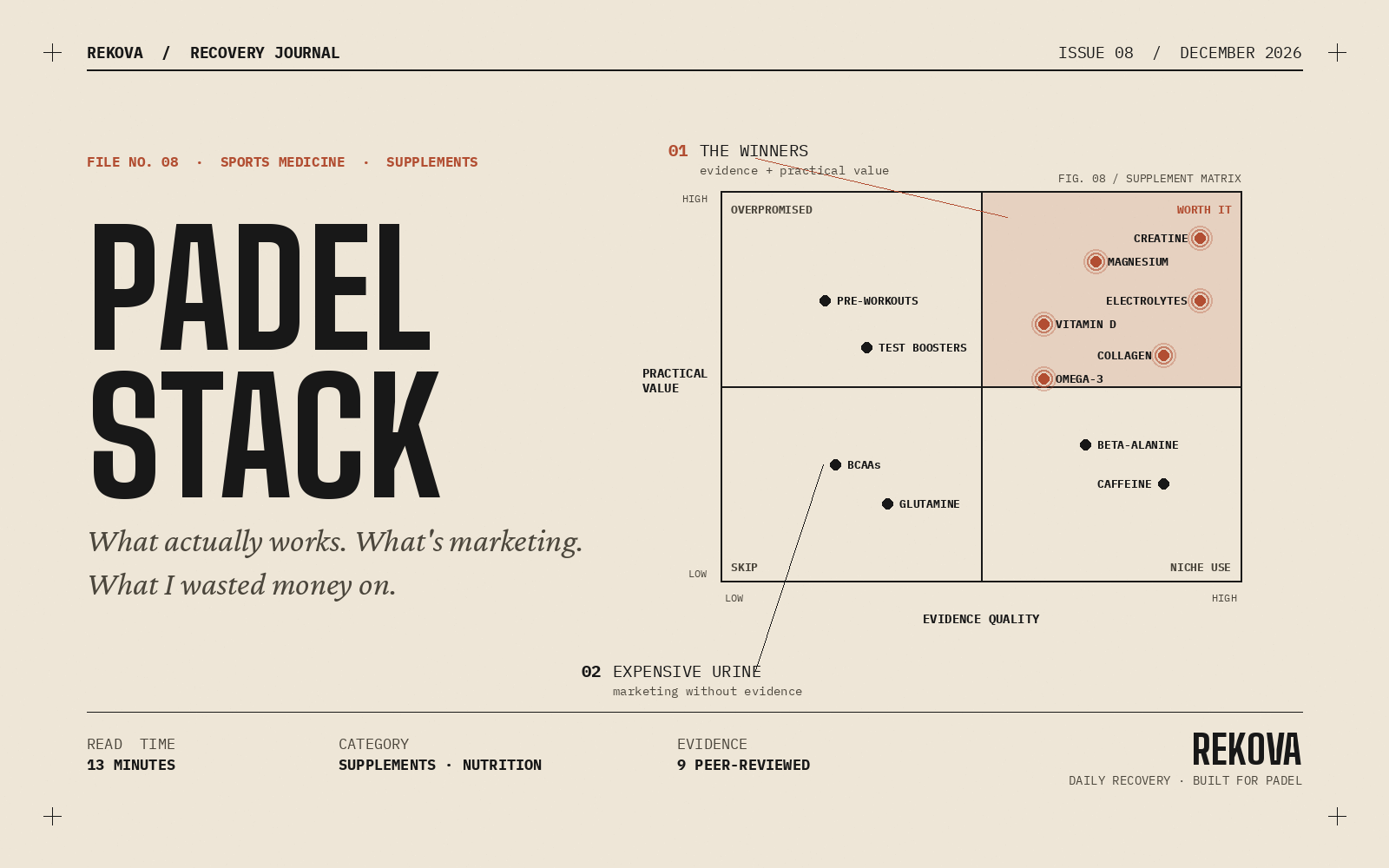
Creatine monohydrate. The most studied sports supplement in history. EFSA has approved the claim that creatine increases physical performance in successive bursts of short-term high-intensity exercise (the daily dose being 3 grams). Hundreds of studies. Very consistent results. Particularly relevant for sports with explosive movements, which is exactly what padel is. Cheap, well tolerated, takes about 4 weeks to fully load the muscles.
I started taking 5 grams of creatine monohydrate per day about 18 months ago. The most noticeable change was a small increase in strength gains during my gym sessions and slightly more explosive movement on court. Not dramatic. But real and consistent.
Protein powder. Useful for hitting daily protein targets if you struggle with whole-food protein at every meal. Whey, casein, plant-based varieties all work. The specific product matters much less than total daily protein intake. EFSA confirms protein contributes to maintenance of muscle mass and to growth of muscle mass.
Caffeine. For performance, 100 to 200 milligrams about 45 minutes before play. Research support is solid for endurance and reaction time benefits. Most amateurs already get this through coffee. No need for a separate supplement unless you want pre-measured dosing.
Electrolytes. For matches over 60 minutes or in heat. Covered in detail in my separate padel hydration article. The point is that sodium and potassium replacement during hard play genuinely matters. Most commercial sports drinks have too much sugar and not enough sodium for what padel demands.
That's the proven core. Four categories. Most amateurs don't actually need more than this for the performance side.
Creatine monohydrate. The most studied sports supplement in history. EFSA has approved the claim that creatine increases physical performance in successive bursts of short-term high-intensity exercise (the daily dose being 3 grams). Hundreds of studies. Very consistent results. Particularly relevant for sports with explosive movements, which is exactly what padel is. Cheap, well tolerated, takes about 4 weeks to fully load the muscles.
I started taking 5 grams of creatine monohydrate per day about 18 months ago. The most noticeable change was a small increase in strength gains during my gym sessions and slightly more explosive movement on court. Not dramatic. But real and consistent.
Protein powder. Useful for hitting daily protein targets if you struggle with whole-food protein at every meal. Whey, casein, plant-based varieties all work. The specific product matters much less than total daily protein intake. EFSA confirms protein contributes to maintenance of muscle mass and to growth of muscle mass.
Caffeine. For performance, 100 to 200 milligrams about 45 minutes before play. Research support is solid for endurance and reaction time benefits. Most amateurs already get this through coffee. No need for a separate supplement unless you want pre-measured dosing.
Electrolytes. For matches over 60 minutes or in heat. Covered in detail in my separate padel hydration article. The point is that sodium and potassium replacement during hard play genuinely matters. Most commercial sports drinks have too much sugar and not enough sodium for what padel demands.
That's the proven core. Four categories. Most amateurs don't actually need more than this for the performance side.
The foundation layer (micronutrient adequacy)
This is where most people benefit but most products oversell.
A basic multivitamin or specific single-nutrient supplements covering the gaps in your diet matters for active athletes. The question is which gaps you actually have.
Magnesium. EFSA confirms magnesium contributes to normal muscle function, reduction of tiredness and fatigue, and electrolyte balance. Around 30 to 40 percent of European adults don't hit recommended daily intake from diet alone. Athletes lose more through sweat. This is genuinely one of the most useful single-nutrient supplements for amateur athletes. Magnesium citrate or glycinate at 200 to 400 milligrams per day works well for most people.
Vitamin D. Particularly relevant for indoor athletes and for adults in northern Europe. EFSA confirms it contributes to normal muscle function and maintenance of normal bones. Many adults run low, especially in winter months. Worth testing your levels via blood work if you've never checked.
Vitamin C. EFSA confirms it contributes to normal collagen formation for the normal function of cartilage and bones, reduction of tiredness and fatigue, and normal energy yielding metabolism. Often included in recovery products specifically for the collagen synthesis support. Real evidence behind these claims.
B vitamin complex. EFSA confirms multiple B vitamins (B1, B2, B3, B5, B6, B12) contribute to normal energy yielding metabolism, and several contribute to reduction of tiredness and fatigue (B2, B3, B5, B6, B9, B12). If you eat varied food you probably get adequate amounts. If your diet is restricted or your activity level is high, a basic B complex covers the bases.
Omega-3 fatty acids (EPA and DHA). EFSA has approved claims for normal cardiac function with daily intake of 250 milligrams of combined EPA and DHA. Beyond cardiac claims, evidence for muscle recovery and inflammatory support is genuinely promising but not yet at the level of approved sport-specific claims. Fish oil capsules work fine. Two grams of combined EPA and DHA daily is what most research uses.
Hydrolyzed collagen. The evidence here is interesting. Several studies show collagen peptides combined with vitamin C may support connective tissue maintenance under athletic load. The body of research is growing, particularly for tendon issues and joint health in active populations. Not yet at the level of approved EFSA health claims for connective tissue, but worth knowing about.
Iron. Critical for women and for any athlete who limits red meat. EFSA confirms iron contributes to normal cognitive function, normal oxygen transport, and reduction of tiredness and fatigue. If you're regularly tired despite good sleep, a ferritin blood test is worth doing.
A basic multivitamin or specific single-nutrient supplements covering the gaps in your diet matters for active athletes. The question is which gaps you actually have.
Magnesium. EFSA confirms magnesium contributes to normal muscle function, reduction of tiredness and fatigue, and electrolyte balance. Around 30 to 40 percent of European adults don't hit recommended daily intake from diet alone. Athletes lose more through sweat. This is genuinely one of the most useful single-nutrient supplements for amateur athletes. Magnesium citrate or glycinate at 200 to 400 milligrams per day works well for most people.
Vitamin D. Particularly relevant for indoor athletes and for adults in northern Europe. EFSA confirms it contributes to normal muscle function and maintenance of normal bones. Many adults run low, especially in winter months. Worth testing your levels via blood work if you've never checked.
Vitamin C. EFSA confirms it contributes to normal collagen formation for the normal function of cartilage and bones, reduction of tiredness and fatigue, and normal energy yielding metabolism. Often included in recovery products specifically for the collagen synthesis support. Real evidence behind these claims.
B vitamin complex. EFSA confirms multiple B vitamins (B1, B2, B3, B5, B6, B12) contribute to normal energy yielding metabolism, and several contribute to reduction of tiredness and fatigue (B2, B3, B5, B6, B9, B12). If you eat varied food you probably get adequate amounts. If your diet is restricted or your activity level is high, a basic B complex covers the bases.
Omega-3 fatty acids (EPA and DHA). EFSA has approved claims for normal cardiac function with daily intake of 250 milligrams of combined EPA and DHA. Beyond cardiac claims, evidence for muscle recovery and inflammatory support is genuinely promising but not yet at the level of approved sport-specific claims. Fish oil capsules work fine. Two grams of combined EPA and DHA daily is what most research uses.
Hydrolyzed collagen. The evidence here is interesting. Several studies show collagen peptides combined with vitamin C may support connective tissue maintenance under athletic load. The body of research is growing, particularly for tendon issues and joint health in active populations. Not yet at the level of approved EFSA health claims for connective tissue, but worth knowing about.
Iron. Critical for women and for any athlete who limits red meat. EFSA confirms iron contributes to normal cognitive function, normal oxygen transport, and reduction of tiredness and fatigue. If you're regularly tired despite good sleep, a ferritin blood test is worth doing.
Genuinely interesting but underwhelming evidence
Things worth knowing about but not expecting miracles from.
Adaptogenic herbs (ashwagandha, rhodiola). Traditional use in stress and energy support. Modern research is interesting but mixed. No EFSA-approved health claims yet for these compounds in athletic contexts. I take a small amount of ashwagandha most evenings and notice some subjective benefit on stress and sleep, but I cannot tell you confidently it's making me a better padel player.
L-theanine. Studied for promoting calm focus without sedation. Often paired with caffeine. Subjective effects, real research signal, no formal health claims.
Curcumin and quercetin. Antioxidant compounds with some research support for inflammation modulation. Bioavailability issues with standard curcumin formulations. Black pepper extract (piperine) improves absorption significantly. Worth knowing about if you have specific issues, not a daily requirement for everyone.
Coenzyme Q10. Plays a role in mitochondrial energy production. Research on supplementation in healthy adults is mixed. Better evidence in older adults or specific deficient populations than in young trained athletes. Probably worth including in a daily formula but not as a standalone purchase for most people under 40.
Acetyl-L-Carnitine. Involved in fatty acid transport into mitochondria. Similar story to CoQ10. Some research support, particularly with age. Not dramatic effects in healthy younger athletes.
Beta-alanine. Increases muscle carnosine, which buffers acid during high-intensity work. Some research support, particularly for sustained high-intensity efforts. May help in long matches with multiple intense rallies. Causes a tingling sensation (paresthesia) at higher doses that many people find uncomfortable.
These can all be part of a comprehensive supplement approach. None of them are the difference between playing well and playing badly.
Adaptogenic herbs (ashwagandha, rhodiola). Traditional use in stress and energy support. Modern research is interesting but mixed. No EFSA-approved health claims yet for these compounds in athletic contexts. I take a small amount of ashwagandha most evenings and notice some subjective benefit on stress and sleep, but I cannot tell you confidently it's making me a better padel player.
L-theanine. Studied for promoting calm focus without sedation. Often paired with caffeine. Subjective effects, real research signal, no formal health claims.
Curcumin and quercetin. Antioxidant compounds with some research support for inflammation modulation. Bioavailability issues with standard curcumin formulations. Black pepper extract (piperine) improves absorption significantly. Worth knowing about if you have specific issues, not a daily requirement for everyone.
Coenzyme Q10. Plays a role in mitochondrial energy production. Research on supplementation in healthy adults is mixed. Better evidence in older adults or specific deficient populations than in young trained athletes. Probably worth including in a daily formula but not as a standalone purchase for most people under 40.
Acetyl-L-Carnitine. Involved in fatty acid transport into mitochondria. Similar story to CoQ10. Some research support, particularly with age. Not dramatic effects in healthy younger athletes.
Beta-alanine. Increases muscle carnosine, which buffers acid during high-intensity work. Some research support, particularly for sustained high-intensity efforts. May help in long matches with multiple intense rallies. Causes a tingling sensation (paresthesia) at higher doses that many people find uncomfortable.
These can all be part of a comprehensive supplement approach. None of them are the difference between playing well and playing badly.
What I now consider mostly marketing
Branched-chain amino acids (BCAAs). Once popular, now well-understood as redundant for anyone consuming adequate total protein. If your protein intake hits 1.6 to 2 grams per kg body weight daily, BCAAs add nothing. Skip them.
Glutamine. Heavily marketed, weak evidence for healthy athletes. Skip it.
Most pre-workout formulas. Usually a small amount of caffeine, beta-alanine for the tingle so you feel something is happening, and a proprietary blend of marginal ingredients at sub-effective doses. Expensive caffeine with extra marketing.
Test boosters and natural anabolics. Marketing dressed up as science. Skip them. The healthy lifestyle factors (sleep, strength training, body composition, stress management) have meaningful effects on testosterone. Supplements don't.
Tendon support proprietary blends. Usually contain glucosamine, MSM, or chondroitin in token amounts. Hydrolyzed collagen with vitamin C has better evidence at proper doses. The proprietary blend products often have neither at meaningful amounts.
ZMA (zinc, magnesium, B6 combination). Most studies on the original formula didn't replicate. The individual nutrients matter. The specific combination claim doesn't.
Most multivitamins with proprietary blends. Look at the actual doses on the label. If you can't see specific amounts of each nutrient because they're hidden behind a proprietary blend label, you don't know what you're paying for.
Recovery shakes with hundreds of ingredients at trace amounts. If a product lists 50 ingredients at 5 milligrams each, none of them are at active doses. This is sprinkle marketing.
Glutamine. Heavily marketed, weak evidence for healthy athletes. Skip it.
Most pre-workout formulas. Usually a small amount of caffeine, beta-alanine for the tingle so you feel something is happening, and a proprietary blend of marginal ingredients at sub-effective doses. Expensive caffeine with extra marketing.
Test boosters and natural anabolics. Marketing dressed up as science. Skip them. The healthy lifestyle factors (sleep, strength training, body composition, stress management) have meaningful effects on testosterone. Supplements don't.
Tendon support proprietary blends. Usually contain glucosamine, MSM, or chondroitin in token amounts. Hydrolyzed collagen with vitamin C has better evidence at proper doses. The proprietary blend products often have neither at meaningful amounts.
ZMA (zinc, magnesium, B6 combination). Most studies on the original formula didn't replicate. The individual nutrients matter. The specific combination claim doesn't.
Most multivitamins with proprietary blends. Look at the actual doses on the label. If you can't see specific amounts of each nutrient because they're hidden behind a proprietary blend label, you don't know what you're paying for.
Recovery shakes with hundreds of ingredients at trace amounts. If a product lists 50 ingredients at 5 milligrams each, none of them are at active doses. This is sprinkle marketing.
How to evaluate any supplement claim
Before buying anything, ask three questions.
What does the actual research say? Look for systematic reviews and meta-analyses, not individual studies. Look at sample sizes, study quality, and conflicts of interest. PubMed is free and accessible.
What's the effective dose? Even ingredients with real evidence often need specific doses to work. Many products contain ingredients at one-tenth the effective dose for marketing purposes. The ingredient appears on the label, but at a level that does nothing.
Are there approved health claims? In Europe, EFSA scientific opinions filter out the worst marketing nonsense. If an ingredient has an approved health claim, that's a reasonable signal of evidence quality. If a product makes claims that go beyond what's officially approved, be skeptical.
If you can't answer these three questions about a product you're about to buy, you're guessing. Most amateur athletes are guessing all the time.
What does the actual research say? Look for systematic reviews and meta-analyses, not individual studies. Look at sample sizes, study quality, and conflicts of interest. PubMed is free and accessible.
What's the effective dose? Even ingredients with real evidence often need specific doses to work. Many products contain ingredients at one-tenth the effective dose for marketing purposes. The ingredient appears on the label, but at a level that does nothing.
Are there approved health claims? In Europe, EFSA scientific opinions filter out the worst marketing nonsense. If an ingredient has an approved health claim, that's a reasonable signal of evidence quality. If a product makes claims that go beyond what's officially approved, be skeptical.
If you can't answer these three questions about a product you're about to buy, you're guessing. Most amateur athletes are guessing all the time.
My current minimalist daily approach
After two years of subtracting and testing, here's what I take consistently.
Morning, with breakfast. Creatine monohydrate 5 grams. Vitamin D 2000 IU (more in winter, less in summer). Omega-3 fish oil capsules providing about 2 grams EPA and DHA combined.
After matches or in the evening. One sachet of Rekova mixed with water. This covers magnesium (300 milligrams), B vitamins, vitamin C with hydrolyzed collagen for connective tissue, electrolytes for sweat losses, plus CoQ10, Acetyl-L-Carnitine, and the adaptogen mix. The reason I use this instead of taking 8 separate products is convenience and consistency. One sachet, in water, every day. I actually stick with it.
Before bed. Magnesium glycinate sometimes if I haven't taken Rekova that day. Helps sleep quality for me.
That's the entire stack. Cost has dropped from 80 euros a month to under 40. Performance and recovery are better. The minimalism turned out to be the point.
Morning, with breakfast. Creatine monohydrate 5 grams. Vitamin D 2000 IU (more in winter, less in summer). Omega-3 fish oil capsules providing about 2 grams EPA and DHA combined.
After matches or in the evening. One sachet of Rekova mixed with water. This covers magnesium (300 milligrams), B vitamins, vitamin C with hydrolyzed collagen for connective tissue, electrolytes for sweat losses, plus CoQ10, Acetyl-L-Carnitine, and the adaptogen mix. The reason I use this instead of taking 8 separate products is convenience and consistency. One sachet, in water, every day. I actually stick with it.
Before bed. Magnesium glycinate sometimes if I haven't taken Rekova that day. Helps sleep quality for me.
That's the entire stack. Cost has dropped from 80 euros a month to under 40. Performance and recovery are better. The minimalism turned out to be the point.
Where Rekova fits in the supplement landscape
I want to be transparent about how I think about this since the Rekova brand publishes these articles.
The formula was built around a simple thesis. For people playing padel multiple times a week, there's a real micronutrient and electrolyte demand that diet alone doesn't reliably cover. Filling that demand through 8 separate products is expensive, inconvenient, and most people don't actually stick with it.
One sachet per day delivers what amateurs lose during matches and what their diets typically run low on. Electrolytes for sweat losses, with proper sodium and potassium ratios for padel-specific demands. Magnesium with EFSA-approved claims for muscle function and fatigue reduction. B vitamins with claims for energy metabolism. Vitamin C with claims for collagen formation. Hydrolyzed collagen for connective tissue support given the tendon issues that show up in this sport. Plus a layer of supporting ingredients including CoQ10, Acetyl-L-Carnitine, and adaptogens.
It is not a treatment for anything. It is not a substitute for sleep, training, real food, and recovery. It is a daily nutritional baseline for someone whose diet has gaps and whose sport creates additional demand.
If you have a perfect diet with adequate magnesium, multiple B vitamins, proper electrolyte intake, and consistent vitamin C, you don't need Rekova or any similar product. Most active adults don't have that perfect diet. That's the gap the product fills.
I take it because the realistic alternative is buying eight separate bottles and failing to take them consistently. The convenience of one sachet matters more than people realize for actual compliance over months and years.
The formula was built around a simple thesis. For people playing padel multiple times a week, there's a real micronutrient and electrolyte demand that diet alone doesn't reliably cover. Filling that demand through 8 separate products is expensive, inconvenient, and most people don't actually stick with it.
One sachet per day delivers what amateurs lose during matches and what their diets typically run low on. Electrolytes for sweat losses, with proper sodium and potassium ratios for padel-specific demands. Magnesium with EFSA-approved claims for muscle function and fatigue reduction. B vitamins with claims for energy metabolism. Vitamin C with claims for collagen formation. Hydrolyzed collagen for connective tissue support given the tendon issues that show up in this sport. Plus a layer of supporting ingredients including CoQ10, Acetyl-L-Carnitine, and adaptogens.
It is not a treatment for anything. It is not a substitute for sleep, training, real food, and recovery. It is a daily nutritional baseline for someone whose diet has gaps and whose sport creates additional demand.
If you have a perfect diet with adequate magnesium, multiple B vitamins, proper electrolyte intake, and consistent vitamin C, you don't need Rekova or any similar product. Most active adults don't have that perfect diet. That's the gap the product fills.
I take it because the realistic alternative is buying eight separate bottles and failing to take them consistently. The convenience of one sachet matters more than people realize for actual compliance over months and years.
FAQ: questions about supplements for padel
Do I really need supplements if I eat well? Define well. Most realistic adult diets have gaps in magnesium, vitamin D, and sometimes B vitamins. If you've never tested your nutrient levels, you don't actually know what you're getting from your diet.
Are pre-workouts worth it for padel? Mostly no. The caffeine portion can help if you don't already drink coffee. Everything else is usually overpriced or ineffective.
Should I take BCAAs around training? No, if you hit your daily protein target. Yes, theoretically, if you train fasted and want some amino acid coverage. Most people overestimate the benefit.
Is creatine safe long-term? Yes. Among the most studied supplements in history. Decades of safety data in healthy adults. Doesn't cause kidney damage in healthy people despite the persistent myth.
Should I cycle off supplements? Most don't require cycling. Creatine doesn't. Magnesium doesn't. Stimulants like caffeine have some logic for cycling to prevent tolerance buildup.
What's the best supplement brand? Brand matters less than ingredient transparency and third-party testing. Look for products that list specific doses, don't use proprietary blends, and have third-party testing for purity.
Are there any supplements I should avoid entirely? Anything making weight-loss promises without diet changes. Anything claiming to boost testosterone naturally beyond healthy lifestyle factors. Anything with a proprietary blend label hiding doses. Anything promising dramatic results that sound too good to be true.
Should I take supplements before or after my padel matches? Depends on the supplement. Caffeine before. Electrolytes during. Protein, magnesium, and recovery-oriented products after. Vitamin D with a meal containing fat. Iron away from coffee or tea.
How much should I spend on supplements per month? For a basic effective stack, around 30 to 50 euros covers everything most amateurs need. If you're spending more than 80 euros a month and you're not a competitive athlete with specific reasons, you're probably overpaying.
What about supplements specifically marketed to padel players? Some are well-formulated. Many are recycled tennis or generic sports products with new packaging. Evaluate them on ingredients and doses, not on the sport name on the label.
Are pre-workouts worth it for padel? Mostly no. The caffeine portion can help if you don't already drink coffee. Everything else is usually overpriced or ineffective.
Should I take BCAAs around training? No, if you hit your daily protein target. Yes, theoretically, if you train fasted and want some amino acid coverage. Most people overestimate the benefit.
Is creatine safe long-term? Yes. Among the most studied supplements in history. Decades of safety data in healthy adults. Doesn't cause kidney damage in healthy people despite the persistent myth.
Should I cycle off supplements? Most don't require cycling. Creatine doesn't. Magnesium doesn't. Stimulants like caffeine have some logic for cycling to prevent tolerance buildup.
What's the best supplement brand? Brand matters less than ingredient transparency and third-party testing. Look for products that list specific doses, don't use proprietary blends, and have third-party testing for purity.
Are there any supplements I should avoid entirely? Anything making weight-loss promises without diet changes. Anything claiming to boost testosterone naturally beyond healthy lifestyle factors. Anything with a proprietary blend label hiding doses. Anything promising dramatic results that sound too good to be true.
Should I take supplements before or after my padel matches? Depends on the supplement. Caffeine before. Electrolytes during. Protein, magnesium, and recovery-oriented products after. Vitamin D with a meal containing fat. Iron away from coffee or tea.
How much should I spend on supplements per month? For a basic effective stack, around 30 to 50 euros covers everything most amateurs need. If you're spending more than 80 euros a month and you're not a competitive athlete with specific reasons, you're probably overpaying.
What about supplements specifically marketed to padel players? Some are well-formulated. Many are recycled tennis or generic sports products with new packaging. Evaluate them on ingredients and doses, not on the sport name on the label.
The short version
Most sports supplements are oversold. The list of products with real, robust evidence is short. Creatine, protein, caffeine, electrolytes form the proven performance core. A magnesium, vitamin D, omega-3, B vitamin, vitamin C foundation covers most micronutrient gaps. Adaptogens, CoQ10, hydrolyzed collagen, and similar interesting-but-underwhelming compounds can be useful in a comprehensive daily formula. Most pre-workouts, BCAAs, glutamine, test boosters, and proprietary blend products are marketing.
If you play padel multiple times a week and want one product that covers the daily baseline, that's the gap a properly formulated recovery drink fills. If you only play once a week and eat reasonably well, you probably don't need much beyond basic vitamin D and maybe some omega-3.
Start with sleep, training, and real food. Add supplements only after those fundamentals are dialed in. Save your money on the marketing.
If you play padel multiple times a week and want one product that covers the daily baseline, that's the gap a properly formulated recovery drink fills. If you only play once a week and eat reasonably well, you probably don't need much beyond basic vitamin D and maybe some omega-3.
Start with sleep, training, and real food. Add supplements only after those fundamentals are dialed in. Save your money on the marketing.
Sources
EFSA. Scientific Opinions on the substantiation of health claims related to magnesium, vitamin C, vitamin D, B vitamins, iron, calcium, omega-3, creatine, and protein. EFSA Journal, various years.
International Society of Sports Nutrition. Position stand on creatine supplementation and exercise. JISSN. 2021 update.
International Society of Sports Nutrition. Position stand on protein and exercise. JISSN. 2024.
Australian Institute of Sport. AIS Sports Supplement Framework. 2024.
Maughan RJ et al. IOC consensus statement on dietary supplements and the high-performance athlete. British Journal of Sports Medicine. 2018.
Marcos Rivero B. et al. Evolution of Physiological Responses and Fatigue Analysis in Padel Matches. Sensors. August 2025.
Healthspan Elite. Padel: what is it and how should you fuel your game? Knowledge Hub. 2025.
Padel Magazine. Padel and nutrition: what to eat before, during and after a match. 2025.
Phillips SM. et al. Protein requirements in older athletes. International Journal of Sport Nutrition and Exercise Metabolism. 2024.
This article shares my own experience with supplements and reflects current research and regulatory positions on sports nutrition. It is not medical advice. Some supplements can interact with medications or be contraindicated for specific medical conditions. If you have any underlying medical condition or take prescription medications, please consult a qualified healthcare professional before starting any new supplement regimen.
Rekova does not treat any medical condition and is not a substitute for medical care or balanced nutrition. It is a daily functional drink with electrolytes, magnesium, hydrolyzed collagen, B vitamins, vitamin C, CoQ10, Acetyl-L-Carnitine, and supporting nutrients, formulated as nutritional support for people who play padel regularly.
International Society of Sports Nutrition. Position stand on creatine supplementation and exercise. JISSN. 2021 update.
International Society of Sports Nutrition. Position stand on protein and exercise. JISSN. 2024.
Australian Institute of Sport. AIS Sports Supplement Framework. 2024.
Maughan RJ et al. IOC consensus statement on dietary supplements and the high-performance athlete. British Journal of Sports Medicine. 2018.
Marcos Rivero B. et al. Evolution of Physiological Responses and Fatigue Analysis in Padel Matches. Sensors. August 2025.
Healthspan Elite. Padel: what is it and how should you fuel your game? Knowledge Hub. 2025.
Padel Magazine. Padel and nutrition: what to eat before, during and after a match. 2025.
Phillips SM. et al. Protein requirements in older athletes. International Journal of Sport Nutrition and Exercise Metabolism. 2024.
This article shares my own experience with supplements and reflects current research and regulatory positions on sports nutrition. It is not medical advice. Some supplements can interact with medications or be contraindicated for specific medical conditions. If you have any underlying medical condition or take prescription medications, please consult a qualified healthcare professional before starting any new supplement regimen.
Rekova does not treat any medical condition and is not a substitute for medical care or balanced nutrition. It is a daily functional drink with electrolytes, magnesium, hydrolyzed collagen, B vitamins, vitamin C, CoQ10, Acetyl-L-Carnitine, and supporting nutrients, formulated as nutritional support for people who play padel regularly.
