A 11 minute read. Updated June 2026.
It was a Monday morning in late September. The alarm went off at 7:15. I sat up in bed, swung my legs over the side to stand up, and my calves felt like someone had injected concrete into them overnight. Two matches the previous Sunday. One was 90 minutes, the second went the full two hours and ended in a tiebreak in the third. I got home at 10 PM, ate a sandwich, fell asleep on the couch.
Standing up that Monday was an event. I had a meeting at 9 AM and I genuinely considered whether I could just lie on the floor with the laptop on a chair.
This wasn't unusual. For the first year and a half I played padel three or four times a week, every Monday after a weekend like that was the same. My body felt like it had been worked over. My thinking was slow until at least 10 AM. I'd promise myself I'd recover better next time, then do nothing different.
The shift came when I started taking recovery seriously. Not in the Instagram way with the ice baths and infrared saunas and recovery boots. In the boring practical way that actually moves the needle.
Below is what I learned, what the actual science says, and what I now know is mostly marketing.
What recovery actually means at the cellular level
When you finish a hard padel match your body has been through a specific kind of stress. Repeated bursts of high intensity, sprints, lunges, jumps for smashes, followed by short recoveries between points. Repeated for an hour or more.
The result inside your muscles isn't just soreness. You have small tears in muscle fibers, depleted glycogen in muscles and liver, lowered concentrations of sodium and potassium and magnesium, accumulation of metabolic byproducts, and small inflammatory responses in connective tissue and joint capsules.
A study published in Sensors in August 2025 looked at 52 amateur padel players across 13 matches. They measured countermovement jump performance and handgrip strength before the match and after each set. Both dropped significantly across sets, with the steepest decline late in the match. Even your basic muscle output drops while you're playing. That loss takes time to come back.
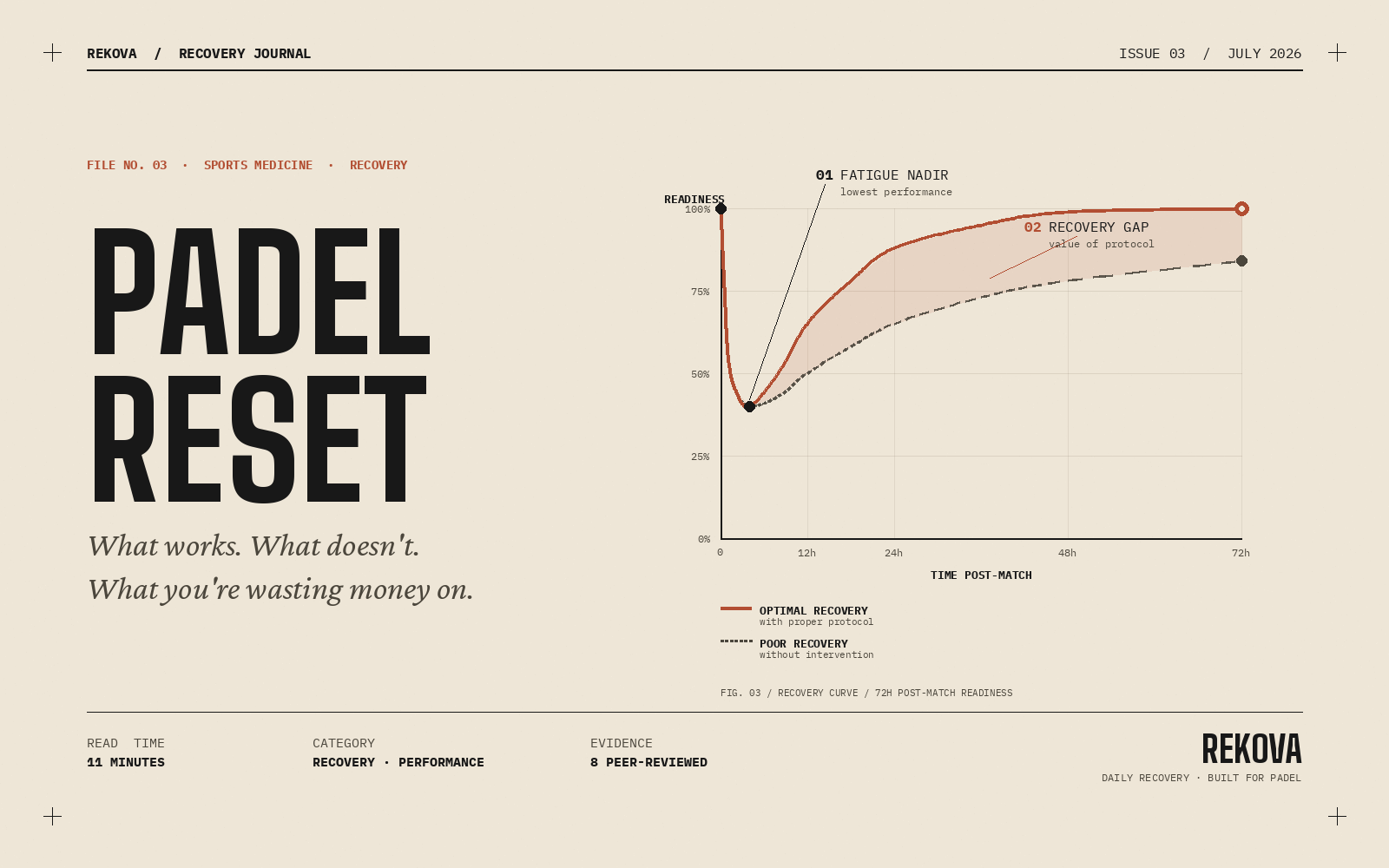
How much time depends almost entirely on what you do in the hours after the match ends.
Your body doesn't recover passively. It recovers based on the conditions you create. Sleep, food, hydration, movement, stress. Each one is a lever you control.
The result inside your muscles isn't just soreness. You have small tears in muscle fibers, depleted glycogen in muscles and liver, lowered concentrations of sodium and potassium and magnesium, accumulation of metabolic byproducts, and small inflammatory responses in connective tissue and joint capsules.
A study published in Sensors in August 2025 looked at 52 amateur padel players across 13 matches. They measured countermovement jump performance and handgrip strength before the match and after each set. Both dropped significantly across sets, with the steepest decline late in the match. Even your basic muscle output drops while you're playing. That loss takes time to come back.
How much time depends almost entirely on what you do in the hours after the match ends.
Your body doesn't recover passively. It recovers based on the conditions you create. Sleep, food, hydration, movement, stress. Each one is a lever you control.
The 30 to 60 minute window after the match
The first hour after exercise gets called the recovery window for a reason. Your muscles are still warm and well perfused. Enzymes for nutrient uptake are upregulated. Your body is primed to absorb what you give it.
What I do now after every match looks like this.
Drink fluid with electrolytes within five minutes of finishing. Doesn't have to be fancy. Water with a pinch of salt works fine. A proper recovery drink works better. The point is to start replacing what you lost before you've even got in the car to drive home.
Eat something within sixty minutes. Carbs and protein together. The classic ratio sports scientists use is around 3 to 1 carbs to protein for endurance athletes, 2 to 1 for strength athletes. Padel sits somewhere in between. A banana with a protein shake. A sandwich. Greek yogurt with honey and some nuts. The exact food matters less than getting the macronutrient mix in.
Take five minutes to stretch lightly. Not aggressive old-school PE stretching. Just gentle range of motion work for calves, hips, shoulders, forearms. Keep blood moving through the muscles you just used.
Skip the beer for at least 90 minutes. I know. I love a cold beer after a match too. But alcohol slows protein synthesis and worsens dehydration. Water and electrolytes first, real food second, then enjoy the social part if you want.
Most players I know skip every single one of these. They finish the match, change, drive home, shower, scroll their phone, maybe eat dinner two hours later. The recovery window closes and they got nothing out of it.
What I do now after every match looks like this.
Drink fluid with electrolytes within five minutes of finishing. Doesn't have to be fancy. Water with a pinch of salt works fine. A proper recovery drink works better. The point is to start replacing what you lost before you've even got in the car to drive home.
Eat something within sixty minutes. Carbs and protein together. The classic ratio sports scientists use is around 3 to 1 carbs to protein for endurance athletes, 2 to 1 for strength athletes. Padel sits somewhere in between. A banana with a protein shake. A sandwich. Greek yogurt with honey and some nuts. The exact food matters less than getting the macronutrient mix in.
Take five minutes to stretch lightly. Not aggressive old-school PE stretching. Just gentle range of motion work for calves, hips, shoulders, forearms. Keep blood moving through the muscles you just used.
Skip the beer for at least 90 minutes. I know. I love a cold beer after a match too. But alcohol slows protein synthesis and worsens dehydration. Water and electrolytes first, real food second, then enjoy the social part if you want.
Most players I know skip every single one of these. They finish the match, change, drive home, shower, scroll their phone, maybe eat dinner two hours later. The recovery window closes and they got nothing out of it.
Sleep is the foundation, everything else is decoration
If I had to pick one variable that matters more than all the others combined, it's sleep.
Growth hormone release, tissue repair, glycogen restoration, central nervous system recovery. Almost everything that happens during physical recovery is downstream of getting enough quality sleep. Studies on professional athletes have shown that restricting sleep to six hours or less for even a few nights dramatically increases injury risk and slows recovery from training load.
The problem with padel specifically is the time of play. Evening matches that end at 10 or 10:30 PM mean you're going to bed wired on adrenaline. Research by Diaz Garcia and colleagues looking at professional padel tournaments found measurable impairments in sleep quality and reaction time across multi-day competitions.
What I do for evening matches now:
No screens for the first 30 minutes after I get home. The blue light plus the mental stimulation makes falling asleep harder. I dim the house lights to the lowest setting.
Magnesium with my evening glass of water. The European Food Safety Authority confirms that magnesium contributes to normal muscle function and to the reduction of tiredness and fatigue. Subjectively my sleep is noticeably better on evenings I take it.
Cool shower instead of hot. Counterintuitive, but a hot shower right before bed raises your core body temperature, which makes it harder to sleep. Lukewarm or cool works better.
If the match ended after 9 PM, I try to be in bed by 11. The temptation to scroll Instagram replaying my best points is real. Resist it.
Growth hormone release, tissue repair, glycogen restoration, central nervous system recovery. Almost everything that happens during physical recovery is downstream of getting enough quality sleep. Studies on professional athletes have shown that restricting sleep to six hours or less for even a few nights dramatically increases injury risk and slows recovery from training load.
The problem with padel specifically is the time of play. Evening matches that end at 10 or 10:30 PM mean you're going to bed wired on adrenaline. Research by Diaz Garcia and colleagues looking at professional padel tournaments found measurable impairments in sleep quality and reaction time across multi-day competitions.
What I do for evening matches now:
No screens for the first 30 minutes after I get home. The blue light plus the mental stimulation makes falling asleep harder. I dim the house lights to the lowest setting.
Magnesium with my evening glass of water. The European Food Safety Authority confirms that magnesium contributes to normal muscle function and to the reduction of tiredness and fatigue. Subjectively my sleep is noticeably better on evenings I take it.
Cool shower instead of hot. Counterintuitive, but a hot shower right before bed raises your core body temperature, which makes it harder to sleep. Lukewarm or cool works better.
If the match ended after 9 PM, I try to be in bed by 11. The temptation to scroll Instagram replaying my best points is real. Resist it.
Stretching, foam rolling, and what people get wrong
This section is going to go against some conventional wisdom.
Static stretching immediately before a match doesn't prevent injury and may actually slightly reduce explosive performance. Save long-hold stretches for after the match or for separate flexibility sessions on rest days.
Dynamic mobility work before a match is what you actually want. Arm circles, leg swings, hip openers, light skipping. Anything that takes your joints through their full range while warming up the muscles.
Foam rolling is useful but not magical. The mechanism is not releasing muscle adhesions like the marketing claims. It's mostly increasing blood flow and providing neural input that calms tight muscles. Five to ten minutes of foam rolling after a match feels good and probably helps a little. Spending 45 minutes on it daily is a waste of time you could spend on actual mobility work.
Static stretching after the match has real benefits if you do it right. Hold each position 30 to 60 seconds. Focus on calves, quads, hamstrings, glutes, hip flexors, chest, shoulders, forearms. The Padel39 stretching guide covers a good basic routine. Bandeja Shop's recovery article has another solid sequence specifically for padel.
The mistake I see at my club every weekend. Guys who stretch for two minutes total after a hard match because they're rushing home. Then they wonder why everything hurts on Tuesday.
Static stretching immediately before a match doesn't prevent injury and may actually slightly reduce explosive performance. Save long-hold stretches for after the match or for separate flexibility sessions on rest days.
Dynamic mobility work before a match is what you actually want. Arm circles, leg swings, hip openers, light skipping. Anything that takes your joints through their full range while warming up the muscles.
Foam rolling is useful but not magical. The mechanism is not releasing muscle adhesions like the marketing claims. It's mostly increasing blood flow and providing neural input that calms tight muscles. Five to ten minutes of foam rolling after a match feels good and probably helps a little. Spending 45 minutes on it daily is a waste of time you could spend on actual mobility work.
Static stretching after the match has real benefits if you do it right. Hold each position 30 to 60 seconds. Focus on calves, quads, hamstrings, glutes, hip flexors, chest, shoulders, forearms. The Padel39 stretching guide covers a good basic routine. Bandeja Shop's recovery article has another solid sequence specifically for padel.
The mistake I see at my club every weekend. Guys who stretch for two minutes total after a hard match because they're rushing home. Then they wonder why everything hurts on Tuesday.
Hydration after the match
I'm not going to repeat the full electrolyte article here. The short version. Water alone isn't enough after a hard session. You also lost sodium, potassium, magnesium. Replace them.
Key number to remember. 1.5 liters of fluid per kilogram of body weight lost, sipped gradually over the next three to four hours. Not chugged in one go.
If you want the full breakdown on what you actually lose and what to drink, I wrote a separate article on padel electrolytes.
Key number to remember. 1.5 liters of fluid per kilogram of body weight lost, sipped gradually over the next three to four hours. Not chugged in one go.
If you want the full breakdown on what you actually lose and what to drink, I wrote a separate article on padel electrolytes.
Cold therapy and the recovery industry stuff
This is where the recovery industry sells you a lot of expensive nonsense.
Let me separate what has decent science behind it from what doesn't.
Cold water immersion or ice baths for 10 to 15 minutes after intense training has some research support for reducing perceived muscle soreness. The mechanism is partly anti-inflammatory and partly nervous system reset. It does work for soreness. But there's a catch. Cold exposure right after strength training appears to blunt some adaptations including muscle hypertrophy. For pure recovery purposes after a hard match, fine. For your gym sessions afterward, probably not great.
Contrast showers, alternating hot and cold, have less consistent research support but feel good and probably help via similar mechanisms. Two or three minutes hot, 30 seconds cold, repeat three or four times. Cheap, easy, takes ten minutes.
Compression boots and sleeves have reasonable evidence for reducing perceived soreness. Mostly through enhanced venous return and lymphatic drainage. Expensive to buy outright, but if you have access at a gym or clinic, they help.
Infrared sauna sessions probably do something via heat exposure and possibly hormesis. The evidence is okay but not strong. If you have access, fine. Spending three thousand euros to install one at home for recovery purposes is an expensive way to maybe sleep slightly better.
Cryotherapy chambers cost 40 to 80 euros per session. The evidence for benefit beyond a cheap ice bath at home is weak. Save your money.
Recovery shakes with proprietary blends marketed as game-changing formulas. Look at the label. If you can't identify what's actually in the product and at what dose, you're paying for branding.
What actually moves the needle for 90 percent of recovery is the boring stuff. Sleep enough. Eat enough. Hydrate. Move gently the day after. Manage training load. That's it.
Let me separate what has decent science behind it from what doesn't.
Cold water immersion or ice baths for 10 to 15 minutes after intense training has some research support for reducing perceived muscle soreness. The mechanism is partly anti-inflammatory and partly nervous system reset. It does work for soreness. But there's a catch. Cold exposure right after strength training appears to blunt some adaptations including muscle hypertrophy. For pure recovery purposes after a hard match, fine. For your gym sessions afterward, probably not great.
Contrast showers, alternating hot and cold, have less consistent research support but feel good and probably help via similar mechanisms. Two or three minutes hot, 30 seconds cold, repeat three or four times. Cheap, easy, takes ten minutes.
Compression boots and sleeves have reasonable evidence for reducing perceived soreness. Mostly through enhanced venous return and lymphatic drainage. Expensive to buy outright, but if you have access at a gym or clinic, they help.
Infrared sauna sessions probably do something via heat exposure and possibly hormesis. The evidence is okay but not strong. If you have access, fine. Spending three thousand euros to install one at home for recovery purposes is an expensive way to maybe sleep slightly better.
Cryotherapy chambers cost 40 to 80 euros per session. The evidence for benefit beyond a cheap ice bath at home is weak. Save your money.
Recovery shakes with proprietary blends marketed as game-changing formulas. Look at the label. If you can't identify what's actually in the product and at what dose, you're paying for branding.
What actually moves the needle for 90 percent of recovery is the boring stuff. Sleep enough. Eat enough. Hydrate. Move gently the day after. Manage training load. That's it.
Active recovery the day after
The instinct after a destroying weekend is to lie on the couch. This makes things worse.
Light activity the day after a hard match accelerates recovery. The mechanism is increased blood flow to the muscles without adding more damage. 20 to 30 minutes of low intensity work, anything that gets your heart rate slightly elevated without taxing the same muscles you used in padel.
What works. Easy cycling, swimming, brisk walking with a dog, gentle yoga flows, light mobility sessions.
What doesn't work. Lying on the couch all day Monday and then wondering why you still feel terrible at Tuesday training.
I do a 30 minute walk every Monday morning now, ideally outdoors with morning sunlight. Sounds small. Makes a noticeable difference by Tuesday.
Light activity the day after a hard match accelerates recovery. The mechanism is increased blood flow to the muscles without adding more damage. 20 to 30 minutes of low intensity work, anything that gets your heart rate slightly elevated without taxing the same muscles you used in padel.
What works. Easy cycling, swimming, brisk walking with a dog, gentle yoga flows, light mobility sessions.
What doesn't work. Lying on the couch all day Monday and then wondering why you still feel terrible at Tuesday training.
I do a 30 minute walk every Monday morning now, ideally outdoors with morning sunlight. Sounds small. Makes a noticeable difference by Tuesday.
Nutrition for recovery and where supplements fit in
Recovery is built on the foundation of regular daily nutrition, not on what you do in the 60 minutes immediately after a match.
If you eat poorly five days a week and chug a recovery shake on Sunday night, that shake fixes nothing. If you eat well most days, then specific recovery support around hard sessions becomes a useful supplement to an already solid base.
The basics that matter. Adequate total daily calories for your activity level. Protein around 1.6 to 2 grams per kilogram of body weight per day. Carbs to fuel the playing volume you actually do. Vegetables and fruits for micronutrients. Some healthy fats. Limited processed junk.
That's not a special diet. That's just sensible eating.
Where micronutrients become specifically relevant for padel. Magnesium is the one I'd flag for any player going more than twice a week. EFSA confirms magnesium contributes to normal muscle function and reduction of tiredness and fatigue. Studies show 30 to 40 percent of European adults don't hit recommended daily magnesium from diet alone, and athletic sweat losses make the gap bigger.
B vitamins are involved in energy metabolism. EFSA confirms that vitamins B1, B2, B3, B5, B6, and B12 all contribute to normal energy yielding metabolism. If you eat a varied diet you probably get them, but elevated metabolic demand and sweat losses can leave you running thinner than you'd think.
Vitamin C contributes to normal collagen formation for the normal function of cartilage and bones. Hydrolyzed collagen has emerging research support for connective tissue maintenance under load.
This is the gap a well-designed recovery drink fills. Not a magic potion. A daily nutritional baseline targeted at what padel specifically depletes.
The Rekova formula was built around this. Electrolytes for what you sweat out. Magnesium and B vitamins for energy metabolism and recovery support. Hydrolyzed collagen with vitamin C for connective tissue. Some adaptogens and antioxidants on top for general resilience. One sachet mixed with water, usually right after the match or in the evening.
It's not a substitute for real food. It's the supplement layer on top of decent daily nutrition.
If you eat poorly five days a week and chug a recovery shake on Sunday night, that shake fixes nothing. If you eat well most days, then specific recovery support around hard sessions becomes a useful supplement to an already solid base.
The basics that matter. Adequate total daily calories for your activity level. Protein around 1.6 to 2 grams per kilogram of body weight per day. Carbs to fuel the playing volume you actually do. Vegetables and fruits for micronutrients. Some healthy fats. Limited processed junk.
That's not a special diet. That's just sensible eating.
Where micronutrients become specifically relevant for padel. Magnesium is the one I'd flag for any player going more than twice a week. EFSA confirms magnesium contributes to normal muscle function and reduction of tiredness and fatigue. Studies show 30 to 40 percent of European adults don't hit recommended daily magnesium from diet alone, and athletic sweat losses make the gap bigger.
B vitamins are involved in energy metabolism. EFSA confirms that vitamins B1, B2, B3, B5, B6, and B12 all contribute to normal energy yielding metabolism. If you eat a varied diet you probably get them, but elevated metabolic demand and sweat losses can leave you running thinner than you'd think.
Vitamin C contributes to normal collagen formation for the normal function of cartilage and bones. Hydrolyzed collagen has emerging research support for connective tissue maintenance under load.
This is the gap a well-designed recovery drink fills. Not a magic potion. A daily nutritional baseline targeted at what padel specifically depletes.
The Rekova formula was built around this. Electrolytes for what you sweat out. Magnesium and B vitamins for energy metabolism and recovery support. Hydrolyzed collagen with vitamin C for connective tissue. Some adaptogens and antioxidants on top for general resilience. One sachet mixed with water, usually right after the match or in the evening.
It's not a substitute for real food. It's the supplement layer on top of decent daily nutrition.
The biggest recovery mistakes I see at my club
Skipping the post-match meal. Or eating it three hours later. Then complaining about Monday soreness.
Going hard four times a week with no strength training to balance the volume. Padel mostly works specific movement patterns. Without complementary strength work, the muscles you don't use start to weaken relative to the ones you do, which sets you up for injury.
Drinking heavily after every match. One or two drinks is fine. Five is just sabotaging recovery for the next session.
Sleeping six hours per night during the work week and trying to make up for it with weekend lie-ins. Sleep debt isn't really repayable. Aim for seven plus hours every night.
Ignoring small injuries. The tweak in your knee or shoulder that you're playing through? It's giving you information. Listen. Take a week off, do mobility work, address the cause. Don't keep playing on it for three months until it becomes a full injury you can't ignore.
Going hard four times a week with no strength training to balance the volume. Padel mostly works specific movement patterns. Without complementary strength work, the muscles you don't use start to weaken relative to the ones you do, which sets you up for injury.
Drinking heavily after every match. One or two drinks is fine. Five is just sabotaging recovery for the next session.
Sleeping six hours per night during the work week and trying to make up for it with weekend lie-ins. Sleep debt isn't really repayable. Aim for seven plus hours every night.
Ignoring small injuries. The tweak in your knee or shoulder that you're playing through? It's giving you information. Listen. Take a week off, do mobility work, address the cause. Don't keep playing on it for three months until it becomes a full injury you can't ignore.
FAQ: questions players ask me
How long should it take to recover from a hard padel match? With decent recovery habits, you should feel basically normal within 24 hours from a typical 90 minute match. Lingering soreness past 48 hours suggests either the match was unusually demanding, your recovery was inadequate, or you have an underlying issue worth addressing.
Are recovery drinks actually worth it? For occasional players, probably not. For people playing three or more times a week, a properly formulated recovery drink saves you cobbling together electrolytes, magnesium, and other micronutrients from separate products. Convenience and consistency matter for actually sticking with it.
Should I take a rest day or play through soreness? Mild soreness is fine to play through. Sharp pain, significantly reduced range of motion, or fatigue that hasn't lifted by warmup means rest. Learn the difference between sore and hurt.
Does protein right after a match really matter? Yes, especially if you play multiple times a week. 20 to 30 grams of protein within the recovery window helps muscle repair. Doesn't have to be a shake. Real food works.
What about sauna before bed? Sauna or hot bath two to three hours before bed can help sleep quality through the temperature drop that follows. Right before bed it's actually worse because it raises core body temperature.
Is recovery worse as you get older? Yes, but less than people assume. The recovery window stays similar in length, but the consequences of poor recovery hit harder. In your forties and fifties you can't get away with the bad habits that worked in your twenties. The fundamentals stay the same. The discipline matters more.
Should I take rest days or play every day? For most amateurs, two consecutive hard days is the maximum before you need at least one easy day or full rest day. Three or four hard days in a row without a break is a fast track to overuse injuries and chronic fatigue.
Are recovery drinks actually worth it? For occasional players, probably not. For people playing three or more times a week, a properly formulated recovery drink saves you cobbling together electrolytes, magnesium, and other micronutrients from separate products. Convenience and consistency matter for actually sticking with it.
Should I take a rest day or play through soreness? Mild soreness is fine to play through. Sharp pain, significantly reduced range of motion, or fatigue that hasn't lifted by warmup means rest. Learn the difference between sore and hurt.
Does protein right after a match really matter? Yes, especially if you play multiple times a week. 20 to 30 grams of protein within the recovery window helps muscle repair. Doesn't have to be a shake. Real food works.
What about sauna before bed? Sauna or hot bath two to three hours before bed can help sleep quality through the temperature drop that follows. Right before bed it's actually worse because it raises core body temperature.
Is recovery worse as you get older? Yes, but less than people assume. The recovery window stays similar in length, but the consequences of poor recovery hit harder. In your forties and fifties you can't get away with the bad habits that worked in your twenties. The fundamentals stay the same. The discipline matters more.
Should I take rest days or play every day? For most amateurs, two consecutive hard days is the maximum before you need at least one easy day or full rest day. Three or four hard days in a row without a break is a fast track to overuse injuries and chronic fatigue.
The short version
Recovery isn't passive. You create it by sleeping enough, eating well, hydrating with electrolytes, moving gently the day after, and managing total training load. The first hour after a match matters more than people think. The boring fundamentals beat expensive gear and supplement stacks 90 percent of the time. If you play three or more times a week, daily micronutrient support fills a real gap. If you only play once a week and you sleep and eat well, you probably don't need much beyond that.
The players who recover best aren't the ones with the fanciest gear. They're the ones who consistently do the basics.
The players who recover best aren't the ones with the fanciest gear. They're the ones who consistently do the basics.
Sources
Marcos Rivero B. et al. Evolution of Physiological Responses and Fatigue Analysis in Padel Matches According to Match Outcome and Playing Position. Sensors. August 2025.
Diaz Garcia J. et al. A Multiday Professional Padel Tournament Impairs Sleep, Mental Toughness, and Reaction Time. 2023.
Epirus London. Ten tips for recovering after competitive padel matches. 2025.
Padel Rumors. 7 Padel-Specific Muscle Recovery Tips for 2025. July 2025.
Bandeja Shop. Comment ameliorer sa recuperation apres un match de padel. 2025.
Padel39. Nutrition tips for long padel matches and quick recovery. 2025.
EFSA. Scientific Opinions on the substantiation of health claims related to magnesium, B vitamins, vitamin C, and collagen. EFSA Journal, various years.
Healthtimes. Why everyone is playing padel and how to recover like a pro. May 2025.
This article shares my own experience and reflects current research on recovery practices in racquet sports. It is not medical advice. If you have persistent soreness, sleep disruption, or any underlying condition affecting recovery, please consult a qualified healthcare professional.
Rekova does not treat injuries and is not a substitute for medical care. It's a daily functional drink with electrolytes, magnesium, hydrolyzed collagen, B vitamins, and supporting nutrients, formulated as nutritional support for people who play padel regularly.
Diaz Garcia J. et al. A Multiday Professional Padel Tournament Impairs Sleep, Mental Toughness, and Reaction Time. 2023.
Epirus London. Ten tips for recovering after competitive padel matches. 2025.
Padel Rumors. 7 Padel-Specific Muscle Recovery Tips for 2025. July 2025.
Bandeja Shop. Comment ameliorer sa recuperation apres un match de padel. 2025.
Padel39. Nutrition tips for long padel matches and quick recovery. 2025.
EFSA. Scientific Opinions on the substantiation of health claims related to magnesium, B vitamins, vitamin C, and collagen. EFSA Journal, various years.
Healthtimes. Why everyone is playing padel and how to recover like a pro. May 2025.
This article shares my own experience and reflects current research on recovery practices in racquet sports. It is not medical advice. If you have persistent soreness, sleep disruption, or any underlying condition affecting recovery, please consult a qualified healthcare professional.
Rekova does not treat injuries and is not a substitute for medical care. It's a daily functional drink with electrolytes, magnesium, hydrolyzed collagen, B vitamins, and supporting nutrients, formulated as nutritional support for people who play padel regularly.
