A 12 minute read. Updated August 2026.
It was a Tuesday evening in November. I'd had lunch around 1 PM. Pollo con arroz from the menu del dia at the bar near my office. Felt fine all afternoon. Match was at 7:30. By 6:45 in the locker room I was still fine.
By the second game of the first set, I was lightheaded. My hands were cold. I missed two easy volleys at the net that I would have nailed in warmup. By the end of the first set I was sitting on the bench wondering if I'd actually eaten anything that day.
Of course I had. The problem was that lunch was almost seven hours behind me. And what I'd eaten was a meal designed for a sedentary afternoon at a desk, not a high-intensity match in the evening.
This was the moment I started taking nutrition for padel seriously. Not in a tracking-every-calorie way. In a practical figuring-out-what-actually-works way.
Below is what I learned, what the actual research says, and what I now know is mostly marketing fluff that costs money and changes nothing.
What padel actually demands nutritionally
Padel sits in an interesting metabolic space. It's not pure endurance like cycling or distance running. It's not pure power like sprinting or olympic lifting. It's intermittent high-intensity work over an hour or two with constant cognitive demands stacked on top.
Research from the National Tennis Centre and Healthspan Elite puts amateur padel energy expenditure at 450 to 580 calories per hour for men, 350 to 450 for women. That's serious cardiovascular work even when it doesn't feel like it. The 2025 Sensors study I keep returning to measured heart rate between 140 and 160 beats per minute through most of an average match.
So your body needs three things in roughly this order of importance.
Fuel that's available right now during play. Carbohydrates in your blood and muscle glycogen.
Fluids and electrolytes to support that work. I covered this in detail in my separate article on padel hydration, so I'll keep it light here.
Building blocks for recovery and adaptation across the week. Protein, micronutrients, fats.
If you get the first two wrong on match day, you'll feel it during the match. If you get the third wrong across weeks, you'll feel it cumulatively as poor recovery, lingering fatigue, and slow improvement.
Research from the National Tennis Centre and Healthspan Elite puts amateur padel energy expenditure at 450 to 580 calories per hour for men, 350 to 450 for women. That's serious cardiovascular work even when it doesn't feel like it. The 2025 Sensors study I keep returning to measured heart rate between 140 and 160 beats per minute through most of an average match.
So your body needs three things in roughly this order of importance.
Fuel that's available right now during play. Carbohydrates in your blood and muscle glycogen.
Fluids and electrolytes to support that work. I covered this in detail in my separate article on padel hydration, so I'll keep it light here.
Building blocks for recovery and adaptation across the week. Protein, micronutrients, fats.
If you get the first two wrong on match day, you'll feel it during the match. If you get the third wrong across weeks, you'll feel it cumulatively as poor recovery, lingering fatigue, and slow improvement.
The pre-match meal: timing matters more than perfection
The single biggest mistake I see at the club is people showing up to evening matches having eaten lunch at noon.
By 7 PM their blood sugar has dropped. Their muscle glycogen is depleted from a normal day of work and not topped up by any specific match prep. They feel okay walking in. They crash by the second set. I lived this version of myself for the first year and a half I played.
What the research consistently lands on for pre-match eating.
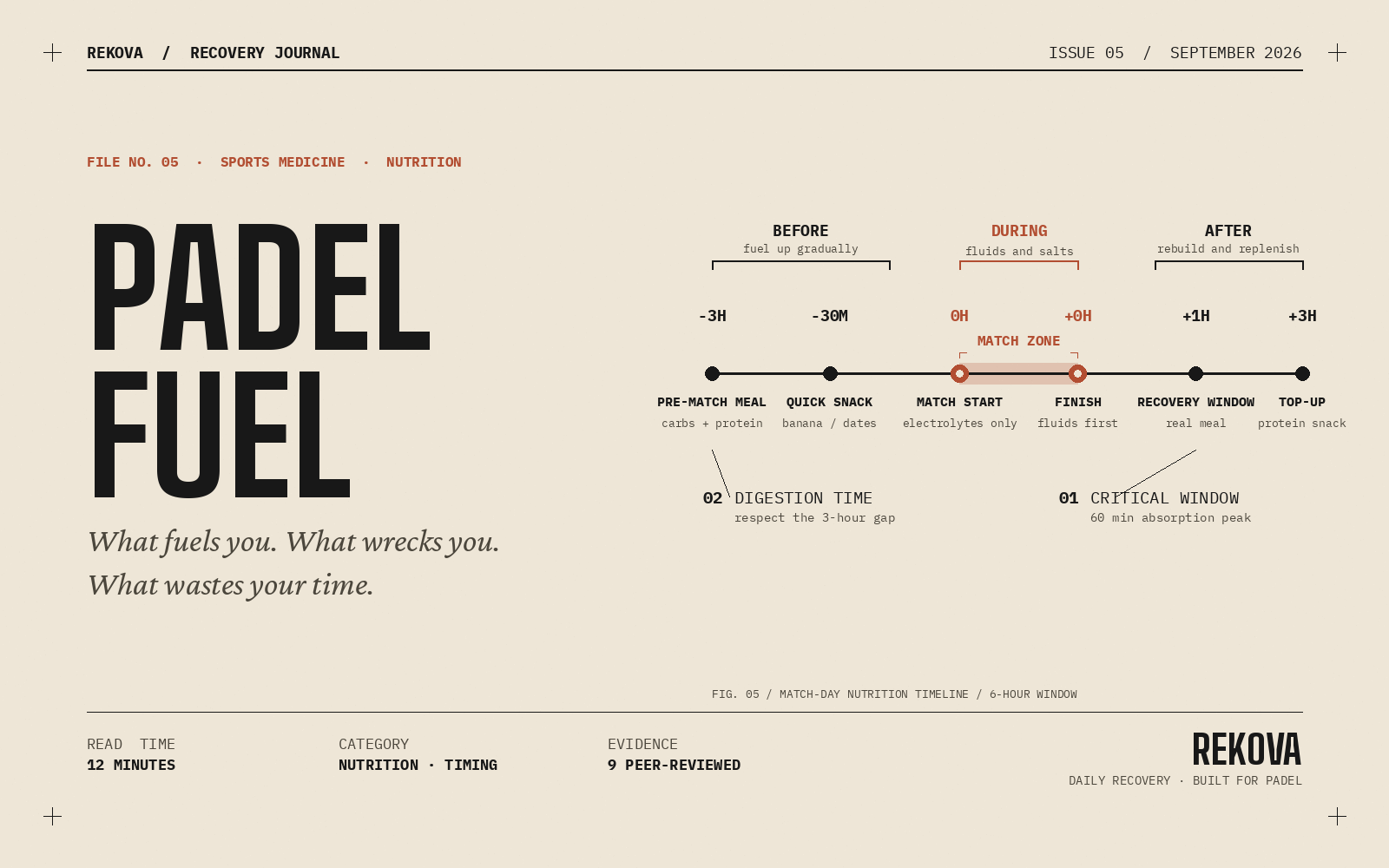
A meal containing carbohydrates 2 to 3 hours before play. Around 1 gram of carbs per kilogram of body weight is a reasonable target for amateur players. So a 75 kg player wants about 75 grams of carbs in that pre-match meal. Rice with chicken. Pasta with vegetables and protein. A sandwich with substance. Doesn't have to be fancy.
A small snack 30 to 60 minutes before play if your last meal was more than 3 hours ago. A banana. A handful of dates. A small piece of bread with honey. The point isn't more carbs in absolute terms. It's having something quick-digesting in your system so your blood sugar is stable when you start.
Skip the heavy fats and high fiber in the immediate pre-match window. They digest slowly and can leave you bloated on court. Save the avocado, the nuts, the bean salad for other meals.
Skip the protein-heavy pre-match meal too. Protein digestion is slower and doesn't help acute performance. Keep protein for the post-match meal or earlier in the day.
For morning matches the math is different. If you play at 9 AM, you've slept most of the night and your glycogen is partially depleted. You can either have a small breakfast 60 to 90 minutes before, toast with honey and a banana works well, or play fasted with a banana right before. I tested both. I play better with the small breakfast. Some players prefer fasted. Try both and see.
By 7 PM their blood sugar has dropped. Their muscle glycogen is depleted from a normal day of work and not topped up by any specific match prep. They feel okay walking in. They crash by the second set. I lived this version of myself for the first year and a half I played.
What the research consistently lands on for pre-match eating.
A meal containing carbohydrates 2 to 3 hours before play. Around 1 gram of carbs per kilogram of body weight is a reasonable target for amateur players. So a 75 kg player wants about 75 grams of carbs in that pre-match meal. Rice with chicken. Pasta with vegetables and protein. A sandwich with substance. Doesn't have to be fancy.
A small snack 30 to 60 minutes before play if your last meal was more than 3 hours ago. A banana. A handful of dates. A small piece of bread with honey. The point isn't more carbs in absolute terms. It's having something quick-digesting in your system so your blood sugar is stable when you start.
Skip the heavy fats and high fiber in the immediate pre-match window. They digest slowly and can leave you bloated on court. Save the avocado, the nuts, the bean salad for other meals.
Skip the protein-heavy pre-match meal too. Protein digestion is slower and doesn't help acute performance. Keep protein for the post-match meal or earlier in the day.
For morning matches the math is different. If you play at 9 AM, you've slept most of the night and your glycogen is partially depleted. You can either have a small breakfast 60 to 90 minutes before, toast with honey and a banana works well, or play fasted with a banana right before. I tested both. I play better with the small breakfast. Some players prefer fasted. Try both and see.
During the match: when fueling actually matters
For a normal 90 minute match in cool conditions, you don't need to eat during play. Water with electrolytes is enough.
For matches over 90 minutes, hot conditions, or back-to-back matches on the same day, you do.
The simple rule. 20 to 30 grams of carbohydrates every 30 to 45 minutes if you're playing extended sessions.
What works in practice. A banana between sets. Half a date bar. A few gulps of an isotonic drink. Some chopped fruit. Anything quickly digestible that delivers carbs without sitting in your stomach.
What doesn't work. A protein bar. A handful of nuts. Anything heavy. These take too long to digest and can give you stomach discomfort during high-intensity play.
The Padel Magazine guide and Mulebar's article both make this point in slightly different words. Match-day fueling is about quick energy availability, not nutritional completeness. The complete meals come before and after.
If you're playing a tournament day with three or four matches, eat a small carb-protein snack between matches when you have 60 plus minutes of break. A sandwich. Rice with chicken. Something with carbs and a little protein. Don't try to play your fourth match on coffee and willpower. I tried this once at a club tournament. Lost both remaining matches and spent the evening with a headache.
For matches over 90 minutes, hot conditions, or back-to-back matches on the same day, you do.
The simple rule. 20 to 30 grams of carbohydrates every 30 to 45 minutes if you're playing extended sessions.
What works in practice. A banana between sets. Half a date bar. A few gulps of an isotonic drink. Some chopped fruit. Anything quickly digestible that delivers carbs without sitting in your stomach.
What doesn't work. A protein bar. A handful of nuts. Anything heavy. These take too long to digest and can give you stomach discomfort during high-intensity play.
The Padel Magazine guide and Mulebar's article both make this point in slightly different words. Match-day fueling is about quick energy availability, not nutritional completeness. The complete meals come before and after.
If you're playing a tournament day with three or four matches, eat a small carb-protein snack between matches when you have 60 plus minutes of break. A sandwich. Rice with chicken. Something with carbs and a little protein. Don't try to play your fourth match on coffee and willpower. I tried this once at a club tournament. Lost both remaining matches and spent the evening with a headache.
The post-match meal: the window people consistently skip
The first 60 minutes after a hard match is when your body is most efficient at absorbing nutrients for recovery. Muscle glycogen rebuilds fastest. Protein synthesis is upregulated. Enzymes that move nutrients into cells are at their peak.
Most amateur players completely waste this window.
What I do now within 60 minutes of finishing. A real meal with carbs and protein together. The classic recommendation is around 1 to 1.2 grams of carbs per kg body weight plus 20 to 30 grams of protein.
What this looks like in practice. Pasta with chicken and tomato sauce. Rice bowl with salmon and vegetables. A sandwich with turkey and some salad on the side. Greek yogurt with granola and fruit. Nothing fancy. Real food.
What doesn't work. Getting home at 10 PM after an evening match and skipping dinner because you're tired. Eating cookies and a beer as dinner. Waiting two hours to eat anything because you got distracted by your phone or by stopping for drinks with the doubles partners.
The carb component matters because your muscle glycogen got depleted during play. The protein component matters because there's been muscle damage that needs repair. Skip either and your recovery suffers.
If you genuinely can't manage a real meal within 60 minutes, a decent compromise is a recovery drink with both carbs and protein, plus a real meal within 90 to 120 minutes. Not ideal. Workable.
Most amateur players completely waste this window.
What I do now within 60 minutes of finishing. A real meal with carbs and protein together. The classic recommendation is around 1 to 1.2 grams of carbs per kg body weight plus 20 to 30 grams of protein.
What this looks like in practice. Pasta with chicken and tomato sauce. Rice bowl with salmon and vegetables. A sandwich with turkey and some salad on the side. Greek yogurt with granola and fruit. Nothing fancy. Real food.
What doesn't work. Getting home at 10 PM after an evening match and skipping dinner because you're tired. Eating cookies and a beer as dinner. Waiting two hours to eat anything because you got distracted by your phone or by stopping for drinks with the doubles partners.
The carb component matters because your muscle glycogen got depleted during play. The protein component matters because there's been muscle damage that needs repair. Skip either and your recovery suffers.
If you genuinely can't manage a real meal within 60 minutes, a decent compromise is a recovery drink with both carbs and protein, plus a real meal within 90 to 120 minutes. Not ideal. Workable.
Daily nutrition: what really moves the needle
Match day nutrition gets all the attention. Daily nutrition is what actually determines how you perform and recover.
If you eat poorly six days a week and then try to dial in your match-day food perfectly, you'll still play and recover badly. Your match-day decisions are a top layer on a foundation that's built throughout the week.
The basics that matter for any amateur athlete playing several times a week.
Enough total calories. Most amateurs I know undereat slightly on match weeks because they're busy and stressed. This catches up with you.
Protein around 1.6 to 2 grams per kilogram of body weight per day. Spread across three or four meals. Not all in one shake at night. A 75 kg player wants 120 to 150 grams of protein daily, ideally 30 to 40 grams per meal.
Adequate carbs to fuel your training volume. If you're playing three or four times a week plus strength sessions, you need real carbs. Not the demonized version. Rice, pasta, bread, potatoes, fruit. The stuff humans have been eating forever.
Vegetables and fruit for micronutrients. Five servings minimum. More is better. Variety matters because different produce delivers different vitamins and minerals.
Some healthy fats. Olive oil, nuts, fatty fish, avocado. These matter for hormones, joint health, and general inflammation control.
Limited processed junk and ultra-processed snacks. Not zero. Just limited. The bag of crisps after a match isn't going to derail you. The bag of crisps as your evening meal five times a week will.
That's it. No magic. No special padel diet. Just sensible eating with enough food to support your activity level.
If you eat poorly six days a week and then try to dial in your match-day food perfectly, you'll still play and recover badly. Your match-day decisions are a top layer on a foundation that's built throughout the week.
The basics that matter for any amateur athlete playing several times a week.
Enough total calories. Most amateurs I know undereat slightly on match weeks because they're busy and stressed. This catches up with you.
Protein around 1.6 to 2 grams per kilogram of body weight per day. Spread across three or four meals. Not all in one shake at night. A 75 kg player wants 120 to 150 grams of protein daily, ideally 30 to 40 grams per meal.
Adequate carbs to fuel your training volume. If you're playing three or four times a week plus strength sessions, you need real carbs. Not the demonized version. Rice, pasta, bread, potatoes, fruit. The stuff humans have been eating forever.
Vegetables and fruit for micronutrients. Five servings minimum. More is better. Variety matters because different produce delivers different vitamins and minerals.
Some healthy fats. Olive oil, nuts, fatty fish, avocado. These matter for hormones, joint health, and general inflammation control.
Limited processed junk and ultra-processed snacks. Not zero. Just limited. The bag of crisps after a match isn't going to derail you. The bag of crisps as your evening meal five times a week will.
That's it. No magic. No special padel diet. Just sensible eating with enough food to support your activity level.
Common mistakes I see at the club
Skipping breakfast on match days. The morning you play in the evening, you should be eating slightly more than usual, not less. Stress and busy work days don't change this.
Eating a heavy lunch right before play. Pasta carbonara at 1 PM for a 2 PM match is going to sit in your stomach. Give yourself 2 to 3 hours for digestion.
Drinking calories instead of eating food. Smoothies and shakes have their place. They're not full substitutes for actual meals with mixed macronutrients across the day.
Trying intermittent fasting on training days. Some people do this fine. Most amateurs trying it for fat loss find their performance crashes. If you want to try fasting protocols, do them on rest days, not on days you play.
Cutting carbs aggressively while playing three or four times a week. This is a recipe for chronic fatigue, poor recovery, and stagnant improvement. Athletes need carbs. Period.
Drinking heavily after every session. One or two drinks is fine. Five or six is sabotaging the recovery window, the protein synthesis, the sleep quality, and the next session's performance.
Ignoring breakfast for evening matches. Your breakfast nine hours before play matters more than people think. A protein-rich breakfast sets up your blood sugar stability for the entire day.
Eating the same five foods on rotation. Micronutrient diversity matters. Eating only chicken, rice, and broccoli for a year leaves gaps you won't notice immediately but will eventually.
Eating a heavy lunch right before play. Pasta carbonara at 1 PM for a 2 PM match is going to sit in your stomach. Give yourself 2 to 3 hours for digestion.
Drinking calories instead of eating food. Smoothies and shakes have their place. They're not full substitutes for actual meals with mixed macronutrients across the day.
Trying intermittent fasting on training days. Some people do this fine. Most amateurs trying it for fat loss find their performance crashes. If you want to try fasting protocols, do them on rest days, not on days you play.
Cutting carbs aggressively while playing three or four times a week. This is a recipe for chronic fatigue, poor recovery, and stagnant improvement. Athletes need carbs. Period.
Drinking heavily after every session. One or two drinks is fine. Five or six is sabotaging the recovery window, the protein synthesis, the sleep quality, and the next session's performance.
Ignoring breakfast for evening matches. Your breakfast nine hours before play matters more than people think. A protein-rich breakfast sets up your blood sugar stability for the entire day.
Eating the same five foods on rotation. Micronutrient diversity matters. Eating only chicken, rice, and broccoli for a year leaves gaps you won't notice immediately but will eventually.
Where supplements fit (the small but real role)
I'm going to keep this section short because I covered it more extensively in my articles on padel electrolytes and padel recovery.
The short version. If your daily diet is solid, you probably don't need much beyond it. If your diet is realistic but imperfect, which describes most adults playing padel several times a week, a daily multivitamin-style support layer fills real gaps.
What I'd actually flag for padel specifically. Magnesium, where EFSA confirms it contributes to normal muscle function, reduction of tiredness and fatigue, and electrolyte balance. B vitamins, where EFSA confirms they contribute to normal energy yielding metabolism. Vitamin D, especially if you play indoors or live somewhere with limited winter sunlight. Iron for women in particular and for anyone who skips red meat. Vitamin C contributes to normal collagen formation and to the reduction of tiredness and fatigue.
This is the gap a well-formulated daily recovery drink fills. The Rekova formula was built around exactly this profile. Electrolytes for what you sweat out. Magnesium and B vitamins for energy and fatigue support. Hydrolyzed collagen with vitamin C for connective tissue. CoQ10 and Acetyl-L-Carnitine for daily cellular support. Adaptogens and antioxidants on top. One sachet mixed with water, usually after the match or in the evening.
Not a meal replacement. Not a magic recovery cure. A daily nutritional baseline that complements normal food.
The short version. If your daily diet is solid, you probably don't need much beyond it. If your diet is realistic but imperfect, which describes most adults playing padel several times a week, a daily multivitamin-style support layer fills real gaps.
What I'd actually flag for padel specifically. Magnesium, where EFSA confirms it contributes to normal muscle function, reduction of tiredness and fatigue, and electrolyte balance. B vitamins, where EFSA confirms they contribute to normal energy yielding metabolism. Vitamin D, especially if you play indoors or live somewhere with limited winter sunlight. Iron for women in particular and for anyone who skips red meat. Vitamin C contributes to normal collagen formation and to the reduction of tiredness and fatigue.
This is the gap a well-formulated daily recovery drink fills. The Rekova formula was built around exactly this profile. Electrolytes for what you sweat out. Magnesium and B vitamins for energy and fatigue support. Hydrolyzed collagen with vitamin C for connective tissue. CoQ10 and Acetyl-L-Carnitine for daily cellular support. Adaptogens and antioxidants on top. One sachet mixed with water, usually after the match or in the evening.
Not a meal replacement. Not a magic recovery cure. A daily nutritional baseline that complements normal food.
Special situations
Early morning matches before work. If you play at 7 AM, you can either play fasted with a banana right before or have a small light breakfast (toast, honey, banana) about 60 minutes before. Avoid heavy or fatty breakfasts. Don't experiment with new foods on match days.
Late evening matches after work. Make sure you're not running on lunch from seven hours ago. Have a real snack around 4 to 5 PM if your match is at 7 to 8 PM. Carbs and a small amount of protein. After the match, even though it's late, eat something. Going to bed hungry sabotages your overnight recovery.
Tournament days with multiple matches. Plan your meals like a schedule. Real breakfast 2 to 3 hours before first match. Light snack between matches. Real food for any break over 90 minutes. Real meal within 60 minutes of last match. Hydrate continuously throughout.
Travel and tournaments away from home. The biggest risk is unfamiliar food disrupting your routine. Bring backup options you trust. Some bananas. Energy bars you've used before. Maybe a small jar of nut butter. Reliable beats optimal when you're not in your kitchen.
Hot summer matches. Eat slightly lighter pre-match and prioritize hydration. The heat will already stress your digestive system. Don't pile a heavy meal on top.
Match days with limited time to eat. A decent compromise meal that takes 5 minutes. Greek yogurt with honey, granola, and a banana. Or a sandwich with turkey, hummus, and some salad. Not optimal. Workable.
Late evening matches after work. Make sure you're not running on lunch from seven hours ago. Have a real snack around 4 to 5 PM if your match is at 7 to 8 PM. Carbs and a small amount of protein. After the match, even though it's late, eat something. Going to bed hungry sabotages your overnight recovery.
Tournament days with multiple matches. Plan your meals like a schedule. Real breakfast 2 to 3 hours before first match. Light snack between matches. Real food for any break over 90 minutes. Real meal within 60 minutes of last match. Hydrate continuously throughout.
Travel and tournaments away from home. The biggest risk is unfamiliar food disrupting your routine. Bring backup options you trust. Some bananas. Energy bars you've used before. Maybe a small jar of nut butter. Reliable beats optimal when you're not in your kitchen.
Hot summer matches. Eat slightly lighter pre-match and prioritize hydration. The heat will already stress your digestive system. Don't pile a heavy meal on top.
Match days with limited time to eat. A decent compromise meal that takes 5 minutes. Greek yogurt with honey, granola, and a banana. Or a sandwich with turkey, hummus, and some salad. Not optimal. Workable.
FAQ: questions players actually ask
What should I eat for breakfast before a morning padel match? Carbs with a little protein, eaten 60 to 90 minutes before play. Toast with honey and an egg. Oatmeal with fruit. Greek yogurt with granola. Avoid heavy fats and high fiber right before play.
Should I do intermittent fasting if I play padel? Probably not on training days. Fasting compounds the fuel deficit caused by hard play. If you want to try fasting, restrict it to rest days. Fueling matters for adaptation.
How long after eating should I wait to play? 2 to 3 hours for a real meal. 30 to 60 minutes for a small snack. Less than that and you risk stomach discomfort during play.
Do I need protein right after the match? Yes, especially if you play multiple times a week. 20 to 30 grams within the recovery window helps muscle repair and adaptation. Doesn't have to be a shake. Real food works.
Can I drink beer after a match? In moderation. One or two drinks won't ruin you. Five or six will. Drink water and electrolytes first, eat real food second, then enjoy the social part if you want.
Is keto compatible with playing padel? Possible but harder. Most padel players perform better on a diet that includes adequate carbs. If you want to be keto, accept that your initial weeks of adaptation will feel worse on court, and that your peak performance may be slightly lower than it would be on a moderate-carb diet.
Should I count calories? Most amateurs don't need to. Eat real food. Eat enough. Adjust based on energy levels, recovery, and body composition changes. If something is off, then tracking for a few weeks can show you what's actually happening.
Are sports nutrition products worth it? Some yes, some no. Carbohydrate gels and isotonic drinks during long matches have real evidence. Protein powders are fine as a convenient supplement to real food. Most pre-workouts are overpriced caffeine. Look at the actual ingredients and doses on the label.
What's the single best food for padel? There isn't one. Variety matters more than any single optimal food. The closest thing to a universal recommendation is real meals with carbs and protein, eaten at sensible times around play.
Should I do intermittent fasting if I play padel? Probably not on training days. Fasting compounds the fuel deficit caused by hard play. If you want to try fasting, restrict it to rest days. Fueling matters for adaptation.
How long after eating should I wait to play? 2 to 3 hours for a real meal. 30 to 60 minutes for a small snack. Less than that and you risk stomach discomfort during play.
Do I need protein right after the match? Yes, especially if you play multiple times a week. 20 to 30 grams within the recovery window helps muscle repair and adaptation. Doesn't have to be a shake. Real food works.
Can I drink beer after a match? In moderation. One or two drinks won't ruin you. Five or six will. Drink water and electrolytes first, eat real food second, then enjoy the social part if you want.
Is keto compatible with playing padel? Possible but harder. Most padel players perform better on a diet that includes adequate carbs. If you want to be keto, accept that your initial weeks of adaptation will feel worse on court, and that your peak performance may be slightly lower than it would be on a moderate-carb diet.
Should I count calories? Most amateurs don't need to. Eat real food. Eat enough. Adjust based on energy levels, recovery, and body composition changes. If something is off, then tracking for a few weeks can show you what's actually happening.
Are sports nutrition products worth it? Some yes, some no. Carbohydrate gels and isotonic drinks during long matches have real evidence. Protein powders are fine as a convenient supplement to real food. Most pre-workouts are overpriced caffeine. Look at the actual ingredients and doses on the label.
What's the single best food for padel? There isn't one. Variety matters more than any single optimal food. The closest thing to a universal recommendation is real meals with carbs and protein, eaten at sensible times around play.
The short version
Padel demands real fuel. Carbs before, electrolytes during, carbs plus protein after. Daily nutrition matters more than perfect match day decisions. The biggest mistake amateurs make is showing up to evening matches having eaten lunch six hours earlier. The second biggest mistake is skipping the post-match meal. Get the basics right consistently and you'll perform better and recover faster than 90 percent of players at your club without any expensive supplements or fancy diets.
Real food. Enough of it. The right timing. That's almost the whole game.
Real food. Enough of it. The right timing. That's almost the whole game.
Sources
Marcos Rivero B. et al. Evolution of Physiological Responses and Fatigue Analysis in Padel Matches According to Match Outcome and Playing Position. Sensors. August 2025.
Healthspan Elite. Padel: what is it and how should you fuel your game? Knowledge Hub. 2025.
Padel Magazine. Padel and nutrition: what to eat before, during and after a match. 2025.
Padel39. Nutrition tips for long padel matches and quick recovery. 2025.
Mulebar. Sports nutrition for padel: improve your performance with the right diet. December 2025.
Enervit. Supplementation for padel. 2022.
EFSA. Scientific Opinions on the substantiation of health claims related to magnesium, B vitamins, iron, vitamin C, vitamin D, and carbohydrates. EFSA Journal, various years.
HSN Store. Supplements for Padel: helping you choose the best. November 2025.
Sevilla Padel Experience. Pre and post workout nutrition for padel players. 2024.
This article shares my own experience playing padel and reflects current sports nutrition research. It's not medical or dietary advice. If you have any underlying condition, food allergy, or specific dietary need, please consult a qualified healthcare professional or registered dietitian before changing your eating patterns.
Rekova is not a meal replacement. It's a daily functional drink with electrolytes, magnesium, B vitamins, CoQ10, Acetyl-L-Carnitine, hydrolyzed collagen, and supporting nutrients, formulated as nutritional support for people who play padel regularly.
Healthspan Elite. Padel: what is it and how should you fuel your game? Knowledge Hub. 2025.
Padel Magazine. Padel and nutrition: what to eat before, during and after a match. 2025.
Padel39. Nutrition tips for long padel matches and quick recovery. 2025.
Mulebar. Sports nutrition for padel: improve your performance with the right diet. December 2025.
Enervit. Supplementation for padel. 2022.
EFSA. Scientific Opinions on the substantiation of health claims related to magnesium, B vitamins, iron, vitamin C, vitamin D, and carbohydrates. EFSA Journal, various years.
HSN Store. Supplements for Padel: helping you choose the best. November 2025.
Sevilla Padel Experience. Pre and post workout nutrition for padel players. 2024.
This article shares my own experience playing padel and reflects current sports nutrition research. It's not medical or dietary advice. If you have any underlying condition, food allergy, or specific dietary need, please consult a qualified healthcare professional or registered dietitian before changing your eating patterns.
Rekova is not a meal replacement. It's a daily functional drink with electrolytes, magnesium, B vitamins, CoQ10, Acetyl-L-Carnitine, hydrolyzed collagen, and supporting nutrients, formulated as nutritional support for people who play padel regularly.
