A 12 minute read. Updated July 2026.
My doubles partner is 52. He's a lawyer in Madrid, runs half-marathons on weekends, and plays padel four times a week. Last summer we played five matches across three days during a club tournament. By Saturday afternoon I was destroyed. Dragging myself between games. Eating ibuprofen like candy. He was the same in match five as in match one. Fresh legs, sharp tactics, no visible accumulated fatigue.
I'm 35. By every basic metric I should have the energy advantage. He's older. Lives in a high-stress career. Probably gets less sleep than I do.
Instead I spent most of that Sunday in bed.
After the tournament I started reading. Then asking him questions over post-match drinks. Then changing things in my own routine. Within about three months I stopped being the guy who crashed in the third set. I'm still not as fresh as he is at match five of a weekend, but the gap closed dramatically.
Here's what I learned about fatigue and how it actually works in this sport. With as little marketing nonsense as I can manage.
What fatigue actually means (because it's not one thing)
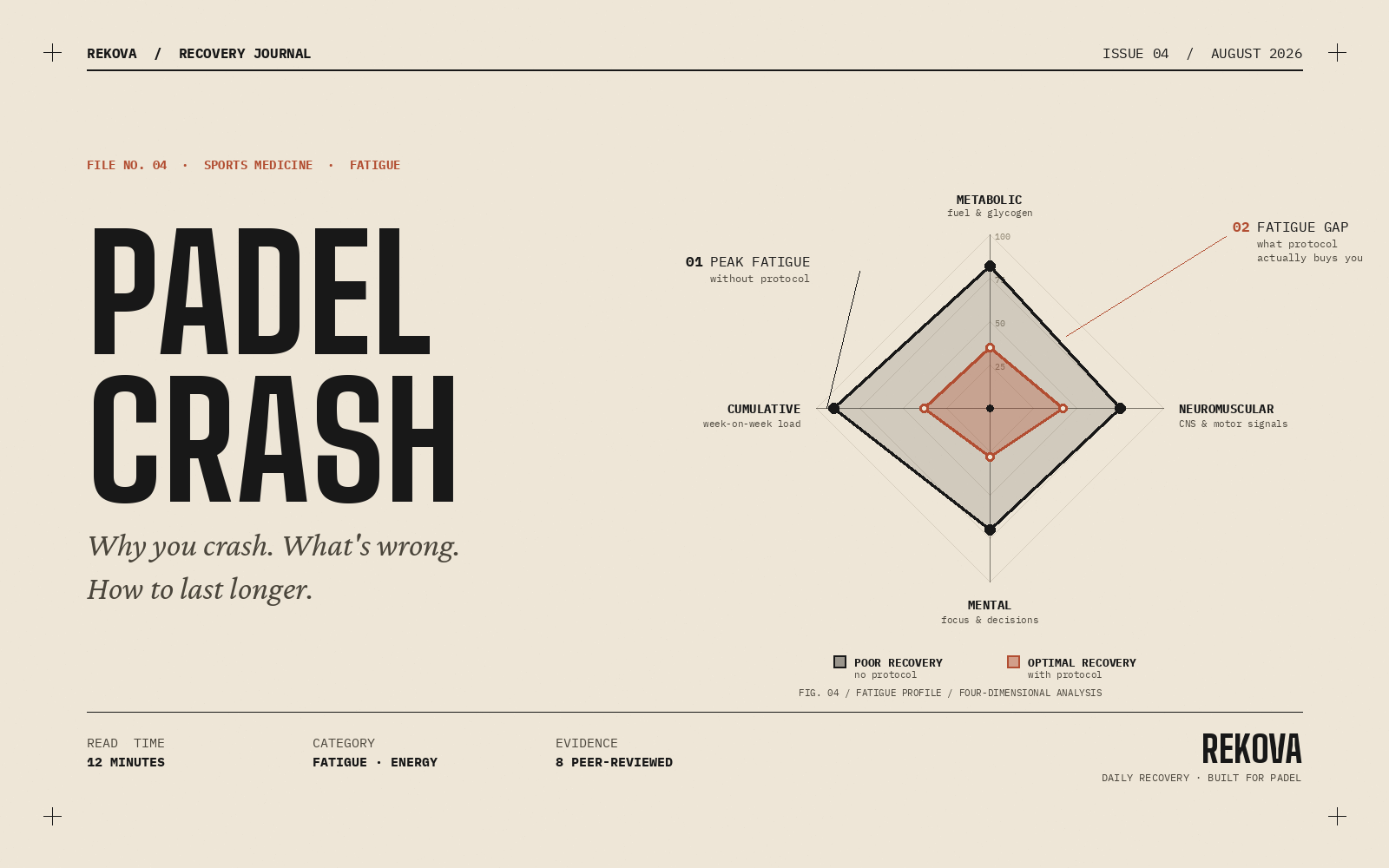
When you say you're tired after a padel match, you could mean three or four different things. Each has a different physiological cause. Each needs a different solution.
Metabolic fatigue is when your muscles run out of fuel or your hydration drops. Glycogen depletion, electrolyte imbalance, blood sugar crashes. This is the kind of tired that comes on suddenly in the third set when your legs go heavy and you can't generate any explosive movement.
Neuromuscular fatigue is when your nervous system stops sending the same signals to your muscles. The contraction is weaker. Reaction time slows. Coordination drops. The Sensors study from August 2025 measured countermovement jump performance and grip strength dropping significantly across sets in amateur padel matches. Not because the muscles failed. Because the nervous system stopped firing them at full intensity.
Mental fatigue is when your decision making gets slower and worse. You start hitting balls into the same patterns instead of reading the play. You miss easy volleys because your eyes saw the ball but your brain didn't process it fast enough.
Cumulative fatigue is what builds across a week of playing. Each individual match might feel okay but by Friday you've got nothing left.
Most articles about padel fatigue treat all four as the same thing. They aren't. The solutions look completely different depending on which one is actually getting you.
Metabolic fatigue is when your muscles run out of fuel or your hydration drops. Glycogen depletion, electrolyte imbalance, blood sugar crashes. This is the kind of tired that comes on suddenly in the third set when your legs go heavy and you can't generate any explosive movement.
Neuromuscular fatigue is when your nervous system stops sending the same signals to your muscles. The contraction is weaker. Reaction time slows. Coordination drops. The Sensors study from August 2025 measured countermovement jump performance and grip strength dropping significantly across sets in amateur padel matches. Not because the muscles failed. Because the nervous system stopped firing them at full intensity.
Mental fatigue is when your decision making gets slower and worse. You start hitting balls into the same patterns instead of reading the play. You miss easy volleys because your eyes saw the ball but your brain didn't process it fast enough.
Cumulative fatigue is what builds across a week of playing. Each individual match might feel okay but by Friday you've got nothing left.
Most articles about padel fatigue treat all four as the same thing. They aren't. The solutions look completely different depending on which one is actually getting you.
Metabolic fatigue: when your engine runs out of fuel
The simplest one to understand. You're running on a finite supply of stuff.
Padel matches at typical intensity burn through muscle glycogen at about 1 to 2 grams per minute. A 90 minute match easily drains 90 to 180 grams of muscle glycogen. Your total muscle glycogen storage is around 400 to 500 grams. So one match takes 20 to 40 percent of your reserves.
If you start the match already low on glycogen because you skipped lunch or are on a low-carb diet, you crash earlier. Simple as that.
The Padel39 nutrition guide and the Healthspan Elite article both land on similar pre-match recommendations. Moderate carbs around 1 gram per kg of body weight, 2 to 3 hours before play. Plus a small snack like a banana 30 minutes before.
Add to glycogen depletion the electrolyte and fluid loss I covered in my separate article on padel hydration. Sweating out 1.5 liters with sodium, potassium, and magnesium means your muscle contraction efficiency drops. By the third set everything feels heavier than it should.
This kind of fatigue responds quickly to intervention. Drink electrolytes mid-match. Have a banana between sets. Take 20 to 30 grams of carbs every 30 minutes if you're playing multiple matches in a day.
If your fatigue comes on suddenly mid-match and you feel shaky or light-headed, this is almost always metabolic. Not training. Not age. You just ran out of fuel.
Padel matches at typical intensity burn through muscle glycogen at about 1 to 2 grams per minute. A 90 minute match easily drains 90 to 180 grams of muscle glycogen. Your total muscle glycogen storage is around 400 to 500 grams. So one match takes 20 to 40 percent of your reserves.
If you start the match already low on glycogen because you skipped lunch or are on a low-carb diet, you crash earlier. Simple as that.
The Padel39 nutrition guide and the Healthspan Elite article both land on similar pre-match recommendations. Moderate carbs around 1 gram per kg of body weight, 2 to 3 hours before play. Plus a small snack like a banana 30 minutes before.
Add to glycogen depletion the electrolyte and fluid loss I covered in my separate article on padel hydration. Sweating out 1.5 liters with sodium, potassium, and magnesium means your muscle contraction efficiency drops. By the third set everything feels heavier than it should.
This kind of fatigue responds quickly to intervention. Drink electrolytes mid-match. Have a banana between sets. Take 20 to 30 grams of carbs every 30 minutes if you're playing multiple matches in a day.
If your fatigue comes on suddenly mid-match and you feel shaky or light-headed, this is almost always metabolic. Not training. Not age. You just ran out of fuel.
Neuromuscular fatigue: when your nervous system taps out
This is the one people understand least.
Your muscles don't contract on their own. Your central nervous system sends signals through motor neurons that trigger the contraction. Repeated high-intensity work fatigues the nervous system as much as the muscles themselves. Often more.
The Diaz Garcia study from 2023 on professional padel tournaments found measurable drops in reaction time and mental toughness across multi-day competitions. The mechanism wasn't muscular weakness. It was central nervous system fatigue accumulating across matches.
Signs that your fatigue is CNS-driven. Your jumps feel sluggish even after rest. Your reaction time to balls is just off. You feel mentally drained more than physically wrecked. Your sleep gets worse instead of better when you'd expect exhaustion to help you sleep.
The fix isn't more carbs or electrolytes. It's recovery time and sleep quality. CNS fatigue can take 48 to 72 hours to fully clear. If you stack three hard matches in three days, you don't have time to recover between them.
Magnesium has a real role here. EFSA confirms that magnesium contributes to normal functioning of the nervous system, normal muscle function, and reduction of tiredness and fatigue. Most European adults run low on it. Athletes lose more through sweat. The deficiency makes CNS recovery slower across the week.
This is also where adaptogenic herbs come into the conversation. Ashwagandha and Rhodiola have a long traditional use for supporting stress response, and there's an emerging body of research looking at their effects on athletic recovery. The European regulatory situation is conservative here, no official health claims have been approved, but the research signal is real for those interested in digging deeper.
L-theanine is interesting too. Studied for promoting a state of calm focus without the sedation of typical relaxants. Some athletes use it for the mental side of recovery before sleep.
Your muscles don't contract on their own. Your central nervous system sends signals through motor neurons that trigger the contraction. Repeated high-intensity work fatigues the nervous system as much as the muscles themselves. Often more.
The Diaz Garcia study from 2023 on professional padel tournaments found measurable drops in reaction time and mental toughness across multi-day competitions. The mechanism wasn't muscular weakness. It was central nervous system fatigue accumulating across matches.
Signs that your fatigue is CNS-driven. Your jumps feel sluggish even after rest. Your reaction time to balls is just off. You feel mentally drained more than physically wrecked. Your sleep gets worse instead of better when you'd expect exhaustion to help you sleep.
The fix isn't more carbs or electrolytes. It's recovery time and sleep quality. CNS fatigue can take 48 to 72 hours to fully clear. If you stack three hard matches in three days, you don't have time to recover between them.
Magnesium has a real role here. EFSA confirms that magnesium contributes to normal functioning of the nervous system, normal muscle function, and reduction of tiredness and fatigue. Most European adults run low on it. Athletes lose more through sweat. The deficiency makes CNS recovery slower across the week.
This is also where adaptogenic herbs come into the conversation. Ashwagandha and Rhodiola have a long traditional use for supporting stress response, and there's an emerging body of research looking at their effects on athletic recovery. The European regulatory situation is conservative here, no official health claims have been approved, but the research signal is real for those interested in digging deeper.
L-theanine is interesting too. Studied for promoting a state of calm focus without the sedation of typical relaxants. Some athletes use it for the mental side of recovery before sleep.
Mental fatigue: when your brain gives out before your body
Padel is more cognitively demanding than people realize.
Every point you're tracking the ball, anticipating opponent positioning, reading partner movement, choosing shot selection, predicting wall bounces. Multiple decisions per second over the course of a match.
A 2024 review by Marcos Rivero and colleagues identified mental fatigue as a major performance factor in racquet sports. As players accumulate matches, decision quality drops measurably. Reaction time slows. Tactical errors increase. The interesting finding was that losing players showed significantly elevated anger, fatigue, and depression scores after three-set matches compared to winning players, suggesting that mental fatigue and outcome interact in ways most people don't account for.
I notice this in myself by about match three of a tournament day. I stop reading the game and start just hitting balls. My partner has to point out tactical opportunities I would have spotted easily in match one.
What I do for it now:
Between matches I find a quiet corner for ten minutes. No phone, no conversations, eyes closed if possible. Just breathing. Sounds dumb. Makes a real difference.
Caffeine has decent research support for offsetting mental fatigue. 100 to 200 mg about 45 minutes before a match if you've already played earlier that day. More than that and you'll be jittery without being sharper.
Adequate sleep the night before is non-negotiable for mental performance. Sleeping six hours instead of seven and a half feels manageable in daily life. On the court it shows up as slower reactions and worse decisions.
The B vitamin family is involved in brain energy metabolism. EFSA confirms several B vitamins contribute to normal psychological function and to the reduction of tiredness and fatigue. B1, B2, B3, B5, B6, B12 all show up in approved claims related to mental energy.
Every point you're tracking the ball, anticipating opponent positioning, reading partner movement, choosing shot selection, predicting wall bounces. Multiple decisions per second over the course of a match.
A 2024 review by Marcos Rivero and colleagues identified mental fatigue as a major performance factor in racquet sports. As players accumulate matches, decision quality drops measurably. Reaction time slows. Tactical errors increase. The interesting finding was that losing players showed significantly elevated anger, fatigue, and depression scores after three-set matches compared to winning players, suggesting that mental fatigue and outcome interact in ways most people don't account for.
I notice this in myself by about match three of a tournament day. I stop reading the game and start just hitting balls. My partner has to point out tactical opportunities I would have spotted easily in match one.
What I do for it now:
Between matches I find a quiet corner for ten minutes. No phone, no conversations, eyes closed if possible. Just breathing. Sounds dumb. Makes a real difference.
Caffeine has decent research support for offsetting mental fatigue. 100 to 200 mg about 45 minutes before a match if you've already played earlier that day. More than that and you'll be jittery without being sharper.
Adequate sleep the night before is non-negotiable for mental performance. Sleeping six hours instead of seven and a half feels manageable in daily life. On the court it shows up as slower reactions and worse decisions.
The B vitamin family is involved in brain energy metabolism. EFSA confirms several B vitamins contribute to normal psychological function and to the reduction of tiredness and fatigue. B1, B2, B3, B5, B6, B12 all show up in approved claims related to mental energy.
Cumulative fatigue: what builds across the week
This was my biggest mistake when I started playing seriously.
I played Monday, Tuesday, Wednesday, Friday, Saturday. Five sessions. Felt fine the first three. Started fading on Friday. Saturday I was just going through the motions.
The issue wasn't any single match. It was the cumulative load with insufficient recovery between sessions.
Most amateur players underestimate how much rest they need between hard sessions. The rule of thumb from sports science is two consecutive hard days max before either a rest day or an easy day. Three or four hard days in a row without a break is the fast track to overuse injuries, chronic fatigue, and stagnant performance.
What changed for me. I switched to three padel sessions plus two strength sessions across the week, with at least one full rest day. Total training volume similar. But the spacing matters more than the total hours.
My 52 year old partner who outlasts me in tournaments? He plays four padel sessions a week but two of them are deliberately low intensity. He calls them feel-good sessions. The focus is fun, not competitive performance. The result is he never accumulates the kind of fatigue I used to.
I played Monday, Tuesday, Wednesday, Friday, Saturday. Five sessions. Felt fine the first three. Started fading on Friday. Saturday I was just going through the motions.
The issue wasn't any single match. It was the cumulative load with insufficient recovery between sessions.
Most amateur players underestimate how much rest they need between hard sessions. The rule of thumb from sports science is two consecutive hard days max before either a rest day or an easy day. Three or four hard days in a row without a break is the fast track to overuse injuries, chronic fatigue, and stagnant performance.
What changed for me. I switched to three padel sessions plus two strength sessions across the week, with at least one full rest day. Total training volume similar. But the spacing matters more than the total hours.
My 52 year old partner who outlasts me in tournaments? He plays four padel sessions a week but two of them are deliberately low intensity. He calls them feel-good sessions. The focus is fun, not competitive performance. The result is he never accumulates the kind of fatigue I used to.
The mitochondria conversation, briefly
You can't read about energy and fatigue without bumping into mitochondria. These are the cellular structures that produce ATP, the molecular currency of energy.
The marketing around mitochondrial support supplements is wild. I want to be careful with what I claim here.
What's real. Mitochondrial density and function are major determinants of endurance performance. Training is by far the most effective way to improve them. Period.
What's also real. Certain nutrients are involved in mitochondrial function. Coenzyme Q10 plays a role in the electron transport chain. Acetyl-L-Carnitine is involved in transporting fatty acids into mitochondria for energy production. These are basic physiological facts.
What I cannot tell you and won't pretend to. That taking a CoQ10 supplement at the doses found in most products will make you noticeably less tired during your padel matches. The research on CoQ10 supplementation in healthy adults is mixed. It seems to have more benefit in people who are deficient or older than in young trained athletes.
If you ask me whether to take these things specifically for energy, I'd say. They probably don't hurt. The evidence is decent but not overwhelming. They're more interesting as part of a broader nutritional baseline than as miracle pills.
For what it's worth, the Rekova formula includes both CoQ10 and Acetyl-L-Carnitine alongside electrolytes, magnesium, B vitamins, and other ingredients. The thinking is that for someone playing three or more times a week, a comprehensive daily baseline is more useful than buying ten separate bottles and trying to time each one. One sachet covers a lot of bases.
It's not a substitute for training. It won't turn you into your 52 year old partner. But for the daily layer of support that builds up across weeks and months, the formula was built around the actual stuff that matters for padel-specific demand.
The marketing around mitochondrial support supplements is wild. I want to be careful with what I claim here.
What's real. Mitochondrial density and function are major determinants of endurance performance. Training is by far the most effective way to improve them. Period.
What's also real. Certain nutrients are involved in mitochondrial function. Coenzyme Q10 plays a role in the electron transport chain. Acetyl-L-Carnitine is involved in transporting fatty acids into mitochondria for energy production. These are basic physiological facts.
What I cannot tell you and won't pretend to. That taking a CoQ10 supplement at the doses found in most products will make you noticeably less tired during your padel matches. The research on CoQ10 supplementation in healthy adults is mixed. It seems to have more benefit in people who are deficient or older than in young trained athletes.
If you ask me whether to take these things specifically for energy, I'd say. They probably don't hurt. The evidence is decent but not overwhelming. They're more interesting as part of a broader nutritional baseline than as miracle pills.
For what it's worth, the Rekova formula includes both CoQ10 and Acetyl-L-Carnitine alongside electrolytes, magnesium, B vitamins, and other ingredients. The thinking is that for someone playing three or more times a week, a comprehensive daily baseline is more useful than buying ten separate bottles and trying to time each one. One sachet covers a lot of bases.
It's not a substitute for training. It won't turn you into your 52 year old partner. But for the daily layer of support that builds up across weeks and months, the formula was built around the actual stuff that matters for padel-specific demand.
What actually changed my fatigue (in order of impact)
If I had to rank what made the biggest difference, here's the honest order.
Sleep. I went from 6 to 6.5 hours per night to 7.5 to 8. Single biggest change. Everything else combined didn't match what consistent sleep alone did.
Spacing my sessions properly. Stopped playing five days in a row. Switched to alternating hard and easy days. Took at least one full rest day per week.
Proper hydration and electrolytes during matches. Stopped relying on just water. Started carrying a bottle with actual electrolyte mix during longer sessions.
Eating properly before and after matches. Real meals on match days. Protein within an hour after playing.
Daily micronutrient support. The Rekova-style stack that fills in magnesium, B vitamins, and the other stuff that depletes across the week.
Strength training twice a week. Counterintuitive but important. Stronger muscles fatigue less under the same load.
Mental recovery practices. The ten minute quiet time between matches. Limiting screen time before bed. Not checking work email after 8 PM.
Notice what's not on this list. Cold plunges. Saunas. Compression boots. Recovery supplements with proprietary blends. Expensive micronutrient testing. These things might help marginally once you've got the basics dialed in. They are not the answer when your basics are broken.
Sleep. I went from 6 to 6.5 hours per night to 7.5 to 8. Single biggest change. Everything else combined didn't match what consistent sleep alone did.
Spacing my sessions properly. Stopped playing five days in a row. Switched to alternating hard and easy days. Took at least one full rest day per week.
Proper hydration and electrolytes during matches. Stopped relying on just water. Started carrying a bottle with actual electrolyte mix during longer sessions.
Eating properly before and after matches. Real meals on match days. Protein within an hour after playing.
Daily micronutrient support. The Rekova-style stack that fills in magnesium, B vitamins, and the other stuff that depletes across the week.
Strength training twice a week. Counterintuitive but important. Stronger muscles fatigue less under the same load.
Mental recovery practices. The ten minute quiet time between matches. Limiting screen time before bed. Not checking work email after 8 PM.
Notice what's not on this list. Cold plunges. Saunas. Compression boots. Recovery supplements with proprietary blends. Expensive micronutrient testing. These things might help marginally once you've got the basics dialed in. They are not the answer when your basics are broken.
FAQ: questions players ask about energy and fatigue
Why am I so tired after padel when other people seem fine? Could be metabolic, neural, mental, or cumulative. The diagnosis matters. Track which type fits your experience and adjust accordingly. Most people who think they're physically tired are actually under-slept and under-fed.
Is feeling exhausted normal after a single match? Some fatigue is normal. Being destroyed for the entire next day after one 90 minute match is not. If that's happening regularly, look at sleep, hydration, nutrition, and total weekly load before you assume something is wrong with you.
Does padel get easier as I improve? Yes and no. The metabolic cost stays similar but you become more efficient. Better technique means less wasted effort. Better positioning means less running. Mental load increases as you play more strategic opponents, so the cognitive demand can actually go up while the physical demand goes down.
Can supplements really help with energy? Some yes, some no. Magnesium and B vitamins have approved EFSA claims for energy metabolism and reduction of fatigue. They help if you're running low. They don't add energy if you're already topped up. The marketing for most pre-workout products is wildly oversold.
Should I drink coffee before padel? Moderate caffeine, around 100 to 200 mg about 45 minutes before play, has decent research support for performance. Don't add it if you're already drinking three coffees that morning. Diminishing returns.
How long until I notice changes if I fix my routine? Sleep changes show up within a week. Nutrition changes within two to three weeks. Training adaptations take six to twelve weeks. Be patient with the slow ones.
What about my age? Recovery does slow as you get older but probably less than people assume. My 52 year old partner outperforms most 30 year olds because his fundamentals are dialed in. Age is real. It's also overused as an excuse for bad recovery habits.
Should I get blood tests for nutrient levels? If you're chronically tired without obvious explanation, yes. Basic labs including vitamin D, B12, ferritin, and thyroid panel are worth doing. Most chronic athletic fatigue traces back to one of those plus inadequate sleep.
Is feeling exhausted normal after a single match? Some fatigue is normal. Being destroyed for the entire next day after one 90 minute match is not. If that's happening regularly, look at sleep, hydration, nutrition, and total weekly load before you assume something is wrong with you.
Does padel get easier as I improve? Yes and no. The metabolic cost stays similar but you become more efficient. Better technique means less wasted effort. Better positioning means less running. Mental load increases as you play more strategic opponents, so the cognitive demand can actually go up while the physical demand goes down.
Can supplements really help with energy? Some yes, some no. Magnesium and B vitamins have approved EFSA claims for energy metabolism and reduction of fatigue. They help if you're running low. They don't add energy if you're already topped up. The marketing for most pre-workout products is wildly oversold.
Should I drink coffee before padel? Moderate caffeine, around 100 to 200 mg about 45 minutes before play, has decent research support for performance. Don't add it if you're already drinking three coffees that morning. Diminishing returns.
How long until I notice changes if I fix my routine? Sleep changes show up within a week. Nutrition changes within two to three weeks. Training adaptations take six to twelve weeks. Be patient with the slow ones.
What about my age? Recovery does slow as you get older but probably less than people assume. My 52 year old partner outperforms most 30 year olds because his fundamentals are dialed in. Age is real. It's also overused as an excuse for bad recovery habits.
Should I get blood tests for nutrient levels? If you're chronically tired without obvious explanation, yes. Basic labs including vitamin D, B12, ferritin, and thyroid panel are worth doing. Most chronic athletic fatigue traces back to one of those plus inadequate sleep.
The short version
Padel fatigue is at least four different things. Metabolic, neuromuscular, mental, cumulative. They have different causes and different fixes. Sleep is the single biggest lever. Spacing your sessions matters more than total hours. Electrolytes, B vitamins, and magnesium fill real gaps for people playing multiple times a week. The expensive recovery industry stuff helps a little if everything else is in order. It doesn't help at all if you're sleeping six hours and eating poorly.
If you're regularly destroyed after matches, start with the boring fundamentals before you buy the fancy supplements.
If you're regularly destroyed after matches, start with the boring fundamentals before you buy the fancy supplements.
Sources
Marcos Rivero B. et al. Evolution of Physiological Responses and Fatigue Analysis in Padel Matches According to Match Outcome and Playing Position. Sensors. August 2025.
Diaz Garcia J. et al. A Multiday Professional Padel Tournament Impairs Sleep, Mental Toughness, and Reaction Time. 2023.
Healthspan Elite. Padel: what is it and how should you fuel your game? Knowledge Hub. 2025.
Padel39. Nutrition tips for long padel matches and quick recovery. 2025.
EFSA. Scientific Opinions on the substantiation of health claims related to magnesium, B vitamins, iron, and vitamin C. EFSA Journal, various years.
Bandeja Shop. Comment ameliorer sa recuperation apres un match de padel. 2025.
Padel Rumors. 7 Padel-Specific Muscle Recovery Tips for 2025. July 2025.
Mulebar. Sports nutrition for padel: improve your performance with the right diet. December 2025.
This article shares my own experience playing padel and reflects current sports science research on fatigue and recovery. It's not medical advice. If you have persistent fatigue, unexplained energy crashes, or any underlying medical condition affecting your energy levels, please consult a qualified healthcare professional. Persistent unexplained fatigue can be a symptom of conditions worth investigating.
Rekova does not treat fatigue and is not a substitute for medical evaluation. It's a daily functional drink with electrolytes, magnesium, B vitamins, CoQ10, Acetyl-L-Carnitine, hydrolyzed collagen, and supporting nutrients, formulated as nutritional support for people who play padel regularly.
Diaz Garcia J. et al. A Multiday Professional Padel Tournament Impairs Sleep, Mental Toughness, and Reaction Time. 2023.
Healthspan Elite. Padel: what is it and how should you fuel your game? Knowledge Hub. 2025.
Padel39. Nutrition tips for long padel matches and quick recovery. 2025.
EFSA. Scientific Opinions on the substantiation of health claims related to magnesium, B vitamins, iron, and vitamin C. EFSA Journal, various years.
Bandeja Shop. Comment ameliorer sa recuperation apres un match de padel. 2025.
Padel Rumors. 7 Padel-Specific Muscle Recovery Tips for 2025. July 2025.
Mulebar. Sports nutrition for padel: improve your performance with the right diet. December 2025.
This article shares my own experience playing padel and reflects current sports science research on fatigue and recovery. It's not medical advice. If you have persistent fatigue, unexplained energy crashes, or any underlying medical condition affecting your energy levels, please consult a qualified healthcare professional. Persistent unexplained fatigue can be a symptom of conditions worth investigating.
Rekova does not treat fatigue and is not a substitute for medical evaluation. It's a daily functional drink with electrolytes, magnesium, B vitamins, CoQ10, Acetyl-L-Carnitine, hydrolyzed collagen, and supporting nutrients, formulated as nutritional support for people who play padel regularly.
