A 12 minute read. Updated May 2026.
I want to start with something honest. Eight months into playing padel four times a week, I woke up one Tuesday morning and couldn't open a jar of olives with my right hand. Just couldn't. The grip wasn't there.
That was the start of my own padel elbow saga. Six weeks off the court, two physios, three braces I bought on Amazon, and a lot of late-night reading of research papers. If you're reading this, you're probably in the same boat or you can feel it coming.
So let me save you some time.
The 2023 systematic review in BMJ Open Sport and Exercise Medicine looked at data from over 2,000 padel players. Their finding was clear. The elbow is the most common injury site in this sport. Not the knee. Not the shoulder. Not the lower back. The elbow, by a wide margin.
Below is what I learned the hard way, plus what the actual science says, plus what nobody told me when I started.
So what is padel elbow exactly
Doctors call it lateral epicondylitis. Same thing tennis players get. Inflammation of the tendons attaching your forearm extensor muscles to the bony bump on the outside of your elbow.
But here's the thing nobody mentions. Padel players get this injury more often than tennis players do. Even though our sport looks easier on paper.
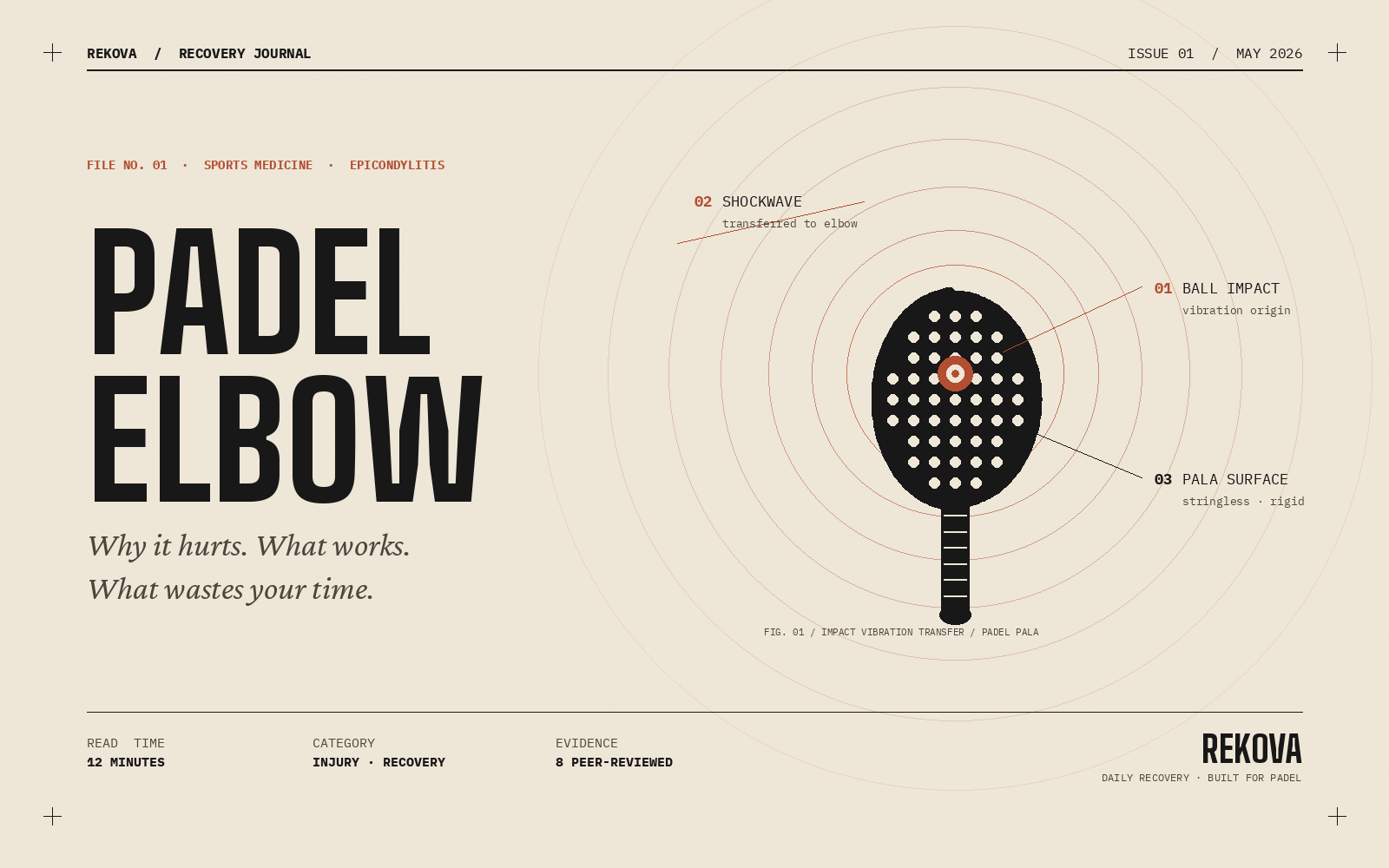
Why? The pala has no strings.
Think about it. A tennis racket has a string bed that flexes and absorbs shock at impact. A padel pala is essentially a solid foam sandwich wrapped in carbon fiber. When you hit the ball, the vibration has nowhere to go except into your hand, up your forearm, and straight into your elbow joint.
The Isokinetic Medical Group ran a detailed study on this in February 2025. Their conclusion was that padel elbow comes from repeated eccentric loading of the forearm extensors after ball contact. The forearm muscles fire to decelerate your wrist, and that deceleration is what shreds the tendon over time.
Beginners get it worse. Because we tend to strike with a bent wrist and keep flexing through contact. I did this for the entire first year I played, and looking back, I'm shocked my elbow lasted as long as it did.
One bad shot doesn't break the elbow. Ten thousand mediocre ones do.
But here's the thing nobody mentions. Padel players get this injury more often than tennis players do. Even though our sport looks easier on paper.
Why? The pala has no strings.
Think about it. A tennis racket has a string bed that flexes and absorbs shock at impact. A padel pala is essentially a solid foam sandwich wrapped in carbon fiber. When you hit the ball, the vibration has nowhere to go except into your hand, up your forearm, and straight into your elbow joint.
The Isokinetic Medical Group ran a detailed study on this in February 2025. Their conclusion was that padel elbow comes from repeated eccentric loading of the forearm extensors after ball contact. The forearm muscles fire to decelerate your wrist, and that deceleration is what shreds the tendon over time.
Beginners get it worse. Because we tend to strike with a bent wrist and keep flexing through contact. I did this for the entire first year I played, and looking back, I'm shocked my elbow lasted as long as it did.
One bad shot doesn't break the elbow. Ten thousand mediocre ones do.
How you know it's actually padel elbow
The injury sneaks up on you. There's no defining moment. No pop, no snap, no sudden agony.
For me it went like this. First a vague ache after long sessions, mostly in the evening. I ignored it for six weeks. Then I started feeling it during play, around the 70 minute mark. I ignored that too. Then came the morning when I couldn't squeeze the toothpaste tube properly with my right hand. That was when I finally booked a physio appointment.
The Corcuera Padel Club clinical guide describes the same progression I went through. Pain only after games. Then pain during games. Then pain in regular life.
What you're looking for specifically. Burning or aching on the outer side of the elbow, sometimes traveling down toward the wrist. Weak grip when lifting something heavy with one hand, like a kettle or a grocery bag. Stiffness in the morning, before you've moved at all. A jolt of pain when you try to extend your arm fully against any resistance.
Now, if your pain came on suddenly during one specific shot, this article isn't for you. That's likely a partial tear or muscle strain. Go see a sports doctor in person.
For me it went like this. First a vague ache after long sessions, mostly in the evening. I ignored it for six weeks. Then I started feeling it during play, around the 70 minute mark. I ignored that too. Then came the morning when I couldn't squeeze the toothpaste tube properly with my right hand. That was when I finally booked a physio appointment.
The Corcuera Padel Club clinical guide describes the same progression I went through. Pain only after games. Then pain during games. Then pain in regular life.
What you're looking for specifically. Burning or aching on the outer side of the elbow, sometimes traveling down toward the wrist. Weak grip when lifting something heavy with one hand, like a kettle or a grocery bag. Stiffness in the morning, before you've moved at all. A jolt of pain when you try to extend your arm fully against any resistance.
Now, if your pain came on suddenly during one specific shot, this article isn't for you. That's likely a partial tear or muscle strain. Go see a sports doctor in person.
The five real reasons you got injured
Most articles list technique and overuse and stop there. Useless. Let me give you the actual five reasons in order of how common they are.
The first one is volume. You ramped up too fast. This is what got me. I went from one game a week to four games a week in about two months. My cardio could handle it. My tendons couldn't. Tendons rebuild slower than muscles, and they don't tell you they're failing until they're already failing.
The second one is technique, specifically your backhand. Padel Magazine put it bluntly in their elbow prevention guide. A poorly executed one-handed backhand is basically a guaranteed ticket to epicondylitis. I had no idea. My backhand looked like a tennis backhand because I'd played tennis as a kid. Wrong sport, wrong mechanics. Took two coaching sessions to fix.
The third one is your pala. Smith Palacio published a study in Ciencia y Deporte in April 2024 with a very specific recommendation. Keep your pala under 350 grams if you're recreational. Below 80 kg of body weight, drop that even lower if you can find one. I was playing with a 370 gram round shape pala because it looked cool. It was destroying my arm.
The fourth one is warm-up, or the absence of it. I'm guilty of this too. I'd show up five minutes before the court time, change shoes, drink some water, and go. Cold tendons in the first ten minutes of play are basically asking for trouble. Padel Now wrote about this in their training materials. Warm-up is the most underrated injury prevention factor in the sport.
The fifth one is recovery. You play. You go home. You shower. You eat. You sleep. That's it. No stretching, no protein, sometimes no proper meal because the game ended at 10pm. Repeat four times a week and the math doesn't work. Sleep alone is not enough recovery for that kind of load.
The first one is volume. You ramped up too fast. This is what got me. I went from one game a week to four games a week in about two months. My cardio could handle it. My tendons couldn't. Tendons rebuild slower than muscles, and they don't tell you they're failing until they're already failing.
The second one is technique, specifically your backhand. Padel Magazine put it bluntly in their elbow prevention guide. A poorly executed one-handed backhand is basically a guaranteed ticket to epicondylitis. I had no idea. My backhand looked like a tennis backhand because I'd played tennis as a kid. Wrong sport, wrong mechanics. Took two coaching sessions to fix.
The third one is your pala. Smith Palacio published a study in Ciencia y Deporte in April 2024 with a very specific recommendation. Keep your pala under 350 grams if you're recreational. Below 80 kg of body weight, drop that even lower if you can find one. I was playing with a 370 gram round shape pala because it looked cool. It was destroying my arm.
The fourth one is warm-up, or the absence of it. I'm guilty of this too. I'd show up five minutes before the court time, change shoes, drink some water, and go. Cold tendons in the first ten minutes of play are basically asking for trouble. Padel Now wrote about this in their training materials. Warm-up is the most underrated injury prevention factor in the sport.
The fifth one is recovery. You play. You go home. You shower. You eat. You sleep. That's it. No stretching, no protein, sometimes no proper meal because the game ended at 10pm. Repeat four times a week and the math doesn't work. Sleep alone is not enough recovery for that kind of load.
What actually works for recovery
Now we get into the part where I made every mistake possible.
The first instinct is to ice everything and rest forever. Wrong. Sort of.
In the first 48 hours after pain spikes, RICE does help. Rest, ice, compression, elevation. Standard sports medicine.
But after that initial window, complete rest can actually slow you down. Tendons need progressive controlled stress to rebuild. The technical term is optimal loading. Sounds fancy. Just means you have to start moving the arm again in specific ways, even when it hurts a little.
The protocol that finally worked for me came from a physiotherapist in Madrid who specializes in racquet sports. It lined up with what Perfect Balance Clinic and Corcuera Padel Club publish. Roughly:
Week one. No padel. No exercise involving the affected arm. Ice 15 minutes a few times a day. Counterforce brace if the pain is sharp during daily activities. This is the only week of true rest.
Weeks two and three. Isometric exercises. You hold a light weight in a fixed position, contracting the forearm without moving the elbow. Blood flow to the tendon increases without aggressive loading. Boring as hell. Effective.
Week four onwards. Eccentric training. This is the gold standard for tendon rehab and it took me a while to understand why. You slowly lower a 1 to 2 kg dumbbell against gravity, focusing only on the lowering phase. Slow count of three, sometimes four. The slow eccentric load is what tells your tendon to rebuild stronger.
Return to court usually happens around weeks six to eight if you follow the protocol. Skip the protocol and you join the crowd that's been dealing with chronic elbow pain for years.
I went back at week seven. First match was 45 minutes at half intensity. No pain. Second week back, 60 minutes. Third week, full sessions. The patience paid off.
The first instinct is to ice everything and rest forever. Wrong. Sort of.
In the first 48 hours after pain spikes, RICE does help. Rest, ice, compression, elevation. Standard sports medicine.
But after that initial window, complete rest can actually slow you down. Tendons need progressive controlled stress to rebuild. The technical term is optimal loading. Sounds fancy. Just means you have to start moving the arm again in specific ways, even when it hurts a little.
The protocol that finally worked for me came from a physiotherapist in Madrid who specializes in racquet sports. It lined up with what Perfect Balance Clinic and Corcuera Padel Club publish. Roughly:
Week one. No padel. No exercise involving the affected arm. Ice 15 minutes a few times a day. Counterforce brace if the pain is sharp during daily activities. This is the only week of true rest.
Weeks two and three. Isometric exercises. You hold a light weight in a fixed position, contracting the forearm without moving the elbow. Blood flow to the tendon increases without aggressive loading. Boring as hell. Effective.
Week four onwards. Eccentric training. This is the gold standard for tendon rehab and it took me a while to understand why. You slowly lower a 1 to 2 kg dumbbell against gravity, focusing only on the lowering phase. Slow count of three, sometimes four. The slow eccentric load is what tells your tendon to rebuild stronger.
Return to court usually happens around weeks six to eight if you follow the protocol. Skip the protocol and you join the crowd that's been dealing with chronic elbow pain for years.
I went back at week seven. First match was 45 minutes at half intensity. No pain. Second week back, 60 minutes. Third week, full sessions. The patience paid off.
Where nutrition fits in, and where it doesn't
I need to be careful with this section. Because the supplement industry loves to sell you the dream that a pill cures tendon injuries. It doesn't.
Nothing you eat or drink will heal epicondylitis on its own. The tissue requires physical rehabilitation work. There's no shortcut.
But your background nutrition does affect how fast your body recovers. And this part has real science behind it.
Magnesium is involved in over 300 enzymatic reactions in your body, including everything related to muscle function. The European Food Safety Authority confirmed two relevant claims. Magnesium contributes to the reduction of tiredness and fatigue, and it supports normal muscle function. For padel specifically, this matters because the magnesium you lose through sweat during a tough match is significant.
Collagen is the structural protein your tendons are literally made of. Research published over the last few years has explored whether hydrolyzed collagen combined with vitamin C can support collagen synthesis in connective tissue. The evidence is promising but I want to be clear. This is not treatment. It's nutritional support for normal physiological processes.
Vitamin C is necessary for your body to build collagen at all. EFSA confirms the claim that vitamin C contributes to normal collagen formation for the normal function of cartilage and bones.
Curcumin and quercetin are plant compounds studied for their role in normal inflammatory response. The data is being built, and these don't have approved EU health claims yet. But sports medicine takes them seriously.
Here's the honest truth though. None of these ingredients work in isolation. And none replace seeing a physiotherapist for an actual injury.
What they do is help when you're playing regularly and want to give your body a fighting chance. If you're someone who plays three or more times a week, basic daily micronutrient support is just sensible. Same as drinking enough water or sleeping seven hours. Not a miracle cure. Just hygiene.
This is the logic behind the Rekova formula. We picked ingredients based on what padel players actually deplete during play, in doses calibrated for daily intake. One sachet, mixed with water, usually after the match or in the evening. It's not a substitute for proper rehab if you're already injured. It's a way to support recovery while you're still playing.
Nothing you eat or drink will heal epicondylitis on its own. The tissue requires physical rehabilitation work. There's no shortcut.
But your background nutrition does affect how fast your body recovers. And this part has real science behind it.
Magnesium is involved in over 300 enzymatic reactions in your body, including everything related to muscle function. The European Food Safety Authority confirmed two relevant claims. Magnesium contributes to the reduction of tiredness and fatigue, and it supports normal muscle function. For padel specifically, this matters because the magnesium you lose through sweat during a tough match is significant.
Collagen is the structural protein your tendons are literally made of. Research published over the last few years has explored whether hydrolyzed collagen combined with vitamin C can support collagen synthesis in connective tissue. The evidence is promising but I want to be clear. This is not treatment. It's nutritional support for normal physiological processes.
Vitamin C is necessary for your body to build collagen at all. EFSA confirms the claim that vitamin C contributes to normal collagen formation for the normal function of cartilage and bones.
Curcumin and quercetin are plant compounds studied for their role in normal inflammatory response. The data is being built, and these don't have approved EU health claims yet. But sports medicine takes them seriously.
Here's the honest truth though. None of these ingredients work in isolation. And none replace seeing a physiotherapist for an actual injury.
What they do is help when you're playing regularly and want to give your body a fighting chance. If you're someone who plays three or more times a week, basic daily micronutrient support is just sensible. Same as drinking enough water or sleeping seven hours. Not a miracle cure. Just hygiene.
This is the logic behind the Rekova formula. We picked ingredients based on what padel players actually deplete during play, in doses calibrated for daily intake. One sachet, mixed with water, usually after the match or in the evening. It's not a substitute for proper rehab if you're already injured. It's a way to support recovery while you're still playing.
Prevention, the boring stuff that actually works
Stretch and mobilize before the match. Minimum ten minutes. Wrists, forearms, shoulders, hips. A few easy rallies at half pace with your partner before you start competing. This single change probably matters more than anything else.
Choose the right pala for your body. If you weigh under 80 kg and you play recreationally, do not buy the 365 gram round-shape pala your favorite pro uses. Pros train for years to handle those. Look at teardrop or hybrid shapes, in the 350 to 360 gram range, with soft or medium hardness. The Bullpadel Hack, Adidas Drive, and Nox AT2 lines have good options for amateurs.
Grip size matters more than you think. Too thin means you grip harder and your forearm dies. Too thick means you lose control and grip harder anyway. Most players need L2 or L3. Get it measured at a shop if possible.
Relax your grip between shots. You only need to squeeze hard at the moment of impact. Everything else can be a loose hold. Watch the pros if you don't believe me. Their hand is almost open between hits.
If your one-handed backhand is the problem, switch to two-handed. I made this switch after my injury and my elbow has been silent for fourteen months. It also improved my consistency on returns.
Don't ramp up your weekly volume too fast. Twice a week with one strength session is much safer than four times a week with nothing else. Especially in your first six months.
And take recovery seriously. Stretch after the match, even when you don't feel like it. Hydrate. Eat something with protein. Sleep more than you think you need.
Choose the right pala for your body. If you weigh under 80 kg and you play recreationally, do not buy the 365 gram round-shape pala your favorite pro uses. Pros train for years to handle those. Look at teardrop or hybrid shapes, in the 350 to 360 gram range, with soft or medium hardness. The Bullpadel Hack, Adidas Drive, and Nox AT2 lines have good options for amateurs.
Grip size matters more than you think. Too thin means you grip harder and your forearm dies. Too thick means you lose control and grip harder anyway. Most players need L2 or L3. Get it measured at a shop if possible.
Relax your grip between shots. You only need to squeeze hard at the moment of impact. Everything else can be a loose hold. Watch the pros if you don't believe me. Their hand is almost open between hits.
If your one-handed backhand is the problem, switch to two-handed. I made this switch after my injury and my elbow has been silent for fourteen months. It also improved my consistency on returns.
Don't ramp up your weekly volume too fast. Twice a week with one strength session is much safer than four times a week with nothing else. Especially in your first six months.
And take recovery seriously. Stretch after the match, even when you don't feel like it. Hydrate. Eat something with protein. Sleep more than you think you need.
When to actually see a doctor
If two weeks of full rest haven't fixed it, you have proper epicondylitis and you need professional help. Don't try to self-medicate past that point.
Get emergency-level urgent if the pain came on sharply during a specific shot, if you see visible swelling or bruising, if you can't fully extend your arm, or if your fingers are numb or tingling.
Chronic epicondylitis that drags past six months sometimes needs more aggressive treatment. PRP injections, shockwave therapy, occasionally surgery. These are conversations to have with a specialist, not with the internet.
Get emergency-level urgent if the pain came on sharply during a specific shot, if you see visible swelling or bruising, if you can't fully extend your arm, or if your fingers are numb or tingling.
Chronic epicondylitis that drags past six months sometimes needs more aggressive treatment. PRP injections, shockwave therapy, occasionally surgery. These are conversations to have with a specialist, not with the internet.
Questions I get asked all the time
How long does padel elbow take to heal? If you follow the protocol I described above, six to eight weeks is realistic. Without proper rehab, it can stretch on for months. The single biggest mistake people make is returning too early because the pain dropped and they assumed they were fine.
Can I play with a brace? A counterforce brace reduces tendon load. Useful during rehab and the first few weeks back. But if you only function with a brace and the pain returns the moment you take it off, that's a sign the tissue isn't actually healed. Don't use the brace as a permanent crutch.
Do ice baths help? A bit. They're a supportive measure, useful after a hard match to reduce some inflammatory response. Not a treatment. I do them sometimes, but I don't think they're essential.
Does magnesium actually work? EFSA confirms magnesium contributes to normal muscle function and reduction of tiredness. So yes for muscle recovery and energy. No, it won't cure your elbow on its own. But maintaining your magnesium levels when you play hard several times a week is just good practice.
Is four times a week too much? Depends on you. If you're under 40, in good general shape, doing strength training, and have decent technique, four sessions can work. If you're sitting at a desk all week and your only exercise is padel, four times is risky. Listen to your body and don't be a hero.
Will I get back to my old level? Yes. Most players do, fully. The only reason people don't is because they rush back and re-injure the same tissue before it's healed. Patience now saves you years later.
Can I play with a brace? A counterforce brace reduces tendon load. Useful during rehab and the first few weeks back. But if you only function with a brace and the pain returns the moment you take it off, that's a sign the tissue isn't actually healed. Don't use the brace as a permanent crutch.
Do ice baths help? A bit. They're a supportive measure, useful after a hard match to reduce some inflammatory response. Not a treatment. I do them sometimes, but I don't think they're essential.
Does magnesium actually work? EFSA confirms magnesium contributes to normal muscle function and reduction of tiredness. So yes for muscle recovery and energy. No, it won't cure your elbow on its own. But maintaining your magnesium levels when you play hard several times a week is just good practice.
Is four times a week too much? Depends on you. If you're under 40, in good general shape, doing strength training, and have decent technique, four sessions can work. If you're sitting at a desk all week and your only exercise is padel, four times is risky. Listen to your body and don't be a hero.
Will I get back to my old level? Yes. Most players do, fully. The only reason people don't is because they rush back and re-injure the same tissue before it's healed. Patience now saves you years later.
The short version
Padel elbow is the most common injury in our sport, caused by the no-string design of the pala and thousands of repetitive impacts that nobody warns you about. It builds slowly and quietly. Recovery requires rest first, then progressive loading work, then patience while the tissue rebuilds. Prevention means proper technique, the right equipment, real warm-up, and actual recovery between sessions. Daily nutrition matters when you're playing a lot, but it isn't a substitute for fixing the underlying problem if you're already hurt.
Don't be the player who plays through pain for a year and then wonders why nothing works. The earlier you address it, the faster you come back.
Don't be the player who plays through pain for a year and then wonders why nothing works. The earlier you address it, the faster you come back.
Sources
Dahmen J. et al. Incidence, prevalence and nature of injuries in padel: a systematic review. BMJ Open Sport and Exercise Medicine. 2023.
Smith Palacio E. Epidemiología de las lesiones en pádel y recomendaciones preventivas. Ciencia y Deporte. April 2024.
Isokinetic Medical Group. The Padel Player's Elbow: How to Prevent and Treat It. February 2025.
Corcuera Padel Club. Understanding Tennis Elbow in Padel. 2025.
Perfect Balance Clinic. Padel Injury Recovery Guide. 2025.
EFSA. Scientific Opinion on the substantiation of health claims related to magnesium. EFSA Journal.
Padel Magazine. How to Avoid the Padel Elbow. 2020.
Padel39. The Most Common Padel Injuries and How to Prevent Them. 2026.
This article shares my own experience and reflects current research. It's not medical advice. If you have ongoing pain or any symptoms I described, please see a qualified healthcare professional. No article and no supplement replaces real diagnosis and treatment.
Rekova does not treat epicondylitis and does not prevent injuries. It's a daily functional drink with electrolytes, magnesium, hydrolyzed collagen, and vitamins, formulated as nutritional support for people who play padel regularly.
Smith Palacio E. Epidemiología de las lesiones en pádel y recomendaciones preventivas. Ciencia y Deporte. April 2024.
Isokinetic Medical Group. The Padel Player's Elbow: How to Prevent and Treat It. February 2025.
Corcuera Padel Club. Understanding Tennis Elbow in Padel. 2025.
Perfect Balance Clinic. Padel Injury Recovery Guide. 2025.
EFSA. Scientific Opinion on the substantiation of health claims related to magnesium. EFSA Journal.
Padel Magazine. How to Avoid the Padel Elbow. 2020.
Padel39. The Most Common Padel Injuries and How to Prevent Them. 2026.
This article shares my own experience and reflects current research. It's not medical advice. If you have ongoing pain or any symptoms I described, please see a qualified healthcare professional. No article and no supplement replaces real diagnosis and treatment.
Rekova does not treat epicondylitis and does not prevent injuries. It's a daily functional drink with electrolytes, magnesium, hydrolyzed collagen, and vitamins, formulated as nutritional support for people who play padel regularly.
