The first time I tried to return to padel after my elbow injury, I lasted 20 minutes before the pain came back. I'd been off for six weeks. The physiotherapist had cleared me. The elbow felt fine in daily activity. I was sure I was ready.
I wasn't. I jumped from zero padel to full-intensity match play with no graduated progression. The tendon, which had been recovering but wasn't fully resilient yet, broke down again. Another four weeks of recovery followed. That second setback was entirely avoidable.
I've returned from three different padel injuries since then. Each time I've done it more methodically. The pattern that works is consistent and the pattern that fails is also consistent. Below is what I've learned about coming back from injury without making the injury worse.
Why returning from injury is harder than it looks
The injury heals. The pain goes away. The doctor or physiotherapist clears you. You feel fine. You return to play. The injury comes back.
This pattern happens because healing has phases that don't all proceed at the same rate.
Pain resolution comes first. Often within weeks. The acute pain signal is gone. Most people interpret this as full recovery.
Tissue healing follows. Slower. Depending on the tissue (muscle, tendon, ligament, bone), full structural healing takes 6 weeks to 6 months.
Strength recovery is slower still. Atrophy happens fast during rest. Rebuilding takes longer than people expect.
Tissue resilience recovery is the slowest. The capacity of a healed tissue to handle high loads without breaking down again often takes 3 to 6 months beyond apparent healing.
Sport-specific demands recovery. The ability of the healed area to handle the specific multi-directional, eccentric, and explosive demands of padel comes last.
Returning to full padel before all these phases complete is how reinjury happens. The injured area can pass the standard medical tests (no pain, no swelling, full range of motion) while still being unable to handle the actual demands of competitive play.
This pattern happens because healing has phases that don't all proceed at the same rate.
Pain resolution comes first. Often within weeks. The acute pain signal is gone. Most people interpret this as full recovery.
Tissue healing follows. Slower. Depending on the tissue (muscle, tendon, ligament, bone), full structural healing takes 6 weeks to 6 months.
Strength recovery is slower still. Atrophy happens fast during rest. Rebuilding takes longer than people expect.
Tissue resilience recovery is the slowest. The capacity of a healed tissue to handle high loads without breaking down again often takes 3 to 6 months beyond apparent healing.
Sport-specific demands recovery. The ability of the healed area to handle the specific multi-directional, eccentric, and explosive demands of padel comes last.
Returning to full padel before all these phases complete is how reinjury happens. The injured area can pass the standard medical tests (no pain, no swelling, full range of motion) while still being unable to handle the actual demands of competitive play.
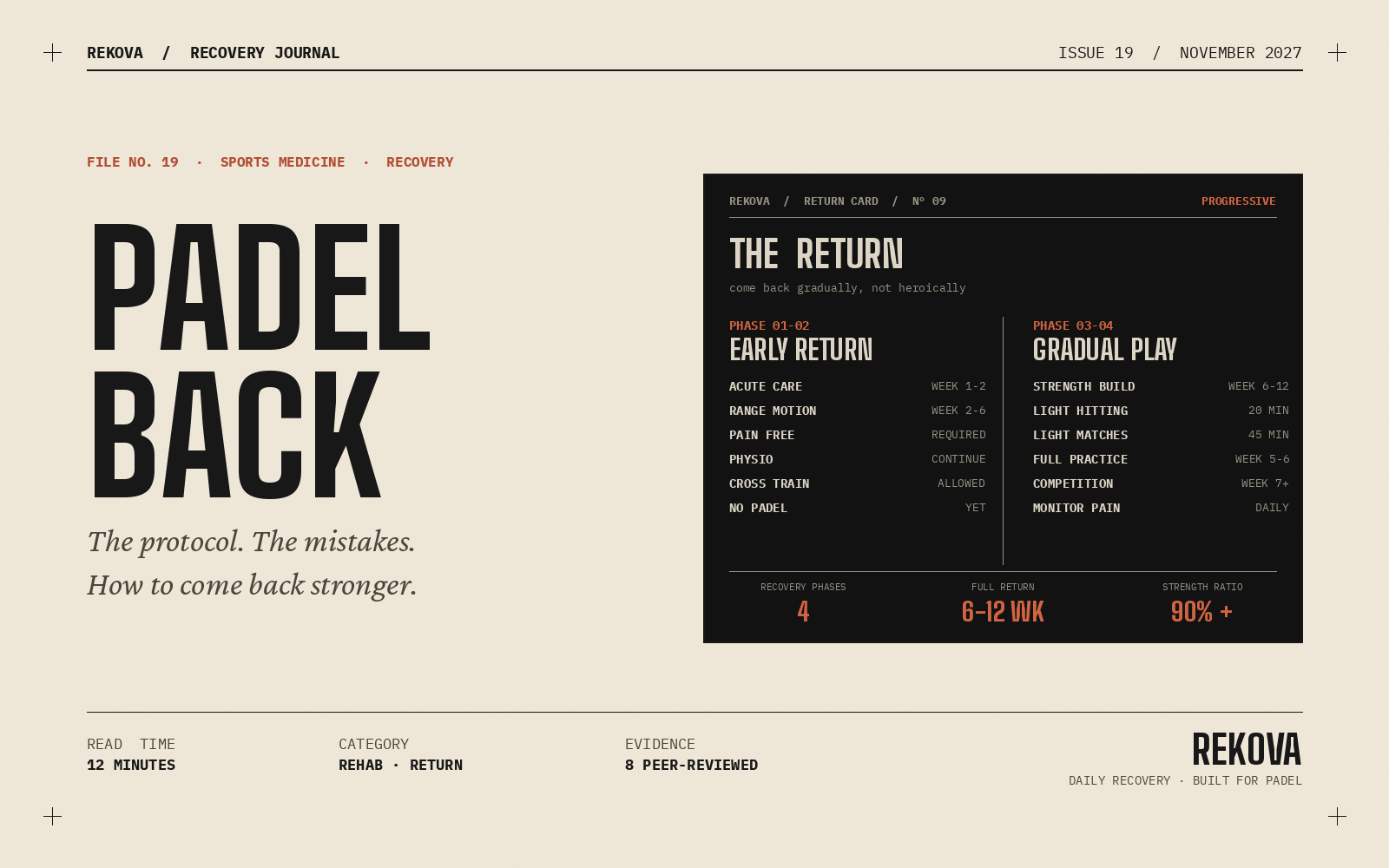
The four phases of return to padel
A reasonable framework for thinking about return, adapted from sports medicine protocols.
Phase 1: Acute care and tissue healing. Day 1 to 14 typically for soft tissue. Longer for bones or surgery. Goal is to manage pain and inflammation while supporting healing. RICE protocol (rest, ice, compression, elevation) for acute injuries. Medical evaluation if severe.
Phase 2: Restored range of motion and pain-free movement. Week 2 to 6 typically. Goal is normal daily movement without pain. Light progressive loading. Physiotherapy if needed. Begins addressing the underlying weakness or imbalance that contributed to injury.
Phase 3: Strength and tissue resilience. Week 6 to 12 typically. Goal is rebuilding to better-than-before. Progressive resistance training. Sport-specific movement patterns at sub-maximal intensity. Cross-training cardio.
Phase 4: Return to sport. Week 12 onward typically. Gradual progression from light hitting to full play to competitive matches. Volume increases before intensity. Continued strength and resilience work alongside.
Timeline varies enormously by injury type. A mild calf strain might compress this to 4 to 6 weeks total. A torn ACL might extend it to 9 to 12 months. The phases themselves remain the same regardless of duration.
The key principle. Don't skip phases. Don't compress them. Each phase prepares the foundation for the next.
Phase 1: Acute care and tissue healing. Day 1 to 14 typically for soft tissue. Longer for bones or surgery. Goal is to manage pain and inflammation while supporting healing. RICE protocol (rest, ice, compression, elevation) for acute injuries. Medical evaluation if severe.
Phase 2: Restored range of motion and pain-free movement. Week 2 to 6 typically. Goal is normal daily movement without pain. Light progressive loading. Physiotherapy if needed. Begins addressing the underlying weakness or imbalance that contributed to injury.
Phase 3: Strength and tissue resilience. Week 6 to 12 typically. Goal is rebuilding to better-than-before. Progressive resistance training. Sport-specific movement patterns at sub-maximal intensity. Cross-training cardio.
Phase 4: Return to sport. Week 12 onward typically. Gradual progression from light hitting to full play to competitive matches. Volume increases before intensity. Continued strength and resilience work alongside.
Timeline varies enormously by injury type. A mild calf strain might compress this to 4 to 6 weeks total. A torn ACL might extend it to 9 to 12 months. The phases themselves remain the same regardless of duration.
The key principle. Don't skip phases. Don't compress them. Each phase prepares the foundation for the next.
The criteria for return to play
Pain absence isn't enough. Use multiple criteria.
Pain. Zero pain during normal activity. Minimal pain during sport-specific movements. Pain returning the day after activity is a warning sign.
Range of motion. Full range matched to the uninjured side. Tested by your physiotherapist if possible, by yourself if not.
Strength. Strength matched to the uninjured side. The classic test for lower body injuries is single-leg squat or single-leg vertical jump. The injured side should match the uninjured side within 90 percent.
Functional movements. The specific movements of padel performed at sub-maximal intensity without pain or compensation. Lateral lunges. Smash motion. Forehand follow-through.
Confidence. Psychological readiness matters. Athletes who return uncertain often reinjure. Working on confidence through gradual progression matters.
If any of these criteria isn't met, you're not ready. Going back anyway is the most common mistake amateurs make.
Pain. Zero pain during normal activity. Minimal pain during sport-specific movements. Pain returning the day after activity is a warning sign.
Range of motion. Full range matched to the uninjured side. Tested by your physiotherapist if possible, by yourself if not.
Strength. Strength matched to the uninjured side. The classic test for lower body injuries is single-leg squat or single-leg vertical jump. The injured side should match the uninjured side within 90 percent.
Functional movements. The specific movements of padel performed at sub-maximal intensity without pain or compensation. Lateral lunges. Smash motion. Forehand follow-through.
Confidence. Psychological readiness matters. Athletes who return uncertain often reinjure. Working on confidence through gradual progression matters.
If any of these criteria isn't met, you're not ready. Going back anyway is the most common mistake amateurs make.
A return-to-play protocol that works
Specific framework I've used three times now.
Day 1 of return. Light hitting only. 20 minutes maximum. No matches. No high-intensity rallies. Hit straight balls with a willing partner. Pay attention to how the injured area feels during and after.
Day 2 to 7. Same as day 1, but every other day. The injured area should feel the same or better the day after each session. If pain returns the next morning, take an extra rest day and reduce intensity next session.
Week 2. Increase to 30 minutes per session, still hitting practice only. Add some lateral movement. Still no full match play.
Week 3. Light matches with players who'll cooperate (no smashing at you, easier balls). 45 minutes maximum. Avoid the corner where you might lunge maximally.
Week 4. Normal matches with players at your level, but only one match per session. Continue strength work.
Week 5 to 6. Building back to normal frequency. By the end of week 6, you should be playing close to your normal volume and intensity.
Week 7 onward. Normal play but with continued attention to the previously injured area. Continued strength and mobility work specific to preventing recurrence.
This is a 6 to 7 week graduated return for moderate soft tissue injury. Severe injuries might double or triple this timeline.
Day 1 of return. Light hitting only. 20 minutes maximum. No matches. No high-intensity rallies. Hit straight balls with a willing partner. Pay attention to how the injured area feels during and after.
Day 2 to 7. Same as day 1, but every other day. The injured area should feel the same or better the day after each session. If pain returns the next morning, take an extra rest day and reduce intensity next session.
Week 2. Increase to 30 minutes per session, still hitting practice only. Add some lateral movement. Still no full match play.
Week 3. Light matches with players who'll cooperate (no smashing at you, easier balls). 45 minutes maximum. Avoid the corner where you might lunge maximally.
Week 4. Normal matches with players at your level, but only one match per session. Continue strength work.
Week 5 to 6. Building back to normal frequency. By the end of week 6, you should be playing close to your normal volume and intensity.
Week 7 onward. Normal play but with continued attention to the previously injured area. Continued strength and mobility work specific to preventing recurrence.
This is a 6 to 7 week graduated return for moderate soft tissue injury. Severe injuries might double or triple this timeline.
Strength training during return
The strength work you do during return matters as much as the time you take.
Targeted at the injured area. The injury revealed a weakness. Address it directly. Tennis elbow needs forearm strengthening. ACL needs quad and hamstring strength. Lower back needs core work. Identify the specific weakness with your physiotherapist or coach.
Progressive overload. Start with very light weight or just body weight. Increase gradually over weeks. The mistake is jumping to your pre-injury strength too quickly.
Eccentric emphasis. Eccentric strength (the lowering phase of a movement) is particularly important for tendon health and rehabilitation. For elbow issues, slow eccentric wrist curls. For Achilles or calf, slow eccentric heel drops.
Full body. Don't focus only on the injured area. Continue strengthening everything else. Maintained strength elsewhere supports recovery.
Three sessions per week typically. More can interfere with healing. Less doesn't drive sufficient adaptation.
I covered general strength training principles in my strength training article. Return-to-play strength work uses the same principles with added emphasis on the injured area.
Targeted at the injured area. The injury revealed a weakness. Address it directly. Tennis elbow needs forearm strengthening. ACL needs quad and hamstring strength. Lower back needs core work. Identify the specific weakness with your physiotherapist or coach.
Progressive overload. Start with very light weight or just body weight. Increase gradually over weeks. The mistake is jumping to your pre-injury strength too quickly.
Eccentric emphasis. Eccentric strength (the lowering phase of a movement) is particularly important for tendon health and rehabilitation. For elbow issues, slow eccentric wrist curls. For Achilles or calf, slow eccentric heel drops.
Full body. Don't focus only on the injured area. Continue strengthening everything else. Maintained strength elsewhere supports recovery.
Three sessions per week typically. More can interfere with healing. Less doesn't drive sufficient adaptation.
I covered general strength training principles in my strength training article. Return-to-play strength work uses the same principles with added emphasis on the injured area.
Common mistakes during return
Returning too soon. Most common mistake. Pain absence doesn't equal readiness.
Returning at full intensity. The other most common mistake. Even if you're ready to play, your first match back isn't the time for tournaments.
Skipping the strength work. Returning to play without addressing the weakness that caused injury sets up reinjury.
Ignoring small warning signs. Mild pain that you push through. Stiffness that you assume will go away. The injured area telling you something subtle. Listen earlier rather than later.
Trying to make up for lost time. The temptation to play extra to catch up on missed practice. Worse than playing the same amount. Take it slower than feels necessary.
Switching back to the equipment that caused the problem. If your pala contributed to the injury (covered in my pala selection article), changing equipment is part of return.
Not adjusting technique. If the injury revealed a technique flaw, working with a coach during return is wise. Coming back with the same problematic technique pattern leads back to the same injury.
Stopping physiotherapy too early. Most people stop physiotherapy when the pain goes away. The real benefit often comes from the work after pain resolves, building the resilience to prevent reinjury.
Inconsistent return progression. Doing the light return for a week, feeling fine, then jumping to normal volume. The body needs the full graduated progression even when it feels ready.
Returning at full intensity. The other most common mistake. Even if you're ready to play, your first match back isn't the time for tournaments.
Skipping the strength work. Returning to play without addressing the weakness that caused injury sets up reinjury.
Ignoring small warning signs. Mild pain that you push through. Stiffness that you assume will go away. The injured area telling you something subtle. Listen earlier rather than later.
Trying to make up for lost time. The temptation to play extra to catch up on missed practice. Worse than playing the same amount. Take it slower than feels necessary.
Switching back to the equipment that caused the problem. If your pala contributed to the injury (covered in my pala selection article), changing equipment is part of return.
Not adjusting technique. If the injury revealed a technique flaw, working with a coach during return is wise. Coming back with the same problematic technique pattern leads back to the same injury.
Stopping physiotherapy too early. Most people stop physiotherapy when the pain goes away. The real benefit often comes from the work after pain resolves, building the resilience to prevent reinjury.
Inconsistent return progression. Doing the light return for a week, feeling fine, then jumping to normal volume. The body needs the full graduated progression even when it feels ready.
When to see a doctor or specialist
Most amateur padel injuries resolve with conservative management. Some don't.
Severe pain that doesn't improve. Pain getting worse week over week instead of better. Anything beyond 2 to 3 weeks without improvement warrants medical evaluation.
Visible deformity or instability. The joint or limb looks wrong. Movement causes the joint to give way. Immediate medical attention.
Numbness or tingling. Nerve involvement. See a doctor.
Significant swelling that doesn't subside. Inflammation lasting beyond 2 to 3 weeks. Get imaging.
Pain that wakes you at night. Different quality than activity-related pain. Often indicates more serious tissue damage.
Recurrent injury to the same area. Multiple incidents in the same area means something structural needs investigation.
Chronic pain (over 3 months). Pain that's lasted beyond expected healing timelines needs investigation for underlying causes.
The cost of medical evaluation is small. The cost of missing something is large. When in doubt, get checked.
For my own elbow injury, the early physiotherapy assessment caught a pattern that wouldn't have resolved with rest alone. The hands-on assessment plus targeted exercises produced better outcomes than I'd have managed solo. Worth the cost.
Severe pain that doesn't improve. Pain getting worse week over week instead of better. Anything beyond 2 to 3 weeks without improvement warrants medical evaluation.
Visible deformity or instability. The joint or limb looks wrong. Movement causes the joint to give way. Immediate medical attention.
Numbness or tingling. Nerve involvement. See a doctor.
Significant swelling that doesn't subside. Inflammation lasting beyond 2 to 3 weeks. Get imaging.
Pain that wakes you at night. Different quality than activity-related pain. Often indicates more serious tissue damage.
Recurrent injury to the same area. Multiple incidents in the same area means something structural needs investigation.
Chronic pain (over 3 months). Pain that's lasted beyond expected healing timelines needs investigation for underlying causes.
The cost of medical evaluation is small. The cost of missing something is large. When in doubt, get checked.
For my own elbow injury, the early physiotherapy assessment caught a pattern that wouldn't have resolved with rest alone. The hands-on assessment plus targeted exercises produced better outcomes than I'd have managed solo. Worth the cost.
Returning mentally, not just physically
The mental side of return to play matters. Often ignored.
Fear of reinjury is normal. After an injury, many players hold back, move tentatively, avoid the situations that caused the injury. This actually increases reinjury risk because tentative movement is bad movement.
Visualization helps. Spending 5 to 10 minutes daily mentally rehearsing playing well, including the previously injured area moving normally, builds confidence.
Talking with someone who's returned successfully. Reduces uncertainty. Provides realistic expectations. Most clubs have plenty of players who've come back from injuries.
Acceptance of new normal. Some injuries leave the area permanently somewhat different. You might need ongoing maintenance work for the rest of your playing career. Accepting this rather than fighting it leads to better long-term outcomes.
Patience with the timeline. The arc from injury to confident return takes longer than most people expect. Allow it.
Fear of reinjury is normal. After an injury, many players hold back, move tentatively, avoid the situations that caused the injury. This actually increases reinjury risk because tentative movement is bad movement.
Visualization helps. Spending 5 to 10 minutes daily mentally rehearsing playing well, including the previously injured area moving normally, builds confidence.
Talking with someone who's returned successfully. Reduces uncertainty. Provides realistic expectations. Most clubs have plenty of players who've come back from injuries.
Acceptance of new normal. Some injuries leave the area permanently somewhat different. You might need ongoing maintenance work for the rest of your playing career. Accepting this rather than fighting it leads to better long-term outcomes.
Patience with the timeline. The arc from injury to confident return takes longer than most people expect. Allow it.
Where Rekova fits
Brief.
Connective tissue healing requires specific nutrients. Vitamin C contributes to normal collagen formation for normal function of cartilage and bones (EFSA confirmed). Protein contributes to growth and maintenance of muscle mass (EFSA confirmed).
The Rekova formula includes hydrolyzed collagen, vitamin C, and magnesium, which support the underlying processes of tissue recovery. This isn't a treatment for the injury itself. It's daily nutritional support that helps the body do its healing work efficiently.
During return phases, when training stress is being deliberately applied to drive adaptation, the baseline nutritional support matters more than during low-activity periods.
Connective tissue healing requires specific nutrients. Vitamin C contributes to normal collagen formation for normal function of cartilage and bones (EFSA confirmed). Protein contributes to growth and maintenance of muscle mass (EFSA confirmed).
The Rekova formula includes hydrolyzed collagen, vitamin C, and magnesium, which support the underlying processes of tissue recovery. This isn't a treatment for the injury itself. It's daily nutritional support that helps the body do its healing work efficiently.
During return phases, when training stress is being deliberately applied to drive adaptation, the baseline nutritional support matters more than during low-activity periods.
FAQ: questions about returning from injury
How long should I rest before trying to come back? Depends on the injury entirely. Mild strains might be 1 to 2 weeks. Tendinopathies often need 4 to 8 weeks. Serious injuries need months. Follow medical guidance, not your impatience.
Can I do other exercise while injured? Usually yes, depending on the injury. Cardio on equipment that doesn't stress the injured area is often fine and helps maintain fitness. Strength training of uninjured areas is fine.
What if my doctor says I can play but I feel unsure? Trust your instinct. The doctor sees you for one assessment. You know your body. If something feels off, take more time.
Should I tape or brace the injured area when returning? Often yes during initial return. Provides feedback and support. Should be a transition aid, not a permanent solution.
When should I see a different doctor for a second opinion? If you've been working with someone for over 2 months without improvement. If recommendations don't make sense to you. If specific concerns aren't being addressed. Second opinions in sports medicine are common and appropriate.
How do I avoid reinjuring once I'm back? Continue the strength work that built resilience. Don't skip warm-up. Address the cause not just the symptom. Monitor for early warning signs.
What if I'm back but not playing my previous level? Normal. Often takes 2 to 3 months of normal play after return before you're at your pre-injury level. Sometimes you find a new normal at slightly lower level. Either way, expect a gradual climb.
Are there supplements that help injury recovery? Mixed evidence. The well-supported ones are adequate protein (1.6 to 2 grams per kg body weight), vitamin C, vitamin D if deficient, and adequate omega-3. Heavily marketed recovery supplements rarely deliver as advertised. I covered this in my supplements article.
Should I change anything about my technique permanently? Sometimes yes. If the injury revealed a technique flaw, working with a coach to address it permanently is wise. Bad technique that caused one injury usually causes the next one too.
How do I tell the difference between normal post-injury soreness and a warning sign? Soreness should be mild, transient (within 24 to 48 hours), and improving across sessions. Pain that worsens, that returns sharply during play, or that wakes you at night is a warning sign.
Can I do other exercise while injured? Usually yes, depending on the injury. Cardio on equipment that doesn't stress the injured area is often fine and helps maintain fitness. Strength training of uninjured areas is fine.
What if my doctor says I can play but I feel unsure? Trust your instinct. The doctor sees you for one assessment. You know your body. If something feels off, take more time.
Should I tape or brace the injured area when returning? Often yes during initial return. Provides feedback and support. Should be a transition aid, not a permanent solution.
When should I see a different doctor for a second opinion? If you've been working with someone for over 2 months without improvement. If recommendations don't make sense to you. If specific concerns aren't being addressed. Second opinions in sports medicine are common and appropriate.
How do I avoid reinjuring once I'm back? Continue the strength work that built resilience. Don't skip warm-up. Address the cause not just the symptom. Monitor for early warning signs.
What if I'm back but not playing my previous level? Normal. Often takes 2 to 3 months of normal play after return before you're at your pre-injury level. Sometimes you find a new normal at slightly lower level. Either way, expect a gradual climb.
Are there supplements that help injury recovery? Mixed evidence. The well-supported ones are adequate protein (1.6 to 2 grams per kg body weight), vitamin C, vitamin D if deficient, and adequate omega-3. Heavily marketed recovery supplements rarely deliver as advertised. I covered this in my supplements article.
Should I change anything about my technique permanently? Sometimes yes. If the injury revealed a technique flaw, working with a coach to address it permanently is wise. Bad technique that caused one injury usually causes the next one too.
How do I tell the difference between normal post-injury soreness and a warning sign? Soreness should be mild, transient (within 24 to 48 hours), and improving across sessions. Pain that worsens, that returns sharply during play, or that wakes you at night is a warning sign.
The short version
Pain absence doesn't equal readiness to return. Use the four-phase framework: acute care, range of motion, strength and resilience, gradual return to sport. Don't skip phases. Don't compress them. Strength work during return matters as much as time. Common mistakes include returning too soon, returning at full intensity, skipping rehab work, and ignoring warning signs. Watch for criteria that warrant medical evaluation. The mental side of return matters too. Expect 2 to 3 months of gradual progression beyond apparent readiness.
The boring fundamentals beat fancy padel-specific drills nine times out of ten. Patience in return is the most boring fundamental.
The boring fundamentals beat fancy padel-specific drills nine times out of ten. Patience in return is the most boring fundamental.
Sources
Ardern CL et al. Consensus statement on return to sport from the First World Congress in Sports Physical Therapy. British Journal of Sports Medicine. 2024 update.
Mendiguchia J et al. Rethinking return to play after hamstring injury. Sports Medicine. 2024.
Smith Palacio E. Epidemiologia de las lesiones en padel y recomendaciones preventivas. Ciencia y Deporte. April 2024.
Dahmen J. et al. Incidence, prevalence and nature of injuries in padel: a systematic review. BMJ Open Sport and Exercise Medicine. 2023.
Lauersen JB et al. The effectiveness of exercise interventions to prevent sports injuries. British Journal of Sports Medicine. 2014, updated 2023.
Phillips SM et al. Protein requirements during recovery from injury and rehabilitation. International Journal of Sport Nutrition and Exercise Metabolism. 2024.
International Society of Sports Nutrition. Position stand on protein, vitamins, and recovery. JISSN. 2024.
EFSA. Scientific Opinions on the substantiation of health claims related to protein, vitamin C, and connective tissue. EFSA Journal, various years.
This article shares my own experience and general guidance on returning from injury. It is not medical advice and is not a substitute for individualized treatment from a qualified medical professional. Any injury warrants medical evaluation before self-managing return to sport. Some injuries that seem minor are actually significant and require specific treatment. Get checked.
Rekova does not treat injuries and is not a substitute for medical care or physiotherapy. It is a daily functional drink with electrolytes, magnesium, hydrolyzed collagen, B vitamins, vitamin C, CoQ10, Acetyl-L-Carnitine, and supporting nutrients, formulated as nutritional support for people who play padel regularly.
Mendiguchia J et al. Rethinking return to play after hamstring injury. Sports Medicine. 2024.
Smith Palacio E. Epidemiologia de las lesiones en padel y recomendaciones preventivas. Ciencia y Deporte. April 2024.
Dahmen J. et al. Incidence, prevalence and nature of injuries in padel: a systematic review. BMJ Open Sport and Exercise Medicine. 2023.
Lauersen JB et al. The effectiveness of exercise interventions to prevent sports injuries. British Journal of Sports Medicine. 2014, updated 2023.
Phillips SM et al. Protein requirements during recovery from injury and rehabilitation. International Journal of Sport Nutrition and Exercise Metabolism. 2024.
International Society of Sports Nutrition. Position stand on protein, vitamins, and recovery. JISSN. 2024.
EFSA. Scientific Opinions on the substantiation of health claims related to protein, vitamin C, and connective tissue. EFSA Journal, various years.
This article shares my own experience and general guidance on returning from injury. It is not medical advice and is not a substitute for individualized treatment from a qualified medical professional. Any injury warrants medical evaluation before self-managing return to sport. Some injuries that seem minor are actually significant and require specific treatment. Get checked.
Rekova does not treat injuries and is not a substitute for medical care or physiotherapy. It is a daily functional drink with electrolytes, magnesium, hydrolyzed collagen, B vitamins, vitamin C, CoQ10, Acetyl-L-Carnitine, and supporting nutrients, formulated as nutritional support for people who play padel regularly.
