A 12 minute read. Updated February 2027.
My Apple Watch tells me I burned 743 calories during my last padel match. That number feels precise. To three significant figures. As if the device measured something specific.
It didn't. My watch made a rough estimate based on my heart rate, my weight, my age, and some general formulas. The actual calories I burned could have been 500. Could have been 900. The watch doesn't really know.
I started thinking about this seriously about a year ago when I tried to use padel to lose 5 kilos and it didn't work the way I expected.
I was playing four times a week. My watch was telling me I was burning 700 to 900 calories per session. That's about 2,800 to 3,600 calories per week from padel alone. Should equal roughly half a kilo of fat loss per week, in theory. I gained two kilos in three months.
So I started reading. About energy balance, about what those watch numbers actually mean, about why exercise alone is famously bad for fat loss, and about how padel actually fits into the picture.
What I learned is below. The honest version. With the math people don't usually show you.
What calories burned actually means
There's no machine that directly measures how much energy you burn during exercise. Even in research labs, calorie expenditure is measured indirectly through three main methods.
Doubly labeled water studies are the gold standard but slow, expensive, and used mostly for daily averages, not single sessions.
Indirect calorimetry measures oxygen consumption and requires lab equipment with a mask and a treadmill.
Predictive equations using heart rate, motion sensors, and demographic data are what your watch does.
Your smartwatch is in category three. It uses your heart rate from the wrist sensor (accurate within about 5 to 10 percent on a good day), your age and weight, and some general activity-recognition algorithms to estimate calories burned.
For low-intensity steady activity like walking, watch estimates are reasonably accurate. For variable-intensity activities like padel, they're rougher. Research comparing wrist-based watch estimates against laboratory measurement consistently shows errors of 15 to 30 percent for racquet sports.
So when your watch says 743 calories, the actual number is probably somewhere between 500 and 900. The actual number varies based on your actual fitness level (fitter players burn fewer calories at the same heart rate), match intensity (which depends on opponents, score pressure, conditions), court conditions (heat increases caloric burn, cold decreases it), how much you ran during the match (some matches involve lots of net play, others more baseline retrieves), and body composition (muscle burns more than fat, even at rest).
The precision of the displayed number creates an illusion of accuracy that doesn't exist.
Doubly labeled water studies are the gold standard but slow, expensive, and used mostly for daily averages, not single sessions.
Indirect calorimetry measures oxygen consumption and requires lab equipment with a mask and a treadmill.
Predictive equations using heart rate, motion sensors, and demographic data are what your watch does.
Your smartwatch is in category three. It uses your heart rate from the wrist sensor (accurate within about 5 to 10 percent on a good day), your age and weight, and some general activity-recognition algorithms to estimate calories burned.
For low-intensity steady activity like walking, watch estimates are reasonably accurate. For variable-intensity activities like padel, they're rougher. Research comparing wrist-based watch estimates against laboratory measurement consistently shows errors of 15 to 30 percent for racquet sports.
So when your watch says 743 calories, the actual number is probably somewhere between 500 and 900. The actual number varies based on your actual fitness level (fitter players burn fewer calories at the same heart rate), match intensity (which depends on opponents, score pressure, conditions), court conditions (heat increases caloric burn, cold decreases it), how much you ran during the match (some matches involve lots of net play, others more baseline retrieves), and body composition (muscle burns more than fat, even at rest).
The precision of the displayed number creates an illusion of accuracy that doesn't exist.
The actual research numbers
OK so what do the numbers actually look like in research?
Healthspan Elite and other sources publishing padel-specific data put amateur energy expenditure at:
For men, roughly 450 to 580 calories per hour during typical play. Higher in matches involving more movement, lower in social games with frequent breaks.
For women, roughly 350 to 450 calories per hour. Lower mostly due to lower body weight on average (calorie burn scales with body mass), not because women work less hard.
For competitive matches with more sustained intensity, both numbers can go up by 20 to 30 percent. For social club play with lots of breaks, they can go down by 20 to 30 percent.
A typical 90-minute amateur match for a 75 kg male: probably 600 to 900 calories. Not the 1,000 or 1,200 your watch might claim.
A 60-minute match: more like 400 to 600 calories.
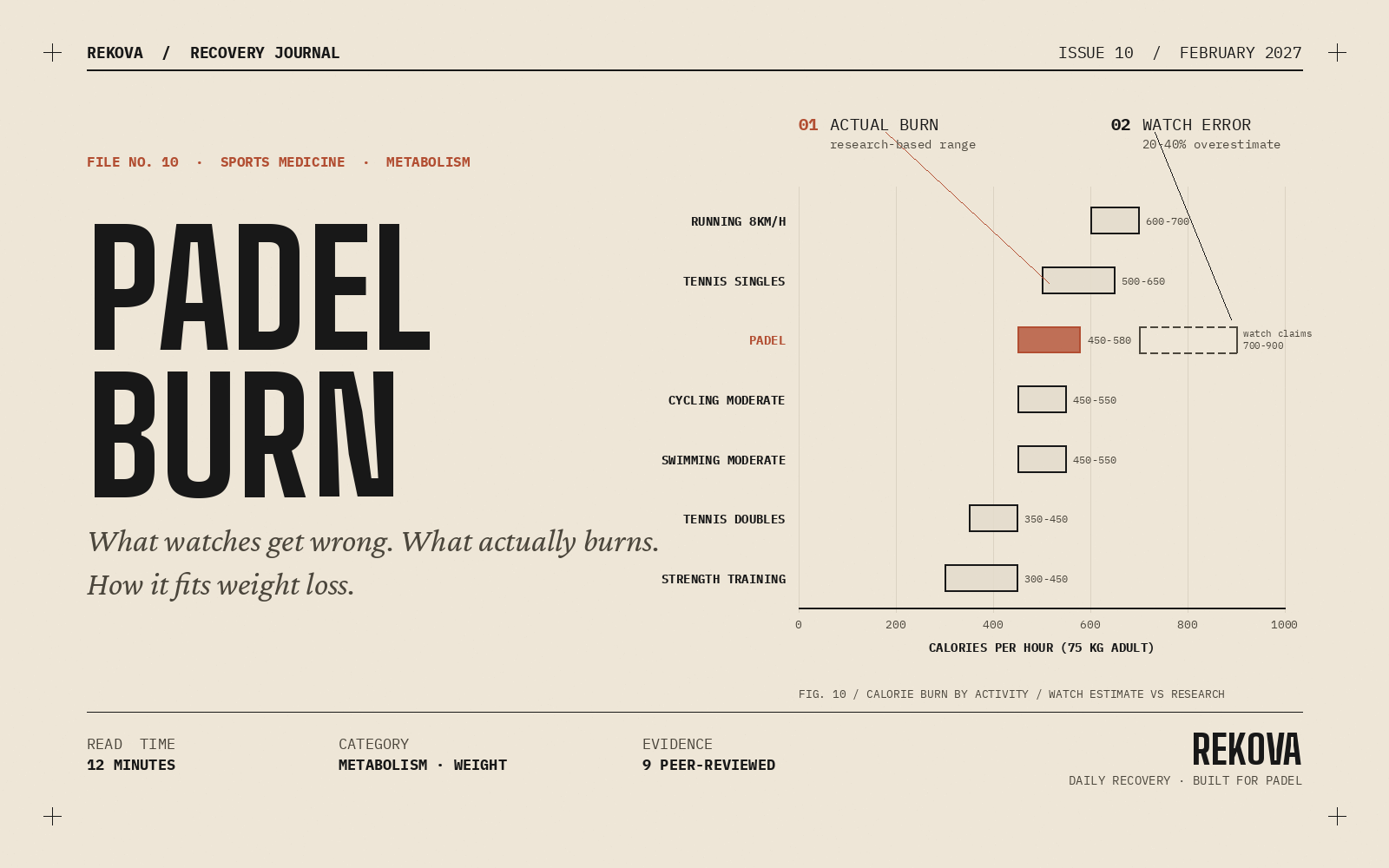
For comparison, here are rough estimates per hour for various activities for a 75 kg adult.
Tennis singles: similar to padel, slightly higher due to more running, around 500 to 650 per hour.
Tennis doubles: lower at around 350 to 450 per hour because of less running.
Running at 8 km per hour: 600 to 700 per hour.
Cycling at moderate pace: around 500 per hour.
Moderate swimming: around 500 per hour.
Strength training: 300 to 450 per hour.
Padel sits in a respectable cardiovascular range but not at the top of intensive activities.
Healthspan Elite and other sources publishing padel-specific data put amateur energy expenditure at:
For men, roughly 450 to 580 calories per hour during typical play. Higher in matches involving more movement, lower in social games with frequent breaks.
For women, roughly 350 to 450 calories per hour. Lower mostly due to lower body weight on average (calorie burn scales with body mass), not because women work less hard.
For competitive matches with more sustained intensity, both numbers can go up by 20 to 30 percent. For social club play with lots of breaks, they can go down by 20 to 30 percent.
A typical 90-minute amateur match for a 75 kg male: probably 600 to 900 calories. Not the 1,000 or 1,200 your watch might claim.
A 60-minute match: more like 400 to 600 calories.
For comparison, here are rough estimates per hour for various activities for a 75 kg adult.
Tennis singles: similar to padel, slightly higher due to more running, around 500 to 650 per hour.
Tennis doubles: lower at around 350 to 450 per hour because of less running.
Running at 8 km per hour: 600 to 700 per hour.
Cycling at moderate pace: around 500 per hour.
Moderate swimming: around 500 per hour.
Strength training: 300 to 450 per hour.
Padel sits in a respectable cardiovascular range but not at the top of intensive activities.
Why exercise alone rarely drives weight loss
This is where the math gets interesting and where I went wrong.
I was burning maybe 2,500 to 3,000 actual calories per week from padel. That's significant. Should equal about 0.3 to 0.4 kg of fat per week if everything else stayed equal.
Two problems.
First, everything else didn't stay equal. I was eating more. Significantly more. When you exercise heavily, you get hungrier. Your body fights to maintain energy balance. Studies on exercise-induced weight loss consistently show that people unconsciously eat back 30 to 60 percent of the calories they burned. Sometimes 100 percent. Sometimes more.
So my 2,800 extra calories burned were probably matched by 1,800 to 2,800 extra calories eaten. I just thought I was earning the extra pasta dinner.
Second, my body adapted. After a few weeks of consistent training, basal metabolic rate adjustments and improved exercise efficiency mean I was burning fewer calories doing the same activity. The body is good at conservation.
These two effects combined explain almost all of why exercise programs alone produce modest fat loss results, while diet changes produce dramatic ones.
This isn't a reason to skip exercise. Exercise has dozens of benefits beyond calorie expenditure. Cardiovascular health. Insulin sensitivity. Mood. Sleep. Strength. Mental performance. All real. All valuable.
It's just that I'll lose weight by playing more padel is not a strategy that works on its own.
I was burning maybe 2,500 to 3,000 actual calories per week from padel. That's significant. Should equal about 0.3 to 0.4 kg of fat per week if everything else stayed equal.
Two problems.
First, everything else didn't stay equal. I was eating more. Significantly more. When you exercise heavily, you get hungrier. Your body fights to maintain energy balance. Studies on exercise-induced weight loss consistently show that people unconsciously eat back 30 to 60 percent of the calories they burned. Sometimes 100 percent. Sometimes more.
So my 2,800 extra calories burned were probably matched by 1,800 to 2,800 extra calories eaten. I just thought I was earning the extra pasta dinner.
Second, my body adapted. After a few weeks of consistent training, basal metabolic rate adjustments and improved exercise efficiency mean I was burning fewer calories doing the same activity. The body is good at conservation.
These two effects combined explain almost all of why exercise programs alone produce modest fat loss results, while diet changes produce dramatic ones.
This isn't a reason to skip exercise. Exercise has dozens of benefits beyond calorie expenditure. Cardiovascular health. Insulin sensitivity. Mood. Sleep. Strength. Mental performance. All real. All valuable.
It's just that I'll lose weight by playing more padel is not a strategy that works on its own.
The role padel actually plays in body composition
Here's the more accurate picture.
Padel is a moderately intense cardiovascular activity. Played consistently, it improves cardiovascular health, builds some muscle (especially legs and core), and burns reasonable calories.
For body composition, padel does these things well. Maintains muscle mass during a caloric deficit. Improves insulin sensitivity for better blood sugar regulation. Increases overall daily activity in some people through general lifestyle change. Helps adherence to other lifestyle changes because people who exercise often eat better too.
For body composition, padel does these things poorly. Creating a meaningful caloric deficit on its own. Building significant muscle (it's primarily cardio, not strength). Targeted fat loss because no exercise burns fat specifically from one body area, contrary to popular marketing.
The realistic path to body composition change using padel. Combine it with moderate dietary changes (modest deficit, adequate protein), add 1 or 2 strength training sessions per week, get adequate sleep, and be patient.
The unrealistic path. Play more padel, expect the watch numbers to translate directly into fat loss.
Padel is a moderately intense cardiovascular activity. Played consistently, it improves cardiovascular health, builds some muscle (especially legs and core), and burns reasonable calories.
For body composition, padel does these things well. Maintains muscle mass during a caloric deficit. Improves insulin sensitivity for better blood sugar regulation. Increases overall daily activity in some people through general lifestyle change. Helps adherence to other lifestyle changes because people who exercise often eat better too.
For body composition, padel does these things poorly. Creating a meaningful caloric deficit on its own. Building significant muscle (it's primarily cardio, not strength). Targeted fat loss because no exercise burns fat specifically from one body area, contrary to popular marketing.
The realistic path to body composition change using padel. Combine it with moderate dietary changes (modest deficit, adequate protein), add 1 or 2 strength training sessions per week, get adequate sleep, and be patient.
The unrealistic path. Play more padel, expect the watch numbers to translate directly into fat loss.
Why strength training matters more than people think
This relates to padel calorie burn in an indirect way that most amateurs miss.
If you do nothing but cardio (including padel), your muscle mass slowly declines. Lost muscle equals lower metabolic rate equals harder to maintain a caloric deficit equals weight loss plateaus.
If you add strength training twice a week, you maintain or build muscle while losing fat. Net result: better body composition, possibly same scale weight, easier to sustain. Higher resting metabolic rate, so you can eat more without gaining.
I covered this in my padel after 40 article. It's actually more important for younger players than people realize too.
A 75 kg amateur padel player who does 4 padel sessions per week and no strength training: probably stable weight, some muscle decline over years.
Same player doing 3 padel sessions plus 2 strength sessions per week: gains muscle, loses fat over time, the scale may not change much but the body changes significantly.
Same weekly time investment. Very different results.
My 52-year-old doubles partner has been at the same weight for ten years. His secret isn't padel volume. It's consistency in everything else, including the strength work he does religiously twice a week.
If you do nothing but cardio (including padel), your muscle mass slowly declines. Lost muscle equals lower metabolic rate equals harder to maintain a caloric deficit equals weight loss plateaus.
If you add strength training twice a week, you maintain or build muscle while losing fat. Net result: better body composition, possibly same scale weight, easier to sustain. Higher resting metabolic rate, so you can eat more without gaining.
I covered this in my padel after 40 article. It's actually more important for younger players than people realize too.
A 75 kg amateur padel player who does 4 padel sessions per week and no strength training: probably stable weight, some muscle decline over years.
Same player doing 3 padel sessions plus 2 strength sessions per week: gains muscle, loses fat over time, the scale may not change much but the body changes significantly.
Same weekly time investment. Very different results.
My 52-year-old doubles partner has been at the same weight for ten years. His secret isn't padel volume. It's consistency in everything else, including the strength work he does religiously twice a week.
When the calories burned number actually matters
There are a few situations where caring about the exact calorie count makes sense.
If you're training for an endurance event where fueling matters, knowing approximate energy expenditure helps plan intake.
If you're trying to gain weight (some people are), tracking calories burned versus consumed in a structured way matters.
If you're in serious caloric deficit for weight loss and want to make sure you're not over-restricting, monitoring expenditure helps.
For most amateur padel players just wanting to be healthy and play well: the calorie number on your watch is interesting trivia, not actionable data.
Your real progress markers should be how you feel in matches, whether you can play four sets without crashing, body composition changes over weeks and months, sleep quality, energy levels through the day, performance metrics like winning more points against the same opponents.
These tell you much more than a watch number.
If you're training for an endurance event where fueling matters, knowing approximate energy expenditure helps plan intake.
If you're trying to gain weight (some people are), tracking calories burned versus consumed in a structured way matters.
If you're in serious caloric deficit for weight loss and want to make sure you're not over-restricting, monitoring expenditure helps.
For most amateur padel players just wanting to be healthy and play well: the calorie number on your watch is interesting trivia, not actionable data.
Your real progress markers should be how you feel in matches, whether you can play four sets without crashing, body composition changes over weeks and months, sleep quality, energy levels through the day, performance metrics like winning more points against the same opponents.
These tell you much more than a watch number.
What I do now (and what the data says)
After two years of thinking about this more clearly, here's my approach.
I look at my watch's calorie number after matches with mild curiosity. I don't use it to plan eating. I don't add my burn to my calorie budget for the day.
I weigh myself once a week on Wednesday mornings and track over time. The single-day number means nothing. The 4-week trend means something.
I track my food intake periodically (a few times a year) to make sure my perception matches reality. Most people significantly underestimate what they're eating. The watch can't tell you that. Phone apps for food tracking can, if you actually use them honestly for a few weeks.
I focus on consistency in the things that actually matter. Sleep around 7 to 8 hours. Adequate protein intake, around 1.6 to 2 grams per kg body weight daily. Strength training twice a week. Padel 3 to 4 times a week. Walking 7,000 plus steps daily. My daily Rekova sachet covering the micronutrient base. The fundamentals.
I'm now down 4 kilos from my peak, two years later. Slow, steady, unglamorous. Most of it came from diet adjustments, not from playing more padel. The padel kept me consistent with everything else and built the strength to support harder play. It wasn't the engine of weight loss. It was the lifestyle that supported it.
I look at my watch's calorie number after matches with mild curiosity. I don't use it to plan eating. I don't add my burn to my calorie budget for the day.
I weigh myself once a week on Wednesday mornings and track over time. The single-day number means nothing. The 4-week trend means something.
I track my food intake periodically (a few times a year) to make sure my perception matches reality. Most people significantly underestimate what they're eating. The watch can't tell you that. Phone apps for food tracking can, if you actually use them honestly for a few weeks.
I focus on consistency in the things that actually matter. Sleep around 7 to 8 hours. Adequate protein intake, around 1.6 to 2 grams per kg body weight daily. Strength training twice a week. Padel 3 to 4 times a week. Walking 7,000 plus steps daily. My daily Rekova sachet covering the micronutrient base. The fundamentals.
I'm now down 4 kilos from my peak, two years later. Slow, steady, unglamorous. Most of it came from diet adjustments, not from playing more padel. The padel kept me consistent with everything else and built the strength to support harder play. It wasn't the engine of weight loss. It was the lifestyle that supported it.
FAQ: questions about padel and calories
How many calories does padel actually burn? Probably 400 to 600 in a typical 90 minute amateur match for an average adult. Watch estimates often overstate this by 20 to 40 percent.
Is padel good for weight loss? Yes, as part of a broader plan. No, as a primary strategy. Diet changes drive most weight loss results.
Should I trust my smartwatch's calorie estimate? Trust it as a rough comparison tool (am I more active this week than last week?). Don't trust it as a precise input for eating decisions.
Will I burn more calories playing harder padel? Yes, but maybe less than you think. The difference between casual play and competitive intensity might be 15 to 25 percent in calories, not double or triple.
What's the most calorie-burning sport? Per hour, cross-country skiing and competitive rowing are usually at the top, around 700 to 900 per hour. Hard running is comparable. Padel sits in the moderate range.
Can I eat more if I played padel today? You can eat slightly more, but probably less than the watch number suggests. Hunger after exercise also has a more complex relationship to calories burned than most people realize.
Does padel build muscle? Some, especially in the legs, core, and forearms. Not as much as actual strength training. Combine both for best results.
Is intermittent fasting compatible with padel? Most people perform worse on padel in a fasted state. If you want to fast, do it on non-playing days. I covered fueling in my padel nutrition article.
How accurate are heart rate-based calorie estimates? More accurate during steady-state activities like running at one pace or cycling. Less accurate during variable activities like padel where heart rate fluctuates. Expect 15 to 30 percent error.
What about other body composition tools like smart scales and body fat percentage estimates? Bathroom scale body fat percentages from bioimpedance devices are quite inaccurate, often 5 to 10 percentage points off. Use them only for trend, not absolute values. The mirror and how clothes fit are often better indicators.
Will more frequent padel help me lose weight faster? Probably not. There's a point of diminishing returns where extra sessions cause extra hunger and more eating, with the calorie balance staying about the same. 3 to 4 quality sessions per week is usually optimal.
Should I do cardio in addition to padel for weight loss? Padel itself is cardio. Adding more isn't usually necessary unless you enjoy it. Time is better spent on strength training and consistency in nutrition.
Is padel good for weight loss? Yes, as part of a broader plan. No, as a primary strategy. Diet changes drive most weight loss results.
Should I trust my smartwatch's calorie estimate? Trust it as a rough comparison tool (am I more active this week than last week?). Don't trust it as a precise input for eating decisions.
Will I burn more calories playing harder padel? Yes, but maybe less than you think. The difference between casual play and competitive intensity might be 15 to 25 percent in calories, not double or triple.
What's the most calorie-burning sport? Per hour, cross-country skiing and competitive rowing are usually at the top, around 700 to 900 per hour. Hard running is comparable. Padel sits in the moderate range.
Can I eat more if I played padel today? You can eat slightly more, but probably less than the watch number suggests. Hunger after exercise also has a more complex relationship to calories burned than most people realize.
Does padel build muscle? Some, especially in the legs, core, and forearms. Not as much as actual strength training. Combine both for best results.
Is intermittent fasting compatible with padel? Most people perform worse on padel in a fasted state. If you want to fast, do it on non-playing days. I covered fueling in my padel nutrition article.
How accurate are heart rate-based calorie estimates? More accurate during steady-state activities like running at one pace or cycling. Less accurate during variable activities like padel where heart rate fluctuates. Expect 15 to 30 percent error.
What about other body composition tools like smart scales and body fat percentage estimates? Bathroom scale body fat percentages from bioimpedance devices are quite inaccurate, often 5 to 10 percentage points off. Use them only for trend, not absolute values. The mirror and how clothes fit are often better indicators.
Will more frequent padel help me lose weight faster? Probably not. There's a point of diminishing returns where extra sessions cause extra hunger and more eating, with the calorie balance staying about the same. 3 to 4 quality sessions per week is usually optimal.
Should I do cardio in addition to padel for weight loss? Padel itself is cardio. Adding more isn't usually necessary unless you enjoy it. Time is better spent on strength training and consistency in nutrition.
The short version
Your watch's calorie number for a padel match is a rough estimate, often overstated by 20 to 40 percent. Real burn for a 90 minute amateur match is probably 400 to 600 calories. Padel is moderately intense exercise with real cardiovascular benefits, but it isn't a weight loss strategy on its own. Most exercise-driven weight loss attempts fail because people unconsciously eat back what they burned and because the body adapts to conserve energy. Combine padel with diet adjustments, strength training twice a week, adequate sleep, and patience.
The watch number is interesting but not actionable. Focus on consistency in the fundamentals. The scale and the watch are not the metrics that matter most. How you feel, how you play, and how you're built over months and years are what matters.
The watch number is interesting but not actionable. Focus on consistency in the fundamentals. The scale and the watch are not the metrics that matter most. How you feel, how you play, and how you're built over months and years are what matters.
Sources
Healthspan Elite. Padel: what is it and how should you fuel your game? Knowledge Hub. 2025.
Marcos Rivero B. et al. Evolution of Physiological Responses and Fatigue Analysis in Padel Matches According to Match Outcome and Playing Position. Sensors. August 2025.
International Society of Sports Nutrition. Position stand on protein and exercise. JISSN. 2024.
Hall KD et al. The role of exercise and physical activity in weight loss and maintenance: a comprehensive review. Obesity Reviews. 2023.
Westerterp KR. Exercise, energy balance and body composition. European Journal of Clinical Nutrition. 2018.
EFSA. Scientific Opinions on the substantiation of health claims related to protein and muscle mass maintenance. EFSA Journal, various years.
Padel Magazine. Padel and fitness: how the sport works your body. 2024.
ACSM. Position stand on physical activity and weight loss. 2024.
Phillips SM et al. Protein requirements in older athletes and active adults. International Journal of Sport Nutrition and Exercise Metabolism. 2024.
This article shares my own experience with weight management and reflects current research on exercise, calories, and body composition. It is not medical advice. If you have any underlying medical condition affecting your weight, energy levels, or body composition, please consult a qualified healthcare professional. Weight management can involve complex medical factors beyond simple calories in versus calories out.
Rekova does not treat any medical condition and is not a substitute for medical care or a structured weight management plan. It is a daily functional drink with electrolytes, magnesium, hydrolyzed collagen, B vitamins, vitamin C, CoQ10, Acetyl-L-Carnitine, and supporting nutrients, formulated as nutritional support for people who play padel regularly.
Marcos Rivero B. et al. Evolution of Physiological Responses and Fatigue Analysis in Padel Matches According to Match Outcome and Playing Position. Sensors. August 2025.
International Society of Sports Nutrition. Position stand on protein and exercise. JISSN. 2024.
Hall KD et al. The role of exercise and physical activity in weight loss and maintenance: a comprehensive review. Obesity Reviews. 2023.
Westerterp KR. Exercise, energy balance and body composition. European Journal of Clinical Nutrition. 2018.
EFSA. Scientific Opinions on the substantiation of health claims related to protein and muscle mass maintenance. EFSA Journal, various years.
Padel Magazine. Padel and fitness: how the sport works your body. 2024.
ACSM. Position stand on physical activity and weight loss. 2024.
Phillips SM et al. Protein requirements in older athletes and active adults. International Journal of Sport Nutrition and Exercise Metabolism. 2024.
This article shares my own experience with weight management and reflects current research on exercise, calories, and body composition. It is not medical advice. If you have any underlying medical condition affecting your weight, energy levels, or body composition, please consult a qualified healthcare professional. Weight management can involve complex medical factors beyond simple calories in versus calories out.
Rekova does not treat any medical condition and is not a substitute for medical care or a structured weight management plan. It is a daily functional drink with electrolytes, magnesium, hydrolyzed collagen, B vitamins, vitamin C, CoQ10, Acetyl-L-Carnitine, and supporting nutrients, formulated as nutritional support for people who play padel regularly.
