A 13 minute read. Updated October 2026.
I've mentioned my doubles partner a few times in these articles. He's 52. Lawyer in Madrid. Runs half-marathons on weekends. Plays padel four times a week. Outlasts me on the court despite being seventeen years older than me.
The first time we played a tournament together I assumed I'd carry the team athletically while he'd bring the smarter shot selection. By the third match of our first weekend I realized that was exactly backwards. He moved better than I did. He made fewer mistakes. He had more energy in the third set than I had in the second.
That experience kicked off a side interest of mine. I started paying attention to the older players at my club. Watching what they did differently. Asking questions when I could. Reading the research on athletic performance in the over-40 population.
Below is what I've put together. What actually changes in the body after 40. What people blame on age that's really just accumulated bad habits. And what the players who are still crushing it in their fifties and sixties seem to do consistently.
What actually changes physiologically after 40
Aging is real. Some things genuinely slow down or shift. The trick is knowing which things, and how much.
Maximum heart rate declines roughly one beat per year after about age 25. By 45 your max heart rate is probably 10 to 15 beats lower than it was at 30. Aerobic capacity (VO2 max) also declines roughly 1 percent per year if you don't train. Less than half that if you do.
Muscle mass starts declining slowly after 30, accelerating after 50 if you don't actively work against it. This is called sarcopenia. Without strength training, an average adult loses around 3 to 5 percent of muscle mass per decade between 30 and 60.
Tendon and ligament elasticity decreases. The connective tissue becomes less able to stretch and recoil. This is why tendon injuries become more common in middle-aged athletes. The tissue is doing the same work with less compliance.
Recovery from intense exercise slows. Sleep quality declines for many adults after 45 or 50. Hormonal levels shift. For men, testosterone declines roughly 1 percent per year after 30. For women, hormonal changes around menopause can affect bone density, body composition, and energy levels.
Bone density declines, especially in women after menopause. This makes falls more dangerous when they happen.
Reaction time slows slightly. Cognitive processing speed for complex motor tasks decreases.
That sounds like a lot of bad news. It isn't, mostly, for the reasons I'll get to.
Maximum heart rate declines roughly one beat per year after about age 25. By 45 your max heart rate is probably 10 to 15 beats lower than it was at 30. Aerobic capacity (VO2 max) also declines roughly 1 percent per year if you don't train. Less than half that if you do.
Muscle mass starts declining slowly after 30, accelerating after 50 if you don't actively work against it. This is called sarcopenia. Without strength training, an average adult loses around 3 to 5 percent of muscle mass per decade between 30 and 60.
Tendon and ligament elasticity decreases. The connective tissue becomes less able to stretch and recoil. This is why tendon injuries become more common in middle-aged athletes. The tissue is doing the same work with less compliance.
Recovery from intense exercise slows. Sleep quality declines for many adults after 45 or 50. Hormonal levels shift. For men, testosterone declines roughly 1 percent per year after 30. For women, hormonal changes around menopause can affect bone density, body composition, and energy levels.
Bone density declines, especially in women after menopause. This makes falls more dangerous when they happen.
Reaction time slows slightly. Cognitive processing speed for complex motor tasks decreases.
That sounds like a lot of bad news. It isn't, mostly, for the reasons I'll get to.
What people blame on age that isn't actually age
Here's the more interesting part.
A lot of what middle-aged amateurs blame on getting older is actually decreased physical activity outside of padel. Worse sleep habits accumulated over years. Worse nutrition habits accumulated over years. More chronic stress with less recovery. Carrying 10 or 15 extra kilograms compared to their twenties. Years of sedentary office work without complementary strength training.
These things look like aging from the inside. They feel like aging. They have very little to do with chronological age and a lot to do with how the years between 25 and 45 were spent.
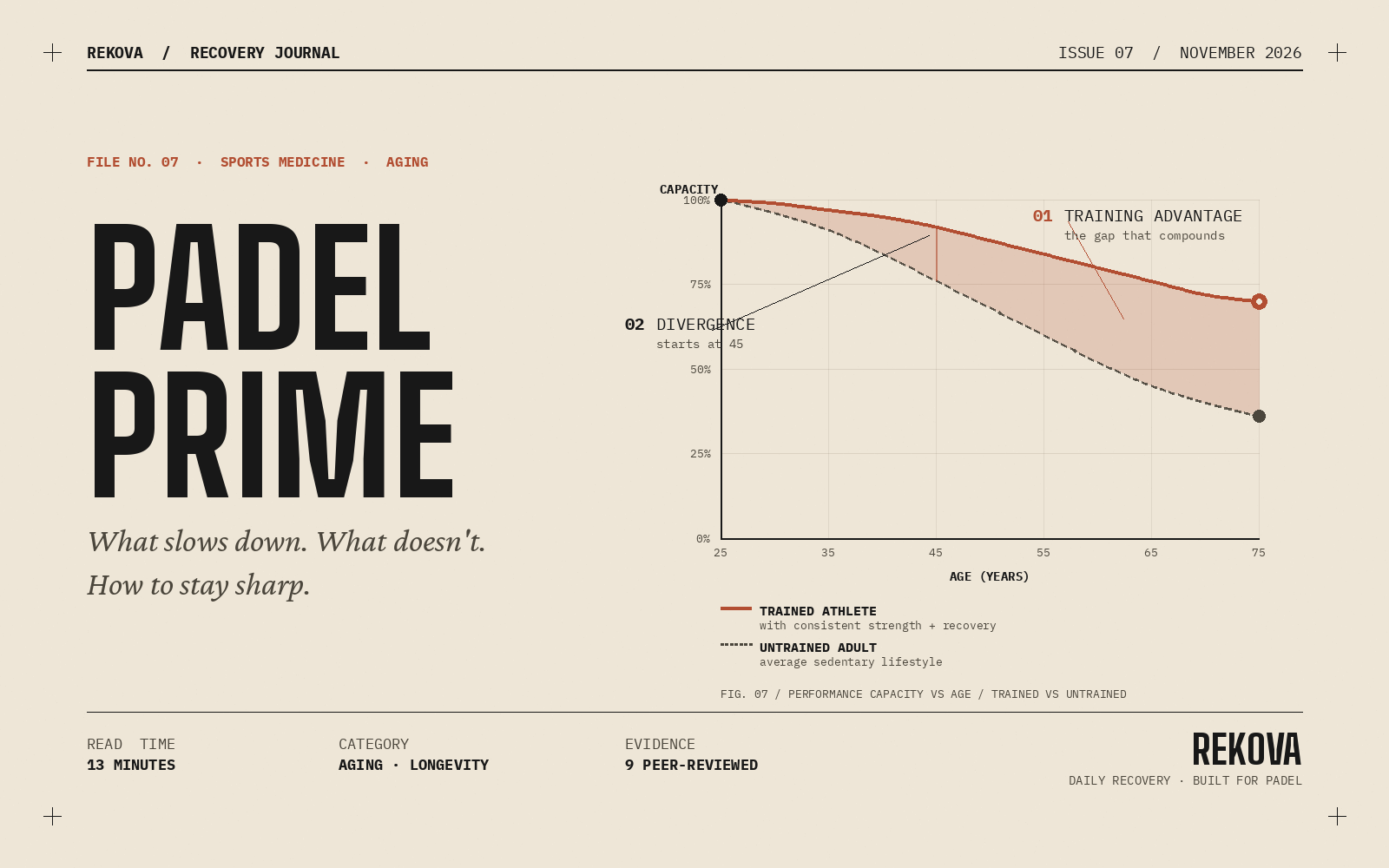
When researchers compare elite master athletes (people in their 60s and 70s who've trained consistently their whole lives) against average sedentary adults the same age, the physiological gaps are enormous. Master athletes often have aerobic capacities, muscle mass, and recovery profiles closer to average 30-year-olds than to average 60-year-olds.
This isn't to say genetics don't matter or that you can age-proof yourself completely. You can't. But the difference between aging well through padel and aging badly through padel is mostly choices, not chronology.
A lot of what middle-aged amateurs blame on getting older is actually decreased physical activity outside of padel. Worse sleep habits accumulated over years. Worse nutrition habits accumulated over years. More chronic stress with less recovery. Carrying 10 or 15 extra kilograms compared to their twenties. Years of sedentary office work without complementary strength training.
These things look like aging from the inside. They feel like aging. They have very little to do with chronological age and a lot to do with how the years between 25 and 45 were spent.
When researchers compare elite master athletes (people in their 60s and 70s who've trained consistently their whole lives) against average sedentary adults the same age, the physiological gaps are enormous. Master athletes often have aerobic capacities, muscle mass, and recovery profiles closer to average 30-year-olds than to average 60-year-olds.
This isn't to say genetics don't matter or that you can age-proof yourself completely. You can't. But the difference between aging well through padel and aging badly through padel is mostly choices, not chronology.
Recovery: what really slows down vs what doesn't
This is the area where the myths are loudest.
What actually does slow down with age. The recovery of tendons and connective tissue. Muscle protein synthesis response to a single bout of exercise. The ability to bounce back from poor sleep. Tolerance for back-to-back high-intensity sessions.
What doesn't slow down as much as people think. Muscle recovery between sessions if everything else (sleep, nutrition, hydration) is dialed in. Cardiovascular recovery within a match. Mental recovery if you protect your sleep.
The research on master athletes consistently finds that the gap between trained older athletes and trained younger athletes in recovery is much smaller than the gap between trained older athletes and sedentary older adults. Training status matters more than age, within reasonable limits.
My 52-year-old partner who outlasts me sleeps 7.5 to 8 hours every night. He eats a Mediterranean-style diet by default because he's been doing it for thirty years. He does two strength sessions per week. He plays his easier padel sessions at genuinely easy intensity. The hard sessions he saves for when he's actually recovered.
I tried to copy his routine for six months. My recovery improved more in those six months than it had in my entire adult life up to that point.
What actually does slow down with age. The recovery of tendons and connective tissue. Muscle protein synthesis response to a single bout of exercise. The ability to bounce back from poor sleep. Tolerance for back-to-back high-intensity sessions.
What doesn't slow down as much as people think. Muscle recovery between sessions if everything else (sleep, nutrition, hydration) is dialed in. Cardiovascular recovery within a match. Mental recovery if you protect your sleep.
The research on master athletes consistently finds that the gap between trained older athletes and trained younger athletes in recovery is much smaller than the gap between trained older athletes and sedentary older adults. Training status matters more than age, within reasonable limits.
My 52-year-old partner who outlasts me sleeps 7.5 to 8 hours every night. He eats a Mediterranean-style diet by default because he's been doing it for thirty years. He does two strength sessions per week. He plays his easier padel sessions at genuinely easy intensity. The hard sessions he saves for when he's actually recovered.
I tried to copy his routine for six months. My recovery improved more in those six months than it had in my entire adult life up to that point.
Why strength training becomes non-negotiable after 40
If there's one thing the research is unambiguous about, it's this.
Without resistance training, you lose muscle mass progressively after 40. Lost muscle mass means lower metabolic rate, reduced functional capacity, decreased bone density, increased injury risk. Padel itself doesn't replace this. Padel works specific movement patterns and energy systems. It doesn't load the whole musculoskeletal system the way strength training does.
What works. Two strength sessions per week, focused on compound movements (squats, deadlifts or hip hinges, presses, pulls, single leg work). 45 to 60 minutes each. Progressive overload, meaning you gradually challenge yourself with more weight or more reps over time.
Doesn't have to be a fancy gym setup. Body weight or dumbbells at home work for most people who haven't been training. Once you've built a base of strength, then maybe consider a real gym membership for the equipment and the accountability.
I started strength training seriously at 33. Two years in, my padel performance improved more from the strength work than from any technique changes I'd made.
For my 52-year-old partner, the strength work is non-negotiable. He skips a padel session if he has to. Never a strength session. His logic is simple. Padel is the fun part. Strength is the foundation everything else stands on.
Without resistance training, you lose muscle mass progressively after 40. Lost muscle mass means lower metabolic rate, reduced functional capacity, decreased bone density, increased injury risk. Padel itself doesn't replace this. Padel works specific movement patterns and energy systems. It doesn't load the whole musculoskeletal system the way strength training does.
What works. Two strength sessions per week, focused on compound movements (squats, deadlifts or hip hinges, presses, pulls, single leg work). 45 to 60 minutes each. Progressive overload, meaning you gradually challenge yourself with more weight or more reps over time.
Doesn't have to be a fancy gym setup. Body weight or dumbbells at home work for most people who haven't been training. Once you've built a base of strength, then maybe consider a real gym membership for the equipment and the accountability.
I started strength training seriously at 33. Two years in, my padel performance improved more from the strength work than from any technique changes I'd made.
For my 52-year-old partner, the strength work is non-negotiable. He skips a padel session if he has to. Never a strength session. His logic is simple. Padel is the fun part. Strength is the foundation everything else stands on.
Tendon health and the long view
The tendon issue deserves its own section because it's where age really shows up specifically.
Tendons are slow-adapting tissue. They respond to load, but more slowly than muscle does. As you age, this adaptation becomes even slower. Recovery from a stressed tendon takes longer in your forties than in your twenties. By your fifties and sixties, the gap is wider.
This is why padel elbow becomes more common in middle-aged amateurs. It's why patellar tendinopathy starts showing up. It's why rotator cuff issues become more frequent. I covered each of these in my separate articles on padel elbow and common padel injuries.
The countermeasures.
Build playing volume more slowly than you think you need to. The young guy who can go from zero to four sessions a week without trouble doesn't exist after 40. The older you are, the more incremental your ramp-up needs to be.
Eccentric strength training works for tendon health. Slow lowering of a weight against gravity. This signals the tendons to remodel and adapt. I covered specific exercises in the padel elbow article.
Nutritional support matters more after 40. Adequate protein at each meal. Vitamin C contributes to normal collagen formation for the normal function of cartilage and bones (EFSA confirmed). Some emerging research on hydrolyzed collagen supplementation specifically for tendon and joint support is particularly relevant for athletes over 40.
Address small tendon pain immediately. The little ache in your elbow or your knee that you would have ignored at 25, you cannot ignore at 45. It compounds. Take a few days off, do mobility work, reduce volume, address the cause.
Tendons are slow-adapting tissue. They respond to load, but more slowly than muscle does. As you age, this adaptation becomes even slower. Recovery from a stressed tendon takes longer in your forties than in your twenties. By your fifties and sixties, the gap is wider.
This is why padel elbow becomes more common in middle-aged amateurs. It's why patellar tendinopathy starts showing up. It's why rotator cuff issues become more frequent. I covered each of these in my separate articles on padel elbow and common padel injuries.
The countermeasures.
Build playing volume more slowly than you think you need to. The young guy who can go from zero to four sessions a week without trouble doesn't exist after 40. The older you are, the more incremental your ramp-up needs to be.
Eccentric strength training works for tendon health. Slow lowering of a weight against gravity. This signals the tendons to remodel and adapt. I covered specific exercises in the padel elbow article.
Nutritional support matters more after 40. Adequate protein at each meal. Vitamin C contributes to normal collagen formation for the normal function of cartilage and bones (EFSA confirmed). Some emerging research on hydrolyzed collagen supplementation specifically for tendon and joint support is particularly relevant for athletes over 40.
Address small tendon pain immediately. The little ache in your elbow or your knee that you would have ignored at 25, you cannot ignore at 45. It compounds. Take a few days off, do mobility work, reduce volume, address the cause.
Hormonal considerations
I'll keep this section careful because hormonal health is medical territory.
For men. Testosterone declines roughly 1 percent per year after 30. By 50, most men have testosterone levels 20 to 30 percent lower than at 25. This affects muscle synthesis, energy, motivation, and recovery. The good news is that healthy lifestyle factors (sleep, strength training, body composition, stress management) have meaningful effects on testosterone production. The other good news is that you can perform well athletically with hormones that are not what they were at 25.
What I'd flag for men over 40. Get blood work annually. Know your numbers. If you're feeling consistently tired, weak, or unmotivated despite doing all the right things, talk to a doctor about hormonal evaluation. Don't self-medicate with internet supplements promising to boost testosterone naturally.
For women. Perimenopause and menopause bring more significant changes. Estrogen levels shift, which affects bone density, body composition, cardiovascular health, sleep, and mood. Adequate calcium and vitamin D intake become particularly important. Strength training becomes even more critical for maintaining bone density.
I'm not the right person to dive deep into women's hormonal health for sport. Specialists in menopause and athletic performance are the right resource. If this applies to you, look for sports physicians who specialize in mid-life female athletes. The research and clinical practice in this area has improved significantly in recent years.
For men. Testosterone declines roughly 1 percent per year after 30. By 50, most men have testosterone levels 20 to 30 percent lower than at 25. This affects muscle synthesis, energy, motivation, and recovery. The good news is that healthy lifestyle factors (sleep, strength training, body composition, stress management) have meaningful effects on testosterone production. The other good news is that you can perform well athletically with hormones that are not what they were at 25.
What I'd flag for men over 40. Get blood work annually. Know your numbers. If you're feeling consistently tired, weak, or unmotivated despite doing all the right things, talk to a doctor about hormonal evaluation. Don't self-medicate with internet supplements promising to boost testosterone naturally.
For women. Perimenopause and menopause bring more significant changes. Estrogen levels shift, which affects bone density, body composition, cardiovascular health, sleep, and mood. Adequate calcium and vitamin D intake become particularly important. Strength training becomes even more critical for maintaining bone density.
I'm not the right person to dive deep into women's hormonal health for sport. Specialists in menopause and athletic performance are the right resource. If this applies to you, look for sports physicians who specialize in mid-life female athletes. The research and clinical practice in this area has improved significantly in recent years.
Nutrition adjustments for older players
The principles from my padel nutrition article still apply. Real food. Enough of it. Right timing. Protein at every meal.
What shifts after 40.
Protein needs may be slightly higher. Research suggests older adults need somewhat more protein per kilogram of body weight than younger adults to maintain muscle mass. The 1.6 to 2 grams per kg per day range I mentioned in the nutrition article is a reasonable target for active 40-plus players, leaning toward the higher end.
Carb tolerance varies more. Some people handle carbs well into their fifties. Others find their insulin sensitivity changes. Pay attention to how you feel after meals. Adjust accordingly.
Hydration sensitivity increases. Older adults often have a weaker thirst signal. You can be slightly dehydrated without realizing it. Drink water proactively, not reactively.
Micronutrient adequacy matters more. Vitamin D becomes more important (skin synthesis decreases with age). B12 absorption can decline. Calcium for bone health. Magnesium for muscle and nerve function. EFSA confirms several relevant claims for these nutrients including the ones for fatigue reduction and muscle function.
Alcohol tolerance decreases significantly. The five-beer post-match session that recovered fine at 25 will wreck a 50-year-old's sleep, recovery, and performance for days afterward.
What shifts after 40.
Protein needs may be slightly higher. Research suggests older adults need somewhat more protein per kilogram of body weight than younger adults to maintain muscle mass. The 1.6 to 2 grams per kg per day range I mentioned in the nutrition article is a reasonable target for active 40-plus players, leaning toward the higher end.
Carb tolerance varies more. Some people handle carbs well into their fifties. Others find their insulin sensitivity changes. Pay attention to how you feel after meals. Adjust accordingly.
Hydration sensitivity increases. Older adults often have a weaker thirst signal. You can be slightly dehydrated without realizing it. Drink water proactively, not reactively.
Micronutrient adequacy matters more. Vitamin D becomes more important (skin synthesis decreases with age). B12 absorption can decline. Calcium for bone health. Magnesium for muscle and nerve function. EFSA confirms several relevant claims for these nutrients including the ones for fatigue reduction and muscle function.
Alcohol tolerance decreases significantly. The five-beer post-match session that recovered fine at 25 will wreck a 50-year-old's sleep, recovery, and performance for days afterward.
Sleep becomes non-negotiable
I covered sleep in detail in my padel recovery article. Two things shift after 40.
First, sleep quality declines for many people. Lighter sleep, more frequent awakenings, less deep sleep. This is partially aging, partially compounded by years of accumulated stress, caffeine timing, and screen habits.
Second, the consequences of poor sleep hit harder. The all-nighter you survived at 25 takes you a week to recover from at 50.
What works. Consistent bedtime within a 30-minute window every night. Cool, dark, quiet bedroom. No screens for 60 minutes before bed. No caffeine after 2 PM. Limit alcohol, especially within 3 hours of bed. Magnesium contributes to normal muscle function and reduction of tiredness and fatigue (EFSA confirmed), and is something many older adults run low on.
First, sleep quality declines for many people. Lighter sleep, more frequent awakenings, less deep sleep. This is partially aging, partially compounded by years of accumulated stress, caffeine timing, and screen habits.
Second, the consequences of poor sleep hit harder. The all-nighter you survived at 25 takes you a week to recover from at 50.
What works. Consistent bedtime within a 30-minute window every night. Cool, dark, quiet bedroom. No screens for 60 minutes before bed. No caffeine after 2 PM. Limit alcohol, especially within 3 hours of bed. Magnesium contributes to normal muscle function and reduction of tiredness and fatigue (EFSA confirmed), and is something many older adults run low on.
Why padel might be the perfect sport after 40
Some sports become inaccessible with age. Sprint sports. Contact sports. High-impact running. The bodies that can sustain those activities into older ages are rare.
Padel is different. The court is small. The walls give you time and second chances. The doubles format means you don't have to cover the entire court alone. The social aspect provides motivation and accountability.
I've watched players in their late sixties at my club play matches against players in their thirties and not be embarrassed. They aren't winning every point. They're competing. Reading the game. Hitting their spots. Playing smart.
This is rare in racquet sports. Tennis singles at 65 is brutal. Squash at 65 is dangerous. Padel doubles at 65 is just padel doubles.
The sport rewards experience and intelligence at least as much as athletic ability. This is structurally good for older players. The 25-year-old who hits harder than you can still lose to the 55-year-old who positions better, anticipates the play, and never wastes energy on bad shot selection.
Padel is different. The court is small. The walls give you time and second chances. The doubles format means you don't have to cover the entire court alone. The social aspect provides motivation and accountability.
I've watched players in their late sixties at my club play matches against players in their thirties and not be embarrassed. They aren't winning every point. They're competing. Reading the game. Hitting their spots. Playing smart.
This is rare in racquet sports. Tennis singles at 65 is brutal. Squash at 65 is dangerous. Padel doubles at 65 is just padel doubles.
The sport rewards experience and intelligence at least as much as athletic ability. This is structurally good for older players. The 25-year-old who hits harder than you can still lose to the 55-year-old who positions better, anticipates the play, and never wastes energy on bad shot selection.
Where supplements fit, briefly
I've covered supplementation in my articles on padel recovery, padel nutrition, and padel electrolytes. The short version specifically for older players.
The micronutrient foundation matters more after 40. Magnesium for muscle function and fatigue reduction. Vitamin D for bones and muscle function. Calcium for bones. B12 because absorption declines with age. Vitamin C for collagen formation. Protein adequacy at each meal.
These are not optional after 40. They're foundational. The body that has to keep performing under athletic load needs the building blocks.
Hydrolyzed collagen has emerging research support for connective tissue maintenance under load. Not definitive yet but interesting, especially given the age-related changes in tendon recovery.
This is the gap a well-formulated daily recovery drink fills if your regular diet has gaps. The Rekova formula was designed around exactly this profile for padel-specific demands. Magnesium, B vitamins, vitamin C, hydrolyzed collagen, electrolytes, CoQ10, and supporting nutrients in doses calibrated for daily intake. Not a treatment for aging. Nutritional support for an active body that has higher requirements than diet alone reliably covers.
The micronutrient foundation matters more after 40. Magnesium for muscle function and fatigue reduction. Vitamin D for bones and muscle function. Calcium for bones. B12 because absorption declines with age. Vitamin C for collagen formation. Protein adequacy at each meal.
These are not optional after 40. They're foundational. The body that has to keep performing under athletic load needs the building blocks.
Hydrolyzed collagen has emerging research support for connective tissue maintenance under load. Not definitive yet but interesting, especially given the age-related changes in tendon recovery.
This is the gap a well-formulated daily recovery drink fills if your regular diet has gaps. The Rekova formula was designed around exactly this profile for padel-specific demands. Magnesium, B vitamins, vitamin C, hydrolyzed collagen, electrolytes, CoQ10, and supporting nutrients in doses calibrated for daily intake. Not a treatment for aging. Nutritional support for an active body that has higher requirements than diet alone reliably covers.
Common mistakes older players make
Trying to play like they did at 25. The five-session week didn't work then either, but you got away with it. You won't get away with it now.
Skipping strength training. Padel doesn't replace strength work. Especially after 40.
Drinking like they're 25. Your liver, your sleep, and your recovery all aged. The drinking didn't.
Ignoring small injuries. The little knee twinge that's been there for a month is information. Address it now while it's still fixable.
Not warming up properly. At 25 you got away with it. At 50 it's an injury waiting to happen.
Comparing themselves to younger players. You're not 25. You're not trying to be 25. You're trying to be the best 50 you can be. Different goal, different measurement.
Quitting when something hurts instead of modifying. Most injuries don't mean you should stop playing. They mean you should play differently. Get a physiotherapist who works with adult athletes and listen to them.
Underestimating recovery. Two consecutive hard days is the maximum, not the minimum. Build in real recovery between sessions.
Skipping strength training. Padel doesn't replace strength work. Especially after 40.
Drinking like they're 25. Your liver, your sleep, and your recovery all aged. The drinking didn't.
Ignoring small injuries. The little knee twinge that's been there for a month is information. Address it now while it's still fixable.
Not warming up properly. At 25 you got away with it. At 50 it's an injury waiting to happen.
Comparing themselves to younger players. You're not 25. You're not trying to be 25. You're trying to be the best 50 you can be. Different goal, different measurement.
Quitting when something hurts instead of modifying. Most injuries don't mean you should stop playing. They mean you should play differently. Get a physiotherapist who works with adult athletes and listen to them.
Underestimating recovery. Two consecutive hard days is the maximum, not the minimum. Build in real recovery between sessions.
FAQ: questions from players in their 40s and 50s
Is it too late to start padel at 45? No. Lots of players I know started in their forties and now play four times a week. The key is the same as for younger beginners. Build volume gradually. Take lessons. Don't skip strength training.
Will I get injured more often as I age? Possibly, if you don't change anything else. Probably not, if you adjust your training, recovery, and nutrition. Most injuries in older players are preventable with the right approach.
How often should I play if I'm 50? Two to four sessions per week is reasonable for most. Three is probably the sweet spot for an amateur with a normal life. More than four typically means insufficient recovery between sessions.
Should I take supplements I didn't need before? Possibly. Vitamin D is worth testing if you live somewhere with limited sun. Magnesium adequacy is worth checking. Protein intake is worth tracking. Beyond that, the supplements that matter most are the same ones that mattered before, you just need them more consistently.
How long should my matches be at 50? As long as you can play them at quality intensity. If you're a tactical mess by the second set, you're playing matches too long for your current conditioning.
What about all those supplements marketed specifically to older men? Most are overpriced for what's actually inside. The fundamentals are the same. Sleep, training, nutrition, mobility, hydration, micronutrient adequacy. Don't chase magic pills.
Will I still improve at padel into my fifties? Yes, especially on the tactical and shot-placement side. Pure athleticism may plateau or decline slightly. Game intelligence and shot quality can keep improving for decades.
When should I see a sports doctor? At minimum, annual checkups including bloodwork once you're past 40. Anytime you have an injury that doesn't resolve within two weeks. Anytime you experience unusual symptoms (chest pain, dizziness, persistent fatigue, unexplained weight changes) during or after exercise.
Can I still play competitive tournaments after 50? Yes. Many clubs have age-group categories specifically for veterans. The play is often very high quality because it rewards tactical experience and clean technique over raw athleticism.
Will I get injured more often as I age? Possibly, if you don't change anything else. Probably not, if you adjust your training, recovery, and nutrition. Most injuries in older players are preventable with the right approach.
How often should I play if I'm 50? Two to four sessions per week is reasonable for most. Three is probably the sweet spot for an amateur with a normal life. More than four typically means insufficient recovery between sessions.
Should I take supplements I didn't need before? Possibly. Vitamin D is worth testing if you live somewhere with limited sun. Magnesium adequacy is worth checking. Protein intake is worth tracking. Beyond that, the supplements that matter most are the same ones that mattered before, you just need them more consistently.
How long should my matches be at 50? As long as you can play them at quality intensity. If you're a tactical mess by the second set, you're playing matches too long for your current conditioning.
What about all those supplements marketed specifically to older men? Most are overpriced for what's actually inside. The fundamentals are the same. Sleep, training, nutrition, mobility, hydration, micronutrient adequacy. Don't chase magic pills.
Will I still improve at padel into my fifties? Yes, especially on the tactical and shot-placement side. Pure athleticism may plateau or decline slightly. Game intelligence and shot quality can keep improving for decades.
When should I see a sports doctor? At minimum, annual checkups including bloodwork once you're past 40. Anytime you have an injury that doesn't resolve within two weeks. Anytime you experience unusual symptoms (chest pain, dizziness, persistent fatigue, unexplained weight changes) during or after exercise.
Can I still play competitive tournaments after 50? Yes. Many clubs have age-group categories specifically for veterans. The play is often very high quality because it rewards tactical experience and clean technique over raw athleticism.
The short version
Aging changes things, but slower and less dramatically than most amateurs think. Recovery slows, tendons get cranky, hormones shift, muscle mass declines without strength training. Most of what people blame on age is actually accumulated bad habits. The fundamentals that work for younger players work better for older players, just applied more strictly. Strength training, sleep, nutrition, gradual volume building, real recovery, addressing small issues immediately. Players who do these things keep playing well into their sixties and beyond. Players who don't burn out by 45.
Padel is one of the better sports for aging well. Take advantage of that. Stack the boring fundamentals. Let your 25-year-old self go and enjoy being whatever age you actually are now.
Padel is one of the better sports for aging well. Take advantage of that. Stack the boring fundamentals. Let your 25-year-old self go and enjoy being whatever age you actually are now.
Sources
Dahmen J. et al. Incidence, prevalence and nature of injuries in padel: a systematic review. BMJ Open Sport and Exercise Medicine. 2023.
Smith Palacio E. Epidemiologia de las lesiones en padel y recomendaciones preventivas. Ciencia y Deporte. April 2024.
Marcos Rivero B. et al. Evolution of Physiological Responses and Fatigue Analysis in Padel Matches According to Match Outcome and Playing Position. Sensors. August 2025.
American College of Sports Medicine. Position stand on exercise and physical activity for older adults. 2024.
Phillips SM. et al. Protein requirements in older athletes: implications for muscle maintenance. International Journal of Sport Nutrition and Exercise Metabolism. 2024.
Isokinetic Medical Group. The Padel Player's Elbow: How to Prevent and Treat It. February 2025.
Healthspan Elite. Padel: what is it and how should you fuel your game? Knowledge Hub. 2025.
EFSA. Scientific Opinions on the substantiation of health claims related to magnesium, vitamin C, vitamin D, calcium, vitamin K, B vitamins, and protein. EFSA Journal, various years.
Padel Magazine. How to Avoid the Padel Elbow. 2020.
This article shares my own experience playing padel and the experience of older players I've spent time with at the club, alongside current research on athletic performance and aging. It is not medical advice. If you have any underlying medical condition, are starting a new training program after a period of inactivity, or are experiencing any symptoms during exercise, please consult a qualified healthcare professional before continuing or changing your routine.
Rekova does not treat aging-related conditions and is not a substitute for medical care or proper training. It is a daily functional drink with electrolytes, magnesium, hydrolyzed collagen, B vitamins, vitamin C, CoQ10, and supporting nutrients, formulated as nutritional support for people who play padel regularly.
Smith Palacio E. Epidemiologia de las lesiones en padel y recomendaciones preventivas. Ciencia y Deporte. April 2024.
Marcos Rivero B. et al. Evolution of Physiological Responses and Fatigue Analysis in Padel Matches According to Match Outcome and Playing Position. Sensors. August 2025.
American College of Sports Medicine. Position stand on exercise and physical activity for older adults. 2024.
Phillips SM. et al. Protein requirements in older athletes: implications for muscle maintenance. International Journal of Sport Nutrition and Exercise Metabolism. 2024.
Isokinetic Medical Group. The Padel Player's Elbow: How to Prevent and Treat It. February 2025.
Healthspan Elite. Padel: what is it and how should you fuel your game? Knowledge Hub. 2025.
EFSA. Scientific Opinions on the substantiation of health claims related to magnesium, vitamin C, vitamin D, calcium, vitamin K, B vitamins, and protein. EFSA Journal, various years.
Padel Magazine. How to Avoid the Padel Elbow. 2020.
This article shares my own experience playing padel and the experience of older players I've spent time with at the club, alongside current research on athletic performance and aging. It is not medical advice. If you have any underlying medical condition, are starting a new training program after a period of inactivity, or are experiencing any symptoms during exercise, please consult a qualified healthcare professional before continuing or changing your routine.
Rekova does not treat aging-related conditions and is not a substitute for medical care or proper training. It is a daily functional drink with electrolytes, magnesium, hydrolyzed collagen, B vitamins, vitamin C, CoQ10, and supporting nutrients, formulated as nutritional support for people who play padel regularly.
