A 12 minute read. Updated April 2027.
I used to think warm-up was for old people and beginners. I'd arrive at the club seven minutes before our court time, change shoes, take three swings to feel the pala, and walk on court ready to play.
For about a year, I got away with this. Then I tore something in my left calf during the first rally of a 9am Saturday match. I'd been running 30 seconds before, body cold from the drive, and pushed off hard for a wide ball. The pop was audible. Six weeks of physiotherapy followed.
The physiotherapist asked me about my warm-up routine. I said I didn't really have one. She gave me a look I've seen many times since then. The look every physiotherapist gives you when they realize you brought your problem on yourself.
That was the start of my mobility education. I learned that warm-up isn't optional past about age 25. I learned that the routine you do matters more than how long it takes. And I learned that most of the stretching advice on YouTube is either dated, wrong for padel, or overcomplicated.
Below is what I do now. What the research supports. And what most amateur players are getting wrong.
Why mobility matters specifically for padel
Padel makes specific demands on the body that other sports don't.
Lateral lunges into corners require deep hip external rotation, hip abduction, and ankle dorsiflexion. Getting to the back wall fast enough requires all three working together.
Rotational shots require thoracic spine rotation. The middle back rotation specifically. Most amateurs have shoulders that rotate but a stiff thoracic spine that doesn't. Result: shoulder strain because the shoulder is doing the work that the upper back should be doing.
Smashes require overhead shoulder mobility plus thoracic extension. People who can't extend their upper spine compensate by hyperextending their lower back. That's how lower back pain starts.
Reaching for low balls in the corner requires hip flexion combined with rotation. Tight hip flexors (which most desk workers have) make this hard. The body compensates with lower back flexion. Hello again, lower back pain.
The Smith Palacio 2024 paper on padel injuries found that the majority of amateur injuries are mechanism-related rather than impact-related. Mechanism injuries are mostly preventable with appropriate mobility work and proper warm-up.
This isn't about flexibility for its own sake. This is about having enough range of motion to do the movements your sport demands without compensating somewhere that gets injured.
Lateral lunges into corners require deep hip external rotation, hip abduction, and ankle dorsiflexion. Getting to the back wall fast enough requires all three working together.
Rotational shots require thoracic spine rotation. The middle back rotation specifically. Most amateurs have shoulders that rotate but a stiff thoracic spine that doesn't. Result: shoulder strain because the shoulder is doing the work that the upper back should be doing.
Smashes require overhead shoulder mobility plus thoracic extension. People who can't extend their upper spine compensate by hyperextending their lower back. That's how lower back pain starts.
Reaching for low balls in the corner requires hip flexion combined with rotation. Tight hip flexors (which most desk workers have) make this hard. The body compensates with lower back flexion. Hello again, lower back pain.
The Smith Palacio 2024 paper on padel injuries found that the majority of amateur injuries are mechanism-related rather than impact-related. Mechanism injuries are mostly preventable with appropriate mobility work and proper warm-up.
This isn't about flexibility for its own sake. This is about having enough range of motion to do the movements your sport demands without compensating somewhere that gets injured.
Mobility vs flexibility vs stretching
Worth clarifying these terms because people use them interchangeably and they're different things.
Flexibility is the passive range of motion of a joint. How far you can move it when relaxed. Useful but not the most important thing.
Mobility is the active range of motion. How far you can move it under control, often against resistance or load. This is what matters for athletic performance.
Stretching is one method to improve flexibility and sometimes mobility. There are other methods including dynamic movement, resistance work through full range of motion, and PNF techniques.
For padel, mobility matters more than flexibility. You don't need to do the splits. You need to lunge deep into a corner with control and come back without injuring anything.
Flexibility is the passive range of motion of a joint. How far you can move it when relaxed. Useful but not the most important thing.
Mobility is the active range of motion. How far you can move it under control, often against resistance or load. This is what matters for athletic performance.
Stretching is one method to improve flexibility and sometimes mobility. There are other methods including dynamic movement, resistance work through full range of motion, and PNF techniques.
For padel, mobility matters more than flexibility. You don't need to do the splits. You need to lunge deep into a corner with control and come back without injuring anything.
Pre-match: 10 minutes is enough
The research on warm-up is consistent on three points.
Dynamic movement beats static stretching before activity. Studies show that holding static stretches for more than 30 seconds before activity actually reduces power output. Dynamic stretching (moving through ranges of motion) prepares the muscles without this downside.
Sport-specific movement matters. The warm-up should resemble what you're about to do. For padel, that means lateral movements, rotational work, and gradual progression to fuller swings.
Warm-up reduces injury risk significantly. The Lauersen 2014 meta-analysis (updated 2023) showed warm-up protocols reduce sports injuries by around 30 to 40 percent. Combined with strength training, the effect is even larger.
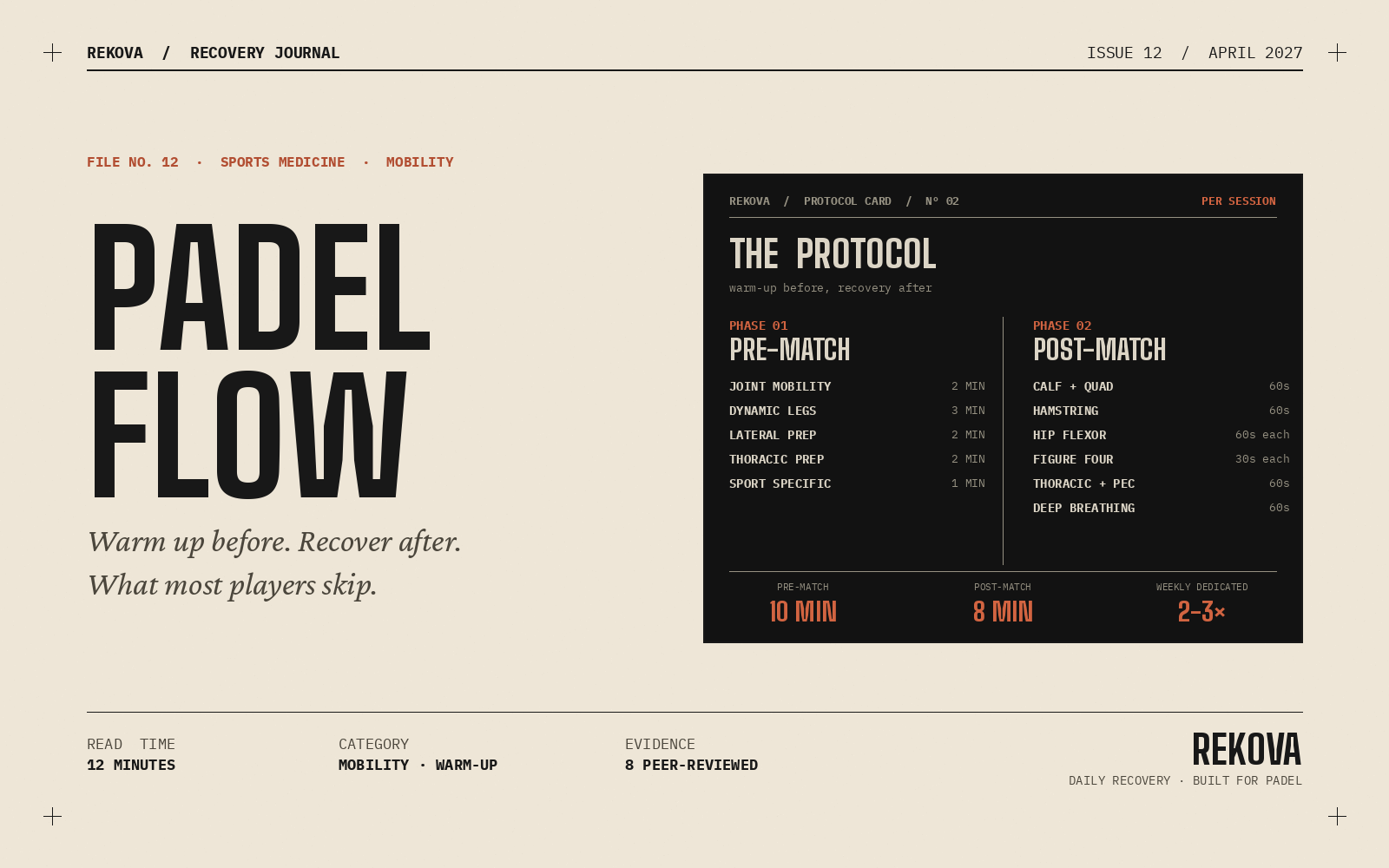
Here's what I do before every padel session. About 10 minutes total.
General joint mobility, 2 minutes. Ankle circles, hip circles, shoulder circles, wrist circles. 10 each direction. The goal is to lubricate joints and increase circulation.
Dynamic leg work, 3 minutes. Leg swings front to back, 10 each leg. Lateral leg swings, 10 each. Walking lunges, 10 forward. Reverse lunges, 10 each.
Lateral and rotational prep, 2 minutes. Side shuffles, 10 each direction. Carioca (the crossover step), 10 each direction. Standing rotational reaches, 10 each side. This is the most padel-specific part.
Thoracic and shoulder prep, 2 minutes. Arm circles forward and back. Cat-cow stretch, 8 reps. Standing thoracic rotations, 10 each side. Light shoulder taps in plank position, 20 total.
Sport-specific, 1 minute. Light pala swings, gradually building. Shadow forehands and backhands at 50 percent intensity, building to 80 percent. Two or three light side-to-side shuffles followed by a swing.
If you have 5 minutes only, skip the general joint mobility and do just dynamic leg work, lateral prep, and pala swings. Better than nothing.
Dynamic movement beats static stretching before activity. Studies show that holding static stretches for more than 30 seconds before activity actually reduces power output. Dynamic stretching (moving through ranges of motion) prepares the muscles without this downside.
Sport-specific movement matters. The warm-up should resemble what you're about to do. For padel, that means lateral movements, rotational work, and gradual progression to fuller swings.
Warm-up reduces injury risk significantly. The Lauersen 2014 meta-analysis (updated 2023) showed warm-up protocols reduce sports injuries by around 30 to 40 percent. Combined with strength training, the effect is even larger.
Here's what I do before every padel session. About 10 minutes total.
General joint mobility, 2 minutes. Ankle circles, hip circles, shoulder circles, wrist circles. 10 each direction. The goal is to lubricate joints and increase circulation.
Dynamic leg work, 3 minutes. Leg swings front to back, 10 each leg. Lateral leg swings, 10 each. Walking lunges, 10 forward. Reverse lunges, 10 each.
Lateral and rotational prep, 2 minutes. Side shuffles, 10 each direction. Carioca (the crossover step), 10 each direction. Standing rotational reaches, 10 each side. This is the most padel-specific part.
Thoracic and shoulder prep, 2 minutes. Arm circles forward and back. Cat-cow stretch, 8 reps. Standing thoracic rotations, 10 each side. Light shoulder taps in plank position, 20 total.
Sport-specific, 1 minute. Light pala swings, gradually building. Shadow forehands and backhands at 50 percent intensity, building to 80 percent. Two or three light side-to-side shuffles followed by a swing.
If you have 5 minutes only, skip the general joint mobility and do just dynamic leg work, lateral prep, and pala swings. Better than nothing.
Post-match: what actually helps recovery
Post-match mobility is different from pre-match. Now you can do static stretching. Now your goal is to help recovery, downregulate the nervous system, and reduce next-day stiffness.
The research on whether static stretching after exercise actually reduces soreness is mixed. The honest answer is that it might help a little, but the bigger benefits are likely psychological and the breathing component.
That said, what I do for about 5 to 10 minutes after a tough match.
Calf stretch against wall or step, 30 seconds each side.
Standing quad stretch, holding ankle behind, 30 seconds each side.
Hamstring stretch in standing forward fold, 30 to 60 seconds.
Hip flexor stretch in kneeling lunge position, 30 to 60 seconds each side. This is the most important one for desk workers.
Figure-four stretch for glutes, sitting on the floor with one ankle over opposite knee, 30 seconds each side.
Thoracic rotation lying on back, 30 seconds each side.
Pec stretch in doorway, 30 seconds each side. Important for shoulder health.
Deep breathing for 60 seconds at the end. Five seconds in, seven seconds out. This shifts the nervous system from sympathetic (fight or flight) to parasympathetic (recovery).
Total: 5 to 10 minutes. Done sitting on the floor near the court before you drive home. Or at home before dinner.
I covered the recovery considerations in detail in my padel recovery article. Mobility work is one piece of a larger recovery picture that includes nutrition, hydration, and sleep.
The research on whether static stretching after exercise actually reduces soreness is mixed. The honest answer is that it might help a little, but the bigger benefits are likely psychological and the breathing component.
That said, what I do for about 5 to 10 minutes after a tough match.
Calf stretch against wall or step, 30 seconds each side.
Standing quad stretch, holding ankle behind, 30 seconds each side.
Hamstring stretch in standing forward fold, 30 to 60 seconds.
Hip flexor stretch in kneeling lunge position, 30 to 60 seconds each side. This is the most important one for desk workers.
Figure-four stretch for glutes, sitting on the floor with one ankle over opposite knee, 30 seconds each side.
Thoracic rotation lying on back, 30 seconds each side.
Pec stretch in doorway, 30 seconds each side. Important for shoulder health.
Deep breathing for 60 seconds at the end. Five seconds in, seven seconds out. This shifts the nervous system from sympathetic (fight or flight) to parasympathetic (recovery).
Total: 5 to 10 minutes. Done sitting on the floor near the court before you drive home. Or at home before dinner.
I covered the recovery considerations in detail in my padel recovery article. Mobility work is one piece of a larger recovery picture that includes nutrition, hydration, and sleep.
Weekly mobility maintenance
Two to three sessions per week of dedicated mobility work makes a noticeable difference within 4 to 6 weeks. This isn't long. It's just consistent.
A reasonable 15-minute routine to do on rest days or after light activity.
Foam rolling, 5 minutes. Quads, IT bands, calves, upper back, glutes. Spend 30 to 60 seconds on each area. The research on foam rolling is mixed but the immediate sensation of looser muscles is real and there's no real downside.
90-90 hip stretches, 3 minutes. Sitting with one leg bent at 90 in front, other leg bent at 90 to the side. Lean over the front leg, then rotate to the back. This is the single best stretch for padel-specific hip mobility.
Couch stretch for hip flexors, 2 minutes. Kneeling with back foot up on couch or wall, front foot forward. 60 seconds each side. Brutal for desk workers but transformative.
Thoracic mobility work, 3 minutes. Cat-cow, thread the needle, prone cobra, prayer stretches. The thoracic spine wants to stiffen. Fight back with consistent attention.
Shoulder mobility work, 2 minutes. Wall slides, band dislocates, doorway pec stretches.
That's it. 15 minutes. Two or three times a week. The effect compounds over months in a way that surprises most people.
For my 52-year-old doubles partner, mobility work has become as important as the strength training he's done for 20 years. He spends 15 minutes most mornings on a basic routine that hasn't changed much over the years. The consistency is what makes the difference, not the specific exercises.
A reasonable 15-minute routine to do on rest days or after light activity.
Foam rolling, 5 minutes. Quads, IT bands, calves, upper back, glutes. Spend 30 to 60 seconds on each area. The research on foam rolling is mixed but the immediate sensation of looser muscles is real and there's no real downside.
90-90 hip stretches, 3 minutes. Sitting with one leg bent at 90 in front, other leg bent at 90 to the side. Lean over the front leg, then rotate to the back. This is the single best stretch for padel-specific hip mobility.
Couch stretch for hip flexors, 2 minutes. Kneeling with back foot up on couch or wall, front foot forward. 60 seconds each side. Brutal for desk workers but transformative.
Thoracic mobility work, 3 minutes. Cat-cow, thread the needle, prone cobra, prayer stretches. The thoracic spine wants to stiffen. Fight back with consistent attention.
Shoulder mobility work, 2 minutes. Wall slides, band dislocates, doorway pec stretches.
That's it. 15 minutes. Two or three times a week. The effect compounds over months in a way that surprises most people.
For my 52-year-old doubles partner, mobility work has become as important as the strength training he's done for 20 years. He spends 15 minutes most mornings on a basic routine that hasn't changed much over the years. The consistency is what makes the difference, not the specific exercises.
What most players get wrong
Skipping warm-up entirely. Already covered. Don't.
Stretching cold muscles before any movement. Static stretches before any general warm-up is asking for a strain. Move first, stretch later.
Holding stretches for 5 seconds. Stretches need 20 to 30 seconds minimum to actually affect tissue. Quick bounces don't count.
Only stretching what feels tight. The tight muscles are often the symptom. The weak antagonist muscles are often the cause. Stretching tight hip flexors helps short-term, but strengthening glutes addresses the root.
Doing the same routine forever. The body adapts. Vary the exercises every 6 to 8 weeks.
Foam rolling the IT band assuming it will lengthen. The IT band is fascia and doesn't really stretch much. Foam rolling it does help by reducing local muscle tension, but don't expect dramatic length changes.
Stretching through pain. Discomfort is fine. Sharp pain is not. There's no benefit to forcing range of motion through resistance.
Ignoring breath. Breathing into a stretch increases the parasympathetic response and allows the muscle to release. Holding your breath increases sympathetic activation and tension.
Stretching cold muscles before any movement. Static stretches before any general warm-up is asking for a strain. Move first, stretch later.
Holding stretches for 5 seconds. Stretches need 20 to 30 seconds minimum to actually affect tissue. Quick bounces don't count.
Only stretching what feels tight. The tight muscles are often the symptom. The weak antagonist muscles are often the cause. Stretching tight hip flexors helps short-term, but strengthening glutes addresses the root.
Doing the same routine forever. The body adapts. Vary the exercises every 6 to 8 weeks.
Foam rolling the IT band assuming it will lengthen. The IT band is fascia and doesn't really stretch much. Foam rolling it does help by reducing local muscle tension, but don't expect dramatic length changes.
Stretching through pain. Discomfort is fine. Sharp pain is not. There's no benefit to forcing range of motion through resistance.
Ignoring breath. Breathing into a stretch increases the parasympathetic response and allows the muscle to release. Holding your breath increases sympathetic activation and tension.
Considerations by age
Younger players under 35 typically have more inherent mobility but often the worst movement habits. Focus on technique and using full range of motion in everything, including strength work. Don't ignore mobility just because you don't feel restricted yet.
Players 35 to 50 have spent years in chairs and need active mobility work to maintain range. This is the demographic where mobility neglect costs the most. Two or three sessions per week is non-negotiable.
Players over 50 have additional considerations including connective tissue stiffness and arthritis in some cases. Mobility work becomes even more important but should be done with more care for warm-up. Longer warm-up before any stretching. Avoid maximum range of motion under load. I covered this in my padel after 40 article.
For women specifically, the natural hormonal variations in joint laxity (covered in my padel for women article) mean cycle phases affect mobility too. Mobility feels easier during ovulation but injury risk also increases at higher laxity points. Use the natural mobility but be careful with maximum stretches in that window.
Players 35 to 50 have spent years in chairs and need active mobility work to maintain range. This is the demographic where mobility neglect costs the most. Two or three sessions per week is non-negotiable.
Players over 50 have additional considerations including connective tissue stiffness and arthritis in some cases. Mobility work becomes even more important but should be done with more care for warm-up. Longer warm-up before any stretching. Avoid maximum range of motion under load. I covered this in my padel after 40 article.
For women specifically, the natural hormonal variations in joint laxity (covered in my padel for women article) mean cycle phases affect mobility too. Mobility feels easier during ovulation but injury risk also increases at higher laxity points. Use the natural mobility but be careful with maximum stretches in that window.
Equipment that's worth buying
You can do most mobility work with no equipment. A few cheap items help.
Foam roller, 30 to 50 euros. The single best mobility purchase. Use it twice a week minimum.
Resistance bands, 10 to 30 euros for a set. Useful for shoulder activation and stretching.
Lacrosse ball or trigger point ball, 5 to 15 euros. For more targeted release on glutes, pecs, calves.
Yoga mat, 20 to 40 euros. If you'll do floor work, a mat makes it pleasant rather than painful.
Total investment: about 80 euros for everything. Lasts years. Pays for itself in one avoided injury.
Foam roller, 30 to 50 euros. The single best mobility purchase. Use it twice a week minimum.
Resistance bands, 10 to 30 euros for a set. Useful for shoulder activation and stretching.
Lacrosse ball or trigger point ball, 5 to 15 euros. For more targeted release on glutes, pecs, calves.
Yoga mat, 20 to 40 euros. If you'll do floor work, a mat makes it pleasant rather than painful.
Total investment: about 80 euros for everything. Lasts years. Pays for itself in one avoided injury.
Where nutrition fits
Mobility work is mechanical. Most of what affects it is consistency and effort. But a few nutritional points worth knowing.
Hydration matters for tissue pliability. Dehydrated muscles and connective tissue are tighter and more prone to injury. I covered hydration in detail in my electrolytes article.
Magnesium contributes to normal muscle function (EFSA confirmed). Magnesium deficiency can contribute to cramping and tightness. Many adults are sub-optimal on magnesium intake.
Calcium contributes to normal muscle function (EFSA confirmed). Vitamin D contributes to normal muscle function (EFSA confirmed). All three work together.
Vitamin C contributes to normal collagen formation for normal function of cartilage and bones (EFSA confirmed). Connective tissue health matters for mobility and injury prevention. For amateurs doing strength plus mobility plus padel, supporting connective tissue makes sense.
This is part of why the Rekova formula includes hydrolyzed collagen, magnesium, vitamin C, and supporting nutrients. The mobility you build through movement gets supported by what you eat and drink.
Hydration matters for tissue pliability. Dehydrated muscles and connective tissue are tighter and more prone to injury. I covered hydration in detail in my electrolytes article.
Magnesium contributes to normal muscle function (EFSA confirmed). Magnesium deficiency can contribute to cramping and tightness. Many adults are sub-optimal on magnesium intake.
Calcium contributes to normal muscle function (EFSA confirmed). Vitamin D contributes to normal muscle function (EFSA confirmed). All three work together.
Vitamin C contributes to normal collagen formation for normal function of cartilage and bones (EFSA confirmed). Connective tissue health matters for mobility and injury prevention. For amateurs doing strength plus mobility plus padel, supporting connective tissue makes sense.
This is part of why the Rekova formula includes hydrolyzed collagen, magnesium, vitamin C, and supporting nutrients. The mobility you build through movement gets supported by what you eat and drink.
FAQ: questions about mobility for padel
Should I stretch before or after padel? Both, but different stretches. Dynamic movement before. Static stretching after.
How long should I warm up? 10 minutes is the practical minimum for adults. 15 if you're over 45 or arriving stiff.
Can I get away with skipping warm-up? Sometimes. For a while. Until you can't. Don't ask me how I know.
Is yoga good for padel? Yes, particularly styles that emphasize functional mobility (like some forms of vinyasa or restorative yoga). Less so for ultra-flexibility-focused styles. Once a week is plenty.
What about static stretching at home, not after sport? Fine but lower priority than dynamic mobility work. If you have to choose, choose the mobility routine over passive stretching.
Should I use heat or ice for tight muscles? Heat before activity to increase blood flow. Ice for acute injuries within the first 48 hours. Beyond that, the evidence is mixed.
Does massage help? Yes, professional sports massage twice a month or so can help significantly. Self-massage with foam roller is a cheaper substitute.
Are static stretches bad for performance? Holding static stretches for more than 30 seconds before activity reduces power output by a small but measurable amount (around 5 to 10 percent in studies). Short static stretches under 15 seconds don't seem to have this effect. After activity, no negative impact.
What about PNF stretching? It works well for mobility gains but requires either a partner or specific knowledge. For most amateurs, simpler protocols are fine.
What if I can't touch my toes? Common in desk workers. Work on hamstring and lower back mobility together. Avoid sit-and-reach style training. Focus instead on hip hinge mobility and posterior chain activation.
How does mobility relate to balance? Tightly. Limited ankle dorsiflexion affects balance and lateral movement quality. Limited hip mobility affects single-leg stability. Mobility work improves balance indirectly.
How quickly will I see results? Range of motion improvements start within 2 weeks. Significant changes in how you feel on court usually come within 4 to 6 weeks of consistent work.
How long should I warm up? 10 minutes is the practical minimum for adults. 15 if you're over 45 or arriving stiff.
Can I get away with skipping warm-up? Sometimes. For a while. Until you can't. Don't ask me how I know.
Is yoga good for padel? Yes, particularly styles that emphasize functional mobility (like some forms of vinyasa or restorative yoga). Less so for ultra-flexibility-focused styles. Once a week is plenty.
What about static stretching at home, not after sport? Fine but lower priority than dynamic mobility work. If you have to choose, choose the mobility routine over passive stretching.
Should I use heat or ice for tight muscles? Heat before activity to increase blood flow. Ice for acute injuries within the first 48 hours. Beyond that, the evidence is mixed.
Does massage help? Yes, professional sports massage twice a month or so can help significantly. Self-massage with foam roller is a cheaper substitute.
Are static stretches bad for performance? Holding static stretches for more than 30 seconds before activity reduces power output by a small but measurable amount (around 5 to 10 percent in studies). Short static stretches under 15 seconds don't seem to have this effect. After activity, no negative impact.
What about PNF stretching? It works well for mobility gains but requires either a partner or specific knowledge. For most amateurs, simpler protocols are fine.
What if I can't touch my toes? Common in desk workers. Work on hamstring and lower back mobility together. Avoid sit-and-reach style training. Focus instead on hip hinge mobility and posterior chain activation.
How does mobility relate to balance? Tightly. Limited ankle dorsiflexion affects balance and lateral movement quality. Limited hip mobility affects single-leg stability. Mobility work improves balance indirectly.
How quickly will I see results? Range of motion improvements start within 2 weeks. Significant changes in how you feel on court usually come within 4 to 6 weeks of consistent work.
The short version
Mobility matters more than flexibility for padel. Dynamic warm-up before play for about 10 minutes. Static stretching and breathing after play for 5 to 10 minutes. Two or three dedicated mobility sessions per week. The padel-specific focus is hip mobility, thoracic rotation, ankle dorsiflexion, and shoulder range. Most amateurs have desk-job-induced restrictions that mobility work addresses. Skip mobility and pay later through injuries that take months to recover from.
The boring fundamentals beat fancy padel-specific drills nine times out of ten.
The boring fundamentals beat fancy padel-specific drills nine times out of ten.
Sources
Lauersen JB et al. The effectiveness of exercise interventions to prevent sports injuries: a systematic review and meta-analysis of randomised controlled trials. British Journal of Sports Medicine. 2014, updated 2023.
Behm DG et al. Acute effects of muscle stretching on physical performance, range of motion, and injury incidence in healthy active individuals. Applied Physiology, Nutrition, and Metabolism. 2023 update.
Smith Palacio E. Epidemiologia de las lesiones en padel y recomendaciones preventivas. Ciencia y Deporte. April 2024.
Dahmen J. et al. Incidence, prevalence and nature of injuries in padel: a systematic review. BMJ Open Sport and Exercise Medicine. 2023.
Knapik JJ et al. Stretching, warming up, and cooling down for prevention of musculoskeletal injuries. Current Sports Medicine Reports. 2023.
International Society of Sports Nutrition. Position stand on protein and exercise. JISSN. 2024.
American College of Sports Medicine. Position stand on physical activity and bone health. 2024.
EFSA. Scientific Opinions on the substantiation of health claims related to magnesium, calcium, vitamin D, and vitamin C. EFSA Journal, various years.
This article shares my own experience with mobility work and reflects current research on warm-up, stretching, and sport-specific mobility. It is not medical advice. If you have a history of joint injuries, have any medical condition affecting your musculoskeletal system, or experience pain during mobility work, please consult a qualified physiotherapist or sports medicine doctor before starting any new program.
Rekova does not replace proper training or warm-up. It is a daily functional drink with electrolytes, magnesium, hydrolyzed collagen, B vitamins, vitamin C, CoQ10, Acetyl-L-Carnitine, and supporting nutrients, formulated as nutritional support for people who play padel regularly.
Behm DG et al. Acute effects of muscle stretching on physical performance, range of motion, and injury incidence in healthy active individuals. Applied Physiology, Nutrition, and Metabolism. 2023 update.
Smith Palacio E. Epidemiologia de las lesiones en padel y recomendaciones preventivas. Ciencia y Deporte. April 2024.
Dahmen J. et al. Incidence, prevalence and nature of injuries in padel: a systematic review. BMJ Open Sport and Exercise Medicine. 2023.
Knapik JJ et al. Stretching, warming up, and cooling down for prevention of musculoskeletal injuries. Current Sports Medicine Reports. 2023.
International Society of Sports Nutrition. Position stand on protein and exercise. JISSN. 2024.
American College of Sports Medicine. Position stand on physical activity and bone health. 2024.
EFSA. Scientific Opinions on the substantiation of health claims related to magnesium, calcium, vitamin D, and vitamin C. EFSA Journal, various years.
This article shares my own experience with mobility work and reflects current research on warm-up, stretching, and sport-specific mobility. It is not medical advice. If you have a history of joint injuries, have any medical condition affecting your musculoskeletal system, or experience pain during mobility work, please consult a qualified physiotherapist or sports medicine doctor before starting any new program.
Rekova does not replace proper training or warm-up. It is a daily functional drink with electrolytes, magnesium, hydrolyzed collagen, B vitamins, vitamin C, CoQ10, Acetyl-L-Carnitine, and supporting nutrients, formulated as nutritional support for people who play padel regularly.
