I bought my first pala based on what a player I admired was using. He was about 30 years old, played in tournaments, hit hard, and his pala was a heavy diamond-shaped one weighing around 380 grams. I figured if it worked for him, it would work for me.
I gave myself padel elbow within two months.
The diamond shape concentrates power at the tip, which is great if you have the technique and arm strength to control it. I had neither. The weight made every shot effortful for my untrained tennis-derived swing. The off-center balance meant my forearm was working overtime to stabilize the pala on every contact.
I now know all of this. Back then I just knew my elbow hurt and I had no idea why.
What follows is what I've learned in the years since. About 40 hours of conversations with shop owners, physiotherapists, and players at various levels. Three pala changes of my own. And reading whatever research exists on the biomechanics of racquet sports equipment.
Below is the honest guide to choosing a pala that fits your body. Not your aspirations. Not what your favorite pro uses. Your actual body.
Why pala choice matters for your body
Most pala marketing focuses on performance. More power. More control. Tournament-grade construction. The implication is that a better pala helps you play better.
True up to a point. The bigger issue is that the wrong pala can quietly destroy your arm.
I covered padel elbow extensively in my dedicated article on that topic. The Smith Palacio 2024 paper found that pala-related factors (weight, shape, balance, vibration absorption) were significant contributors to amateur injury patterns. About 18 percent of amateur injuries trace back to equipment selection issues.
The mechanism is simple. Every shot transfers force through the pala into your hand, forearm, elbow, and shoulder. A pala that doesn't suit your body amplifies that force in problematic ways. Over hundreds of shots per session, thousands per week, the cumulative load shows up as tendinopathy, wrist strain, or shoulder issues.
This isn't theoretical. Walk into any padel club and ask how many regular players have had elbow problems. The answer is most of them. Many of those problems trace partly to equipment choices.
True up to a point. The bigger issue is that the wrong pala can quietly destroy your arm.
I covered padel elbow extensively in my dedicated article on that topic. The Smith Palacio 2024 paper found that pala-related factors (weight, shape, balance, vibration absorption) were significant contributors to amateur injury patterns. About 18 percent of amateur injuries trace back to equipment selection issues.
The mechanism is simple. Every shot transfers force through the pala into your hand, forearm, elbow, and shoulder. A pala that doesn't suit your body amplifies that force in problematic ways. Over hundreds of shots per session, thousands per week, the cumulative load shows up as tendinopathy, wrist strain, or shoulder issues.
This isn't theoretical. Walk into any padel club and ask how many regular players have had elbow problems. The answer is most of them. Many of those problems trace partly to equipment choices.
The three factors that actually matter
Pala marketing talks about dozens of variables. Most don't matter much. Three do.
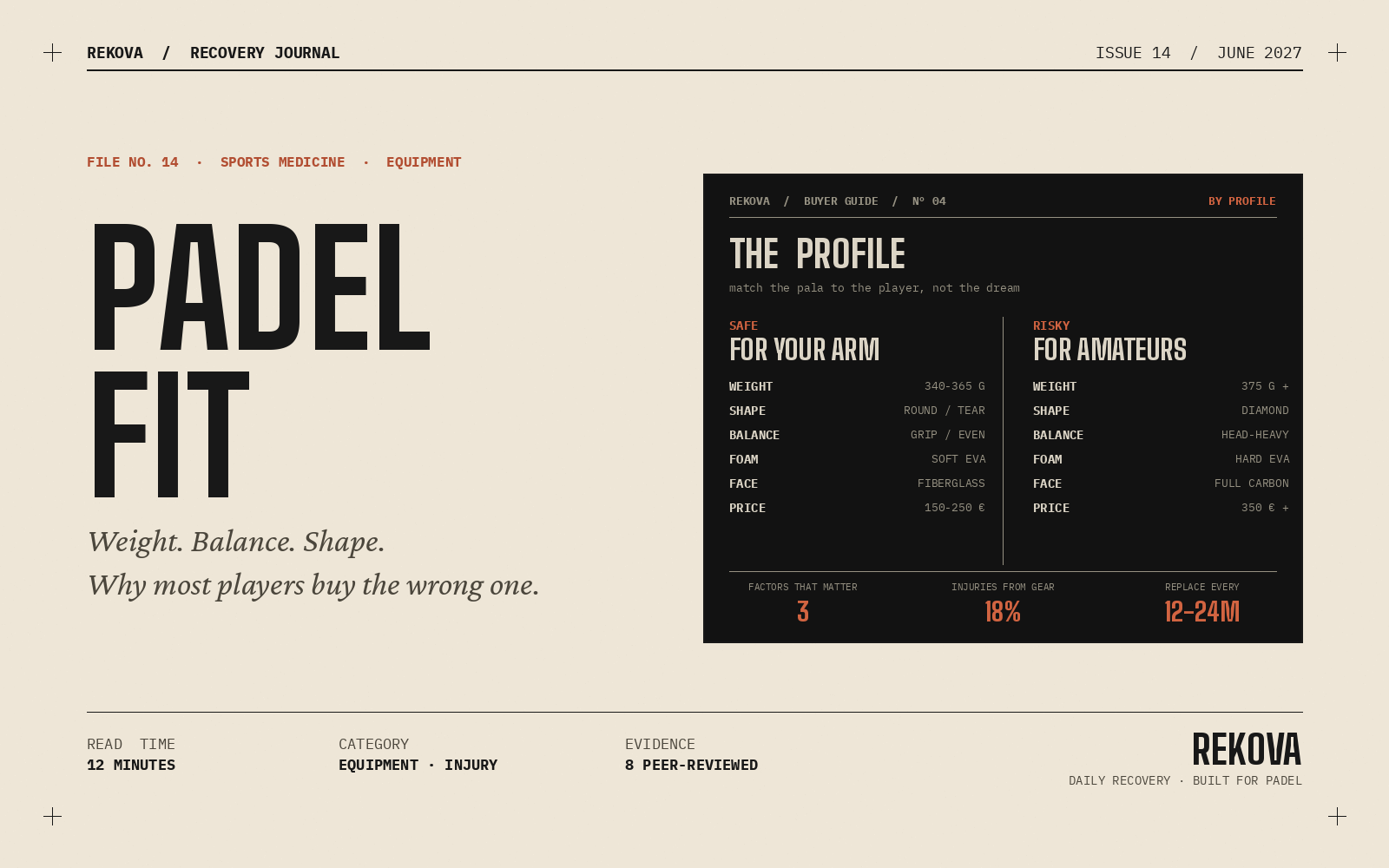
Weight. How heavy the pala is. Typical range from 340 grams (lighter) to 385 grams (heavier). This determines how much effort each swing requires.
Balance. Where the weight is distributed between the grip and the head. This determines how the pala feels in motion and how much stabilization your forearm does.
Shape. Round, teardrop, or diamond. This determines where the sweet spot is and how forgiving the pala is on off-center hits.
If you understand these three factors and choose appropriately, you'll have a pala that fits your body. The other factors (materials, brand, color) matter much less.
Weight. How heavy the pala is. Typical range from 340 grams (lighter) to 385 grams (heavier). This determines how much effort each swing requires.
Balance. Where the weight is distributed between the grip and the head. This determines how the pala feels in motion and how much stabilization your forearm does.
Shape. Round, teardrop, or diamond. This determines where the sweet spot is and how forgiving the pala is on off-center hits.
If you understand these three factors and choose appropriately, you'll have a pala that fits your body. The other factors (materials, brand, color) matter much less.
Weight: what's right for what
Pala weight has a direct relationship with the strain you put on your arm. Heavier palas require more effort to swing and absorb more impact force at contact.
The standard categories.
Lightweight, 340 to 360 grams. Best for beginners, smaller players, players with arm injury history, players over 50, most women players, and anyone who hits with technique over power. Forgiving on the arm.
Mid-weight, 360 to 375 grams. The sweet spot for most amateur men of average build with no injury history. Provides decent power without excessive strain. Where most amateurs should land.
Heavyweight, 375 to 385 plus grams. For experienced players with developed technique, larger players, and players who want maximum power for offensive play. Demanding on the arm. Requires good warm-up and good form to use without injury.
Manufacturers sometimes go above 385 grams. I'd avoid these as an amateur regardless of your body size unless a physiotherapist or coach specifically recommends one.
Adding weight via lead tape (cinta de plomo) is common. Adds 5 to 15 grams of customization. Useful for fine-tuning. But adding 30 grams to a stock 360-gram pala doesn't make it a 390-gram pala. The factory-designed weight distribution stays optimized for the original weight.
Subtracting weight isn't really possible. If you want lighter, buy lighter.
The standard categories.
Lightweight, 340 to 360 grams. Best for beginners, smaller players, players with arm injury history, players over 50, most women players, and anyone who hits with technique over power. Forgiving on the arm.
Mid-weight, 360 to 375 grams. The sweet spot for most amateur men of average build with no injury history. Provides decent power without excessive strain. Where most amateurs should land.
Heavyweight, 375 to 385 plus grams. For experienced players with developed technique, larger players, and players who want maximum power for offensive play. Demanding on the arm. Requires good warm-up and good form to use without injury.
Manufacturers sometimes go above 385 grams. I'd avoid these as an amateur regardless of your body size unless a physiotherapist or coach specifically recommends one.
Adding weight via lead tape (cinta de plomo) is common. Adds 5 to 15 grams of customization. Useful for fine-tuning. But adding 30 grams to a stock 360-gram pala doesn't make it a 390-gram pala. The factory-designed weight distribution stays optimized for the original weight.
Subtracting weight isn't really possible. If you want lighter, buy lighter.
Balance: the most underappreciated factor
Pala balance matters more than most players realize. The category most amateurs ignore.
Grip-heavy balance. The weight is concentrated toward the handle. The pala feels lighter than it actually is when swinging. Easier to maneuver, less strain on the arm, gentler on the elbow. Better for control players, beginners, and anyone with arm issues.
Even balance. The weight is distributed roughly equally between handle and head. The pala feels balanced and predictable. Suits most amateurs and most game styles.
Head-heavy balance. The weight is concentrated toward the head. The pala feels heavier when swinging and generates more power at contact, but requires more arm strength to stabilize. More strain on elbow and wrist. Better for advanced offensive players who can handle the additional demands.
Shape correlates with balance. Round palas tend to be grip-balanced. Teardrops are usually even-balanced. Diamonds are typically head-balanced. But within each shape category there's variation.
The simple test in the shop. Hold the pala by the grip with your arm extended. Notice where the weight feels concentrated. If it feels like the weight is hanging from the tip, it's head-heavy. If it feels balanced in your hand, it's even or grip-balanced.
Most amateurs benefit from grip-balanced or even-balanced palas. Most amateurs buy head-balanced diamonds because they look aggressive. This is one of the most common mistakes that contribute to elbow problems.
Grip-heavy balance. The weight is concentrated toward the handle. The pala feels lighter than it actually is when swinging. Easier to maneuver, less strain on the arm, gentler on the elbow. Better for control players, beginners, and anyone with arm issues.
Even balance. The weight is distributed roughly equally between handle and head. The pala feels balanced and predictable. Suits most amateurs and most game styles.
Head-heavy balance. The weight is concentrated toward the head. The pala feels heavier when swinging and generates more power at contact, but requires more arm strength to stabilize. More strain on elbow and wrist. Better for advanced offensive players who can handle the additional demands.
Shape correlates with balance. Round palas tend to be grip-balanced. Teardrops are usually even-balanced. Diamonds are typically head-balanced. But within each shape category there's variation.
The simple test in the shop. Hold the pala by the grip with your arm extended. Notice where the weight feels concentrated. If it feels like the weight is hanging from the tip, it's head-heavy. If it feels balanced in your hand, it's even or grip-balanced.
Most amateurs benefit from grip-balanced or even-balanced palas. Most amateurs buy head-balanced diamonds because they look aggressive. This is one of the most common mistakes that contribute to elbow problems.
Shape: round, teardrop, diamond
The three classic shapes have meaningful differences for how they feel and what they do.
Round. The sweet spot is in the center of the pala. Larger forgiving area on off-center hits. Best for beginners and control players. Generates less power than other shapes but offers the most consistent feel.
Teardrop. The sweet spot is between the center and the head. Sometimes called the universal shape. Balanced trade-off between power and control. Best for intermediate players and most amateurs. The largest category in modern padel.
Diamond. The sweet spot is in the head, near the tip. Maximum power on well-placed hits but very unforgiving on off-center contacts. Off-center hits with a diamond transmit lots of vibration to the arm. Best for advanced offensive players with developed technique.
For most amateur players, teardrop is the safe default. Some amateurs do better with round shapes. Diamond should be reserved for players with at least 2 to 3 years of consistent playing and confirmed good technique.
If you've been playing less than a year and are using a diamond, switch. Almost certainly the wrong shape for your level.
Round. The sweet spot is in the center of the pala. Larger forgiving area on off-center hits. Best for beginners and control players. Generates less power than other shapes but offers the most consistent feel.
Teardrop. The sweet spot is between the center and the head. Sometimes called the universal shape. Balanced trade-off between power and control. Best for intermediate players and most amateurs. The largest category in modern padel.
Diamond. The sweet spot is in the head, near the tip. Maximum power on well-placed hits but very unforgiving on off-center contacts. Off-center hits with a diamond transmit lots of vibration to the arm. Best for advanced offensive players with developed technique.
For most amateur players, teardrop is the safe default. Some amateurs do better with round shapes. Diamond should be reserved for players with at least 2 to 3 years of consistent playing and confirmed good technique.
If you've been playing less than a year and are using a diamond, switch. Almost certainly the wrong shape for your level.
Materials and surface
Less impact than the three factors above, but worth knowing.
Foam core. Most palas use either EVA foam or FOAM (or marketing-named versions). Softer foam (often called soft or FOAM) is more comfortable on impact, transmits less vibration to the arm, and generally easier on the body. Harder foam (EVA Hard or similar) provides more power and more rebound but transmits more vibration. For amateur arm health, softer foam is the safer choice.
Face material. Fiberglass surfaces are softer and easier on the arm. Carbon fiber is harder, generates more power, transmits more vibration. Hybrid faces exist. Fiberglass is gentler for amateurs.
Surface texture. Rough vs smooth. Affects spin generation. Doesn't significantly affect arm health.
Frame construction. Higher-end palas have better vibration damping built in. The difference between a 80-euro and 200-euro pala includes meaningful improvements in vibration management at impact. If your budget allows mid-range, the arm-health benefit is real.
Foam core. Most palas use either EVA foam or FOAM (or marketing-named versions). Softer foam (often called soft or FOAM) is more comfortable on impact, transmits less vibration to the arm, and generally easier on the body. Harder foam (EVA Hard or similar) provides more power and more rebound but transmits more vibration. For amateur arm health, softer foam is the safer choice.
Face material. Fiberglass surfaces are softer and easier on the arm. Carbon fiber is harder, generates more power, transmits more vibration. Hybrid faces exist. Fiberglass is gentler for amateurs.
Surface texture. Rough vs smooth. Affects spin generation. Doesn't significantly affect arm health.
Frame construction. Higher-end palas have better vibration damping built in. The difference between a 80-euro and 200-euro pala includes meaningful improvements in vibration management at impact. If your budget allows mid-range, the arm-health benefit is real.
The marketing tricks to ignore
A few patterns in pala marketing that don't really matter.
Pro player endorsements. Players who are sponsored use what they're sponsored to use. Their pala may or may not actually suit them. It almost certainly doesn't suit you.
Year-over-year model updates. Most yearly model updates are cosmetic or marginal. The 2026 version of a popular pala isn't dramatically different from the 2024 version.
Specific technologies with proprietary names. Companies invent names for normal manufacturing techniques. Branded names for foam types, fiber arrangements, surface coatings. Most don't represent meaningful differences from competitor products.
Pala color. Doesn't affect performance or arm health. Doesn't matter beyond personal preference.
Weight ranges from the manufacturer. Stated as ranges (for example, 365 to 375 grams) because individual palas vary. The specific pala you receive could be anywhere in the range. If precise weight matters to you, take a luggage scale to the shop.
What does matter. Weight, balance, shape, material softness, vibration damping. The basics that actually affect your body. Companies talking about these factors in plain language are giving you useful information. Companies invoking proprietary technologies are mostly selling marketing.
Pro player endorsements. Players who are sponsored use what they're sponsored to use. Their pala may or may not actually suit them. It almost certainly doesn't suit you.
Year-over-year model updates. Most yearly model updates are cosmetic or marginal. The 2026 version of a popular pala isn't dramatically different from the 2024 version.
Specific technologies with proprietary names. Companies invent names for normal manufacturing techniques. Branded names for foam types, fiber arrangements, surface coatings. Most don't represent meaningful differences from competitor products.
Pala color. Doesn't affect performance or arm health. Doesn't matter beyond personal preference.
Weight ranges from the manufacturer. Stated as ranges (for example, 365 to 375 grams) because individual palas vary. The specific pala you receive could be anywhere in the range. If precise weight matters to you, take a luggage scale to the shop.
What does matter. Weight, balance, shape, material softness, vibration damping. The basics that actually affect your body. Companies talking about these factors in plain language are giving you useful information. Companies invoking proprietary technologies are mostly selling marketing.
How to choose if you're a beginner
If you've been playing less than a year:
Weight 340 to 360 grams. Stay light. Your technique isn't developed enough to make a heavier pala work for you.
Round or teardrop shape. Skip the diamond entirely until you have technique.
Grip-balanced or even balance. You need help, not extra demands on your arm.
Softer foam, fiberglass face. Forgiveness on every dimension.
Price range 60 to 150 euros. There's no reason to spend more until you know whether you'll keep playing. Used market is fine.
This pala won't make you look like an aggressive offensive player. That's correct. You aren't one yet.
Weight 340 to 360 grams. Stay light. Your technique isn't developed enough to make a heavier pala work for you.
Round or teardrop shape. Skip the diamond entirely until you have technique.
Grip-balanced or even balance. You need help, not extra demands on your arm.
Softer foam, fiberglass face. Forgiveness on every dimension.
Price range 60 to 150 euros. There's no reason to spend more until you know whether you'll keep playing. Used market is fine.
This pala won't make you look like an aggressive offensive player. That's correct. You aren't one yet.
How to choose if you're intermediate
If you've been playing 1 to 3 years and have good fundamentals:
Weight 360 to 375 grams. The mid-range. Match your strength and playing style.
Teardrop is the default. Round if you're more of a control player.
Even balance. Some lean toward head-balanced if you have strength and want offense, grip-balanced if you have any arm history.
Mid-grade foam and fiberglass or hybrid face.
Price range 150 to 250 euros gets you genuine performance improvements over entry-level palas. The arm health benefits of better vibration damping become noticeable here.
Weight 360 to 375 grams. The mid-range. Match your strength and playing style.
Teardrop is the default. Round if you're more of a control player.
Even balance. Some lean toward head-balanced if you have strength and want offense, grip-balanced if you have any arm history.
Mid-grade foam and fiberglass or hybrid face.
Price range 150 to 250 euros gets you genuine performance improvements over entry-level palas. The arm health benefits of better vibration damping become noticeable here.
How to choose if you have a history of injury
If you've had padel elbow or wrist or shoulder issues:
Weight 340 to 365 grams. Lighter than your strength might suggest. Take pressure off the joints.
Round or teardrop shape. Diamond is not for you, regardless of your level.
Grip-balanced or even balance. Off-center balance amplifies forearm load.
Softer foam, fiberglass face. Maximum vibration absorption.
Consider switching to a thicker grip (gripping a thicker handle reduces forearm strain).
I covered the full elbow recovery and prevention protocol in my dedicated article. The pala choice is one piece of a larger picture.
Weight 340 to 365 grams. Lighter than your strength might suggest. Take pressure off the joints.
Round or teardrop shape. Diamond is not for you, regardless of your level.
Grip-balanced or even balance. Off-center balance amplifies forearm load.
Softer foam, fiberglass face. Maximum vibration absorption.
Consider switching to a thicker grip (gripping a thicker handle reduces forearm strain).
I covered the full elbow recovery and prevention protocol in my dedicated article. The pala choice is one piece of a larger picture.
Grip size and technique
The grip on the pala matters more than most players think.
Standard pala grips run about 18 mm in diameter. Most adults can use them comfortably. People with very small hands sometimes find them too thick. People with large hands sometimes find them too thin.
Overgrips (added on top of the original grip) change the effective diameter. Adding one overgrip increases diameter by about 1.5 mm. Adding two increases by about 3 mm.
For arm health, a slightly thicker grip is often better than a thinner one. Larger grip diameter reduces the muscle work needed to maintain a stable grip on impact. Less work in the forearm means less elbow tendon strain.
If you have any elbow issues, try adding an overgrip. Often makes a noticeable difference within weeks.
Grip technique matters too. The death grip (gripping as hard as possible at all times) wastes energy and increases tendon strain. The right grip pressure is firm at contact but relaxed between shots. Players with elbow issues often default to gripping too hard. Conscious relaxation between shots helps.
Standard pala grips run about 18 mm in diameter. Most adults can use them comfortably. People with very small hands sometimes find them too thick. People with large hands sometimes find them too thin.
Overgrips (added on top of the original grip) change the effective diameter. Adding one overgrip increases diameter by about 1.5 mm. Adding two increases by about 3 mm.
For arm health, a slightly thicker grip is often better than a thinner one. Larger grip diameter reduces the muscle work needed to maintain a stable grip on impact. Less work in the forearm means less elbow tendon strain.
If you have any elbow issues, try adding an overgrip. Often makes a noticeable difference within weeks.
Grip technique matters too. The death grip (gripping as hard as possible at all times) wastes energy and increases tendon strain. The right grip pressure is firm at contact but relaxed between shots. Players with elbow issues often default to gripping too hard. Conscious relaxation between shots helps.
When to replace your pala
Pala lifespan depends on use frequency and quality. Some guidelines.
Recreational player (1 to 2 sessions per week). A mid-range pala lasts 18 to 36 months before noticeable degradation. The foam compresses, surface wear accumulates, performance drops gradually.
Regular player (3 to 4 sessions per week). 12 to 24 months. The same pala wears faster with more use.
Tournament player. 6 to 12 months. The pala gets significantly more stress.
Signs your pala is past its prime. Visible cracks in the surface (definite replacement). Foam feels deflated or dead at impact. The sound of the ball off the pala changes (becomes duller). Performance drops noticeably. Increased vibration through your arm on contact.
A pala that's deteriorating transmits more vibration to your arm. Playing on a beat-up pala increases injury risk. Replacement isn't just about performance.
Recreational player (1 to 2 sessions per week). A mid-range pala lasts 18 to 36 months before noticeable degradation. The foam compresses, surface wear accumulates, performance drops gradually.
Regular player (3 to 4 sessions per week). 12 to 24 months. The same pala wears faster with more use.
Tournament player. 6 to 12 months. The pala gets significantly more stress.
Signs your pala is past its prime. Visible cracks in the surface (definite replacement). Foam feels deflated or dead at impact. The sound of the ball off the pala changes (becomes duller). Performance drops noticeably. Increased vibration through your arm on contact.
A pala that's deteriorating transmits more vibration to your arm. Playing on a beat-up pala increases injury risk. Replacement isn't just about performance.
Where Rekova fits
Brief. Equipment choices reduce mechanical strain on your body. Recovery and nutrition help your body handle the strain that remains.
A daily recovery drink with magnesium for normal muscle function, vitamin C contributing to normal collagen formation for normal function of cartilage and bones, B vitamins, and hydrolyzed collagen supports the connective tissue health that gets stressed by regular play.
This is part of a complete approach. Right pala plus good technique plus proper warm-up plus daily nutritional support plus consistent recovery. Each piece matters. None substitute for the others.
A daily recovery drink with magnesium for normal muscle function, vitamin C contributing to normal collagen formation for normal function of cartilage and bones, B vitamins, and hydrolyzed collagen supports the connective tissue health that gets stressed by regular play.
This is part of a complete approach. Right pala plus good technique plus proper warm-up plus daily nutritional support plus consistent recovery. Each piece matters. None substitute for the others.
FAQ: questions about pala selection
What's the best pala for elbow problems? Light (under 365 grams), round or teardrop shape, grip-balanced, soft foam, fiberglass face. Avoid diamond shapes entirely. Add an overgrip if your handle feels thin.
Should I try a pala before buying? Yes if possible. Most padel shops let you hit a few balls with display models. Some clubs have demo programs. Online buying without trying is fine for established brands and known model lines but riskier for new releases.
How much should I spend? Beginner: 60 to 150 euros. Intermediate: 150 to 250 euros. Serious amateur: 200 to 350 euros. Above 350 euros you're paying for marginal improvements that mostly don't matter to amateur play.
Used palas worth considering? Yes, but check carefully for cracks, signs of repair, or excessive surface wear. A used 200-euro pala for 100 euros is a great deal if it's in good shape. A 200-euro pala for 50 euros that's beat up is a bad deal at any price.
How often should beginners change palas? Don't rush. The first pala can last 2 to 3 years for occasional players. Don't keep buying new palas hoping they'll fix your game. Better technique fixes your game.
What about kids' palas? Real consideration for junior players. Smaller, lighter palas designed for kids exist. Don't put an adult pala in the hands of an under-12 player.
Does pala color affect performance? No. Pure marketing.
What's the difference between competition palas and recreational palas? The boundary is fuzzy. Competition-labeled palas typically have better materials and construction but cost more. For amateurs, the labels are often more marketing than practical difference.
Should women use women-specific palas? Sometimes yes. Smaller hands often benefit from grip-balanced palas with thinner handles. The women-specific marketing is mostly about lighter weight, which is appropriate for many but not all women. I covered women-specific considerations in my padel for women article.
What about palas for players over 50? Lighter weight (340 to 360 grams), grip-balanced, soft foam. Same logic as for players with injury history. I covered this in my padel after 40 article.
Should I try a pala before buying? Yes if possible. Most padel shops let you hit a few balls with display models. Some clubs have demo programs. Online buying without trying is fine for established brands and known model lines but riskier for new releases.
How much should I spend? Beginner: 60 to 150 euros. Intermediate: 150 to 250 euros. Serious amateur: 200 to 350 euros. Above 350 euros you're paying for marginal improvements that mostly don't matter to amateur play.
Used palas worth considering? Yes, but check carefully for cracks, signs of repair, or excessive surface wear. A used 200-euro pala for 100 euros is a great deal if it's in good shape. A 200-euro pala for 50 euros that's beat up is a bad deal at any price.
How often should beginners change palas? Don't rush. The first pala can last 2 to 3 years for occasional players. Don't keep buying new palas hoping they'll fix your game. Better technique fixes your game.
What about kids' palas? Real consideration for junior players. Smaller, lighter palas designed for kids exist. Don't put an adult pala in the hands of an under-12 player.
Does pala color affect performance? No. Pure marketing.
What's the difference between competition palas and recreational palas? The boundary is fuzzy. Competition-labeled palas typically have better materials and construction but cost more. For amateurs, the labels are often more marketing than practical difference.
Should women use women-specific palas? Sometimes yes. Smaller hands often benefit from grip-balanced palas with thinner handles. The women-specific marketing is mostly about lighter weight, which is appropriate for many but not all women. I covered women-specific considerations in my padel for women article.
What about palas for players over 50? Lighter weight (340 to 360 grams), grip-balanced, soft foam. Same logic as for players with injury history. I covered this in my padel after 40 article.
The short version
Three factors matter for pala selection in terms of your body. Weight, balance, shape. Lighter palas, grip-balanced or even balance, and round or teardrop shapes are gentler on the arm and forgiving for amateurs. Diamond-shaped head-heavy palas look aggressive and cause more injuries. Soft foam and fiberglass faces transmit less vibration to the arm. Marketing focuses on pro endorsements and proprietary technologies that mostly don't matter. Replacement timing depends on use frequency. Beat-up palas transmit more vibration and increase injury risk. The right pala fits your body, not your aspirations.
The boring fundamentals beat fancy padel-specific marketing nine times out of ten.
The boring fundamentals beat fancy padel-specific marketing nine times out of ten.
Sources
Smith Palacio E. Epidemiologia de las lesiones en padel y recomendaciones preventivas. Ciencia y Deporte. April 2024.
Dahmen J. et al. Incidence, prevalence and nature of injuries in padel: a systematic review. BMJ Open Sport and Exercise Medicine. 2023.
Bandeja Shop. Pala selection guide for amateur players. 2025.
Padel39. Buyer guide for padel rackets. 2025 edition.
Padel Magazine. Pala technology and player health. 2024.
Marcos Rivero B. et al. Evolution of Physiological Responses and Fatigue Analysis in Padel Matches. Sensors. August 2025.
Padel Rumors. Equipment reviews and analysis. 2024-2026.
EFSA. Scientific Opinions on the substantiation of health claims related to magnesium and vitamin C. EFSA Journal, various years.
This article shares my own experience with pala selection and general industry knowledge about padel equipment. It is not medical advice. If you have any persistent arm, wrist, elbow, or shoulder pain, please consult a qualified physiotherapist or sports medicine doctor. Equipment changes alone rarely resolve established injuries.
Rekova does not treat injuries and is not a substitute for medical care. It is a daily functional drink with electrolytes, magnesium, hydrolyzed collagen, B vitamins, vitamin C, CoQ10, Acetyl-L-Carnitine, and supporting nutrients, formulated as nutritional support for people who play padel regularly.
Dahmen J. et al. Incidence, prevalence and nature of injuries in padel: a systematic review. BMJ Open Sport and Exercise Medicine. 2023.
Bandeja Shop. Pala selection guide for amateur players. 2025.
Padel39. Buyer guide for padel rackets. 2025 edition.
Padel Magazine. Pala technology and player health. 2024.
Marcos Rivero B. et al. Evolution of Physiological Responses and Fatigue Analysis in Padel Matches. Sensors. August 2025.
Padel Rumors. Equipment reviews and analysis. 2024-2026.
EFSA. Scientific Opinions on the substantiation of health claims related to magnesium and vitamin C. EFSA Journal, various years.
This article shares my own experience with pala selection and general industry knowledge about padel equipment. It is not medical advice. If you have any persistent arm, wrist, elbow, or shoulder pain, please consult a qualified physiotherapist or sports medicine doctor. Equipment changes alone rarely resolve established injuries.
Rekova does not treat injuries and is not a substitute for medical care. It is a daily functional drink with electrolytes, magnesium, hydrolyzed collagen, B vitamins, vitamin C, CoQ10, Acetyl-L-Carnitine, and supporting nutrients, formulated as nutritional support for people who play padel regularly.
