A 11 minute read. Updated May 2026.
It was a Saturday in August at a club outside Marbella. Second set, 4 all. I chased a ball off the back wall, planted my left foot to push back to the center, and my calf locked up like someone had driven a screwdriver into it. Couldn't move. We forfeited the match. I drove home swearing at myself the entire way.
That cramp is what got me into the topic of electrolytes. Before that day I thought hydration just meant drink water. Plenty of it. Done.
Turns out that's not just incomplete. In some situations it can make things worse.
The science of sweat in racquet sports has been studied for decades. We have good data on how much fluid you lose per hour, what minerals go with it, and what happens when you replace them wrong. Most padel players I've talked to know none of this. Including the guys who can crush me 6 to 2.
Here is what I wish someone had told me before that Marbella match.
What's actually happening to your body during a match
Padel looks deceptively easy. The court is small, the rallies are long, and you spend a lot of time at the net waiting for the next shot. Compared to running or tennis singles, the perceived effort is lower.
But the metabolic reality is brutal.
Research from the National Tennis Centre measured energy expenditure in recreational padel players at 450 to 580 calories per hour for men, 350 to 450 for women. That's in the same range as serious cycling. A study published in Sports in 2025 looked at amateur players across 13 matches and recorded an average match duration of 57 minutes with around 152 points played. Heart rate sat between 140 and 160 beats per minute throughout most of the match, hitting peaks in the second and third sets.
So while you might feel like you're just standing around between rallies, your cardiovascular system is running at 70 to 80 percent of max for the better part of an hour.
That kind of sustained effort means sweat. A lot of it.
Now here's the kicker that most articles skip. Padel courts are enclosed by glass walls. The British nutrition specialists at Healthspan Elite pointed out something obvious that I'd never thought about. The glass enclosure reduces airflow across the court. Evaporation is the main mechanism your body uses to cool itself. Less airflow means less evaporation, which means more sweating to compensate.
That summer afternoon in Marbella, I probably lost close to two liters of fluid in 90 minutes. Mostly water. But also sodium. Potassium. Magnesium. Calcium. A small amount of zinc and other trace minerals. All gone, soaked into my shirt and the artificial grass.
When you only replace the water and not the minerals, you create the exact conditions for a cramp.
But the metabolic reality is brutal.
Research from the National Tennis Centre measured energy expenditure in recreational padel players at 450 to 580 calories per hour for men, 350 to 450 for women. That's in the same range as serious cycling. A study published in Sports in 2025 looked at amateur players across 13 matches and recorded an average match duration of 57 minutes with around 152 points played. Heart rate sat between 140 and 160 beats per minute throughout most of the match, hitting peaks in the second and third sets.
So while you might feel like you're just standing around between rallies, your cardiovascular system is running at 70 to 80 percent of max for the better part of an hour.
That kind of sustained effort means sweat. A lot of it.
Now here's the kicker that most articles skip. Padel courts are enclosed by glass walls. The British nutrition specialists at Healthspan Elite pointed out something obvious that I'd never thought about. The glass enclosure reduces airflow across the court. Evaporation is the main mechanism your body uses to cool itself. Less airflow means less evaporation, which means more sweating to compensate.
That summer afternoon in Marbella, I probably lost close to two liters of fluid in 90 minutes. Mostly water. But also sodium. Potassium. Magnesium. Calcium. A small amount of zinc and other trace minerals. All gone, soaked into my shirt and the artificial grass.
When you only replace the water and not the minerals, you create the exact conditions for a cramp.
Why water alone is not the answer
This is the part nobody explains clearly.
Your muscles contract through a controlled exchange of sodium, potassium, and calcium ions across cell membranes. When the balance of those minerals shifts too far, the muscle either stops responding properly or it locks up in spasm. The technical term is exercise-associated muscle cramp.
If you drink large amounts of pure water while sweating heavily, you dilute the sodium concentration in your blood. Your body sees the imbalance and tries to correct it, but it does so by either dumping more fluid through urine or pulling sodium from places it shouldn't. In severe cases this leads to hyponatremia, which is a genuine medical emergency. In milder cases it just means cramping calves and a destroyed feeling for the next 24 hours.
This is why pure water can sometimes be worse than nothing during a long hot session. You're flushing your system without replacing what was lost.
Side note. I'm not saying don't drink water. I'm saying water alone is not a complete strategy if you're playing hard for more than 45 minutes in warm conditions.
Your muscles contract through a controlled exchange of sodium, potassium, and calcium ions across cell membranes. When the balance of those minerals shifts too far, the muscle either stops responding properly or it locks up in spasm. The technical term is exercise-associated muscle cramp.
If you drink large amounts of pure water while sweating heavily, you dilute the sodium concentration in your blood. Your body sees the imbalance and tries to correct it, but it does so by either dumping more fluid through urine or pulling sodium from places it shouldn't. In severe cases this leads to hyponatremia, which is a genuine medical emergency. In milder cases it just means cramping calves and a destroyed feeling for the next 24 hours.
This is why pure water can sometimes be worse than nothing during a long hot session. You're flushing your system without replacing what was lost.
Side note. I'm not saying don't drink water. I'm saying water alone is not a complete strategy if you're playing hard for more than 45 minutes in warm conditions.
The minerals you lose and what each one does
Let me keep this practical.
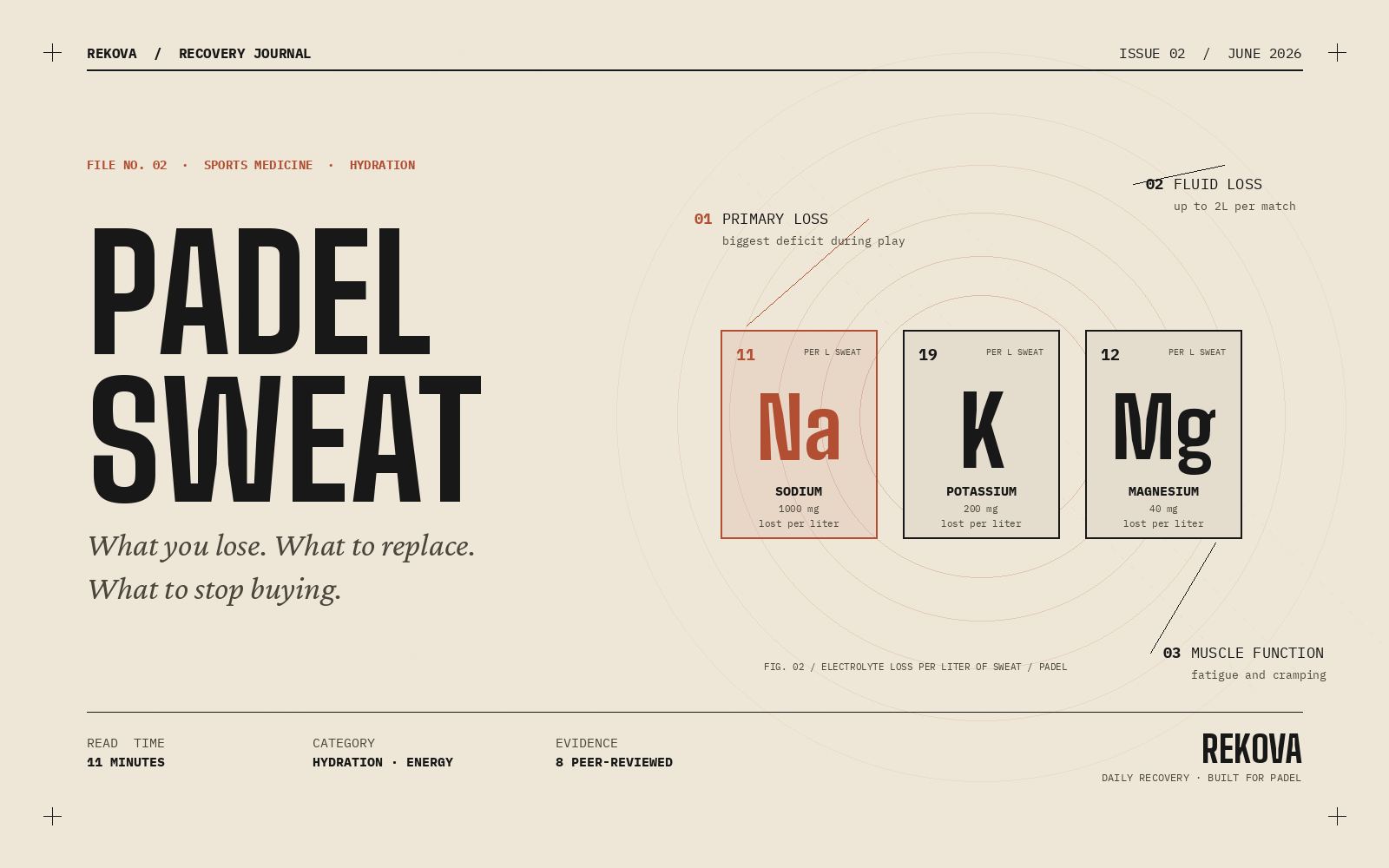
Sodium is the big one. You lose between 500 and 1500 milligrams of sodium per liter of sweat, depending on how salty you are personally. Some people lose more, some less. If you finish a match and you can see white crusty deposits on your shirt or skin, you're a heavy sodium loser. Sodium controls fluid balance and nerve signaling. Run low and your body cannot properly retain water, no matter how much you drink. The European Food Safety Authority confirmed that sodium chloride contributes to maintaining normal water balance.
Potassium is second in volume lost. Most players don't think about it because we tend to get plenty from food. Bananas, potatoes, beans, salmon. But during an intense match you can lose more than your usual food intake replaces. EFSA confirms that potassium contributes to normal muscle function and to the maintenance of normal blood pressure.
Magnesium is the quiet one. You lose less of it than sodium or potassium, but most people are running low to begin with. Studies done across European populations consistently show that 30 to 40 percent of adults don't hit recommended magnesium intake from diet alone. Add athletic sweat losses and you have a problem. EFSA has approved several claims for magnesium that are directly relevant here. Magnesium contributes to normal muscle function. Magnesium contributes to normal energy yielding metabolism. Magnesium contributes to electrolyte balance. And, importantly, magnesium contributes to the reduction of tiredness and fatigue.
Calcium gets attention for bones but it's also involved in every muscle contraction. Losses through sweat are smaller, and most players don't need to think about it as long as their general diet includes dairy or fortified alternatives.
There's also a long tail of trace minerals like zinc, copper, manganese, chromium. These matter for general physiology but they're not your immediate problem during a match. Address sodium, potassium, and magnesium first and the rest tends to look after itself.
Sodium is the big one. You lose between 500 and 1500 milligrams of sodium per liter of sweat, depending on how salty you are personally. Some people lose more, some less. If you finish a match and you can see white crusty deposits on your shirt or skin, you're a heavy sodium loser. Sodium controls fluid balance and nerve signaling. Run low and your body cannot properly retain water, no matter how much you drink. The European Food Safety Authority confirmed that sodium chloride contributes to maintaining normal water balance.
Potassium is second in volume lost. Most players don't think about it because we tend to get plenty from food. Bananas, potatoes, beans, salmon. But during an intense match you can lose more than your usual food intake replaces. EFSA confirms that potassium contributes to normal muscle function and to the maintenance of normal blood pressure.
Magnesium is the quiet one. You lose less of it than sodium or potassium, but most people are running low to begin with. Studies done across European populations consistently show that 30 to 40 percent of adults don't hit recommended magnesium intake from diet alone. Add athletic sweat losses and you have a problem. EFSA has approved several claims for magnesium that are directly relevant here. Magnesium contributes to normal muscle function. Magnesium contributes to normal energy yielding metabolism. Magnesium contributes to electrolyte balance. And, importantly, magnesium contributes to the reduction of tiredness and fatigue.
Calcium gets attention for bones but it's also involved in every muscle contraction. Losses through sweat are smaller, and most players don't need to think about it as long as their general diet includes dairy or fortified alternatives.
There's also a long tail of trace minerals like zinc, copper, manganese, chromium. These matter for general physiology but they're not your immediate problem during a match. Address sodium, potassium, and magnesium first and the rest tends to look after itself.
How much you actually lose per match
This depends on three variables. Body weight. Temperature and humidity. Match intensity.
The rough numbers from sports science research that's been done on racquet sports look like this.
A 75 kilogram player in cool indoor conditions might lose around 600 to 800 milliliters of fluid during a 90 minute match. Sodium losses around 800 milligrams total.
The same player on a hot summer day on an outdoor court with the glass walls reflecting heat can easily lose 1.5 to 2 liters of fluid. Sodium losses around 2 to 3 grams. Potassium around 200 to 300 milligrams. Magnesium around 30 to 50 milligrams.
A simple trick that Healthspan Elite published. Weigh yourself naked or in dry clothes before the match. Weigh yourself the same way after. The difference is mostly water loss. Multiply by 1.5 liters per kilogram lost, and that's how much fluid you need to replace gradually over the following few hours. Not all at once. Sip over 3 to 4 hours.
The first time I did this honestly I'd lost 1.4 kilograms in a single match. That's over two liters of fluid. No wonder I was destroyed every Sunday morning.
The rough numbers from sports science research that's been done on racquet sports look like this.
A 75 kilogram player in cool indoor conditions might lose around 600 to 800 milliliters of fluid during a 90 minute match. Sodium losses around 800 milligrams total.
The same player on a hot summer day on an outdoor court with the glass walls reflecting heat can easily lose 1.5 to 2 liters of fluid. Sodium losses around 2 to 3 grams. Potassium around 200 to 300 milligrams. Magnesium around 30 to 50 milligrams.
A simple trick that Healthspan Elite published. Weigh yourself naked or in dry clothes before the match. Weigh yourself the same way after. The difference is mostly water loss. Multiply by 1.5 liters per kilogram lost, and that's how much fluid you need to replace gradually over the following few hours. Not all at once. Sip over 3 to 4 hours.
The first time I did this honestly I'd lost 1.4 kilograms in a single match. That's over two liters of fluid. No wonder I was destroyed every Sunday morning.
Signs you're under hydrating without realizing it
This took me a while to learn to recognize.
Cramps are obvious. By the time you cramp, you've been under hydrated for a while.
Less obvious signals include a dull headache after the match that doesn't go away with sleep. Feeling unusually tired the next day even though the match itself wasn't that long. Dark yellow urine. Dry mouth that water doesn't seem to fix. Trouble falling asleep at night despite physical exhaustion. Muscle twitches in your eyelids or fingers in the evening.
If any of those sound familiar, you're not drinking enough during play. Or you're drinking only water and missing the minerals.
Cramps are obvious. By the time you cramp, you've been under hydrated for a while.
Less obvious signals include a dull headache after the match that doesn't go away with sleep. Feeling unusually tired the next day even though the match itself wasn't that long. Dark yellow urine. Dry mouth that water doesn't seem to fix. Trouble falling asleep at night despite physical exhaustion. Muscle twitches in your eyelids or fingers in the evening.
If any of those sound familiar, you're not drinking enough during play. Or you're drinking only water and missing the minerals.
When to drink, what to drink
This is where I see most people overthink things.
Before the match. You want to arrive on court already hydrated. The Padel Magazine guide on nutrition suggests around 500 milliliters of water with a pinch of salt or a few electrolyte tablets one to two hours before play. Not chugged. Sipped.
During the match. For matches under 60 minutes in cool conditions, plain water in small sips between games is fine. For matches over 60 minutes, or in heat above 25 degrees Celsius, you want an isotonic drink with sodium and ideally some carbs. The amount that works for most players is around 500 to 750 milliliters per hour.
After the match. This is the window people skip. You've finished the third set, you're sweaty, you grab a beer with the doubles partners and head home. Big mistake. The first 30 to 60 minutes after exercise is when your body is most efficient at replacing minerals and rebuilding glycogen stores. A combination of fluids, electrolytes, and a small amount of protein is what your system actually wants.
Now I'm not telling you to skip the beer. I'm saying have the water and the electrolytes first, then enjoy the beer. Order matters more than people realize.
Before the match. You want to arrive on court already hydrated. The Padel Magazine guide on nutrition suggests around 500 milliliters of water with a pinch of salt or a few electrolyte tablets one to two hours before play. Not chugged. Sipped.
During the match. For matches under 60 minutes in cool conditions, plain water in small sips between games is fine. For matches over 60 minutes, or in heat above 25 degrees Celsius, you want an isotonic drink with sodium and ideally some carbs. The amount that works for most players is around 500 to 750 milliliters per hour.
After the match. This is the window people skip. You've finished the third set, you're sweaty, you grab a beer with the doubles partners and head home. Big mistake. The first 30 to 60 minutes after exercise is when your body is most efficient at replacing minerals and rebuilding glycogen stores. A combination of fluids, electrolytes, and a small amount of protein is what your system actually wants.
Now I'm not telling you to skip the beer. I'm saying have the water and the electrolytes first, then enjoy the beer. Order matters more than people realize.
Common mistakes I see at the club
Drinking only water during long sessions. Already covered. Skip if you're playing under an hour in cool conditions, otherwise mix in electrolytes.
Drinking too much fluid all at once. Your gut can only absorb so much liquid per minute, around 800 to 1000 milliliters per hour at the absolute max for most people. Chugging a liter between sets doesn't hydrate you faster. It just sits in your stomach and makes you nauseous.
Relying on sports drinks loaded with sugar. The classic supermarket sports drinks have plenty of sodium but they're often loaded with sugar. For a 90 minute padel session you don't need 60 grams of sugar. You need 20 to 40 grams maximum, and ideally split across the match rather than dumped in one bottle.
Drinking coffee or energy drinks as your only fluid before play. Caffeine is fine in moderate doses. It can even help athletic performance. But it's mildly diuretic and not a hydration source by itself. Have your coffee, then have your water on top of it.
Using electrolyte tablets that contain almost no electrolytes. This is a category of products that drives me a little crazy. Some popular brands market themselves as hydration tablets while delivering 250 to 350 milligrams of sodium per tablet. That's a fraction of what you need for a tough match. Read the label. If the sodium content is under 400 milligrams per serving, you're paying for flavored water with a vitamin sprinkle.
Drinking too much fluid all at once. Your gut can only absorb so much liquid per minute, around 800 to 1000 milliliters per hour at the absolute max for most people. Chugging a liter between sets doesn't hydrate you faster. It just sits in your stomach and makes you nauseous.
Relying on sports drinks loaded with sugar. The classic supermarket sports drinks have plenty of sodium but they're often loaded with sugar. For a 90 minute padel session you don't need 60 grams of sugar. You need 20 to 40 grams maximum, and ideally split across the match rather than dumped in one bottle.
Drinking coffee or energy drinks as your only fluid before play. Caffeine is fine in moderate doses. It can even help athletic performance. But it's mildly diuretic and not a hydration source by itself. Have your coffee, then have your water on top of it.
Using electrolyte tablets that contain almost no electrolytes. This is a category of products that drives me a little crazy. Some popular brands market themselves as hydration tablets while delivering 250 to 350 milligrams of sodium per tablet. That's a fraction of what you need for a tough match. Read the label. If the sodium content is under 400 milligrams per serving, you're paying for flavored water with a vitamin sprinkle.
Where supplements and recovery drinks fit in
Here's where I have to be careful with the language. Both for legal reasons and because the supplement industry sells a lot of nonsense.
No drink, no powder, and no pill is going to make you a better padel player on its own. The biggest factors are still technique, training, conditioning, sleep, and general diet. If those aren't in order, no supplement matters.
That said. If you play three or more times a week, the cumulative cost of mineral losses across the week adds up. By Friday you can be running low on magnesium and potassium even if every individual match felt fine. This is where a daily recovery drink with the right electrolyte profile starts to matter.
What I look for in a product. At minimum 400 to 600 milligrams of sodium per serving. Around 200 to 400 milligrams of potassium. Around 150 to 300 milligrams of magnesium, ideally in a well absorbed form like magnesium citrate. Some support nutrients like B vitamins, since EFSA confirms that vitamins B1, B2, B3, B5, B6, and B12 all contribute to normal energy yielding metabolism. Bonus points for ingredients that support general recovery, like collagen and vitamin C, where vitamin C contributes to normal collagen formation for the normal function of cartilage and bones.
The Rekova formula was built around exactly this profile. Electrolyte stack with sodium, potassium, and magnesium in doses that match what padel players actually lose. Hydrolyzed collagen with vitamin C for connective tissue support. B vitamin complex for energy metabolism. A few adaptogenic herbs and antioxidants on top. One sachet mixed with water, usually after the match or in the evening.
It's not a magic bullet and we don't claim it is. It's a daily nutritional baseline for people who play padel regularly and want to give their body what it keeps losing on court.
No drink, no powder, and no pill is going to make you a better padel player on its own. The biggest factors are still technique, training, conditioning, sleep, and general diet. If those aren't in order, no supplement matters.
That said. If you play three or more times a week, the cumulative cost of mineral losses across the week adds up. By Friday you can be running low on magnesium and potassium even if every individual match felt fine. This is where a daily recovery drink with the right electrolyte profile starts to matter.
What I look for in a product. At minimum 400 to 600 milligrams of sodium per serving. Around 200 to 400 milligrams of potassium. Around 150 to 300 milligrams of magnesium, ideally in a well absorbed form like magnesium citrate. Some support nutrients like B vitamins, since EFSA confirms that vitamins B1, B2, B3, B5, B6, and B12 all contribute to normal energy yielding metabolism. Bonus points for ingredients that support general recovery, like collagen and vitamin C, where vitamin C contributes to normal collagen formation for the normal function of cartilage and bones.
The Rekova formula was built around exactly this profile. Electrolyte stack with sodium, potassium, and magnesium in doses that match what padel players actually lose. Hydrolyzed collagen with vitamin C for connective tissue support. B vitamin complex for energy metabolism. A few adaptogenic herbs and antioxidants on top. One sachet mixed with water, usually after the match or in the evening.
It's not a magic bullet and we don't claim it is. It's a daily nutritional baseline for people who play padel regularly and want to give their body what it keeps losing on court.
What I do now after a hard match
I'm not a sports scientist. I'm a guy who's been playing four times a week for almost three years and finally figured out a routine that doesn't leave me wrecked the next morning. For what it's worth, here's what I do.
Before the match. 500 milliliters of water with an electrolyte tablet about 90 minutes before play. Light meal of carbs and a small amount of protein two hours before. Banana on the way to the club.
During the match. Water bottle with diluted electrolyte mix on the bench. A few sips between every other game. If it's hot, more often.
Immediately after. A sachet of Rekova in water, drunk in the locker room before I leave. This gives me electrolytes, magnesium, collagen, and the supporting micronutrients all at once.
Within an hour. A real meal. Carbs, protein, vegetables. Nothing fancy.
Before bed. A glass of water with a pinch of salt if I haven't already taken in enough sodium.
Next morning my urine is light yellow, my muscles feel normal, my energy is intact. That's the goal.
Before the match. 500 milliliters of water with an electrolyte tablet about 90 minutes before play. Light meal of carbs and a small amount of protein two hours before. Banana on the way to the club.
During the match. Water bottle with diluted electrolyte mix on the bench. A few sips between every other game. If it's hot, more often.
Immediately after. A sachet of Rekova in water, drunk in the locker room before I leave. This gives me electrolytes, magnesium, collagen, and the supporting micronutrients all at once.
Within an hour. A real meal. Carbs, protein, vegetables. Nothing fancy.
Before bed. A glass of water with a pinch of salt if I haven't already taken in enough sodium.
Next morning my urine is light yellow, my muscles feel normal, my energy is intact. That's the goal.
FAQ: questions players ask me about hydration
How much water should I drink in a padel match? Around 500 to 750 milliliters per hour if the match is intense and over an hour long. Less in cool conditions, more in heat. Sip rather than chug.
Are sports drinks good for padel? Some are. Most popular brands have too much sugar and not enough sodium for an hour plus of intense play. Look for products with at least 400 milligrams of sodium per serving and moderate carbs.
What about coconut water? Coconut water has potassium but is low in sodium, which is the mineral you lose most. It's fine as a supplementary drink but not as your primary hydration during a hard match.
Can I just eat salty food before playing? You can, and it helps somewhat. But salty food doesn't replace electrolytes during play. You still want something on the court with you.
Why do my legs cramp at night after a match? Classic sign of magnesium or potassium depletion combined with general dehydration. Magnesium contributes to normal muscle function. If this happens often, look at your overall mineral intake across the week, not just match day.
Do I really need electrolytes if I play indoors in a cool club? For shorter sessions under an hour, probably not. Just drink water. For longer or intense sessions, yes, you still sweat enough to benefit from electrolyte replacement even in cool indoor conditions.
Is Pedialyte or oral rehydration solution a good option? Yes, these are clinically designed for rehydration and have excellent sodium content. They taste medicinal but they work. Good emergency option if you've really overdone it.
Are sports drinks good for padel? Some are. Most popular brands have too much sugar and not enough sodium for an hour plus of intense play. Look for products with at least 400 milligrams of sodium per serving and moderate carbs.
What about coconut water? Coconut water has potassium but is low in sodium, which is the mineral you lose most. It's fine as a supplementary drink but not as your primary hydration during a hard match.
Can I just eat salty food before playing? You can, and it helps somewhat. But salty food doesn't replace electrolytes during play. You still want something on the court with you.
Why do my legs cramp at night after a match? Classic sign of magnesium or potassium depletion combined with general dehydration. Magnesium contributes to normal muscle function. If this happens often, look at your overall mineral intake across the week, not just match day.
Do I really need electrolytes if I play indoors in a cool club? For shorter sessions under an hour, probably not. Just drink water. For longer or intense sessions, yes, you still sweat enough to benefit from electrolyte replacement even in cool indoor conditions.
Is Pedialyte or oral rehydration solution a good option? Yes, these are clinically designed for rehydration and have excellent sodium content. They taste medicinal but they work. Good emergency option if you've really overdone it.
The short version
You sweat more in padel than you think because the glass walls trap heat and reduce evaporation. You lose sodium, potassium, and magnesium along with water. Replacing only water can make things worse by diluting your blood sodium. The minimum you want during a hard match is sodium, potassium, and ideally magnesium. Drink during the match in small amounts, eat a normal meal afterwards, and pay attention to your urine color the next morning. Skip the supermarket sports drinks with 60 grams of sugar and look for cleaner formulations with proper electrolyte doses.
If you play regularly and want one product to cover the daily baseline, that's the gap a recovery drink fills. If you only play once a week and you're already drinking enough water, you probably don't need much beyond that.
If you play regularly and want one product to cover the daily baseline, that's the gap a recovery drink fills. If you only play once a week and you're already drinking enough water, you probably don't need much beyond that.
Sources
Healthspan Elite. Padel: what is it and how should you fuel your game? Knowledge Hub. 2025.
Marcos Rivero B. et al. Evolution of Physiological Responses and Fatigue Analysis in Padel Matches According to Match Outcome and Playing Position. Sensors. August 2025.
Padel Magazine. Padel and nutrition: what to eat before, during and after a match. 2025.
Padel39. Nutrition tips for long padel matches and quick recovery. 2025.
EFSA. Scientific Opinions on the substantiation of health claims related to magnesium, potassium, sodium chloride, and B vitamins. EFSA Journal, various years.
HSN Store. Supplements for Padel: helping you choose the best. November 2025.
Enervit. Supplementation for padel. 2022.
Mulebar. Sports nutrition for padel: improve your performance with the right diet. December 2025.
This article shares my own experience playing padel and reflects current sports science research on hydration and electrolyte balance. It's not medical advice. If you cramp frequently, get persistent headaches after exercise, or have any underlying condition that affects fluid or electrolyte balance, please consult a qualified healthcare professional before changing your hydration routine.
Rekova does not treat dehydration and does not prevent cramps. It's a daily functional drink with electrolytes, magnesium, hydrolyzed collagen, B vitamins, and supporting nutrients, formulated as nutritional support for people who play padel regularly.
Marcos Rivero B. et al. Evolution of Physiological Responses and Fatigue Analysis in Padel Matches According to Match Outcome and Playing Position. Sensors. August 2025.
Padel Magazine. Padel and nutrition: what to eat before, during and after a match. 2025.
Padel39. Nutrition tips for long padel matches and quick recovery. 2025.
EFSA. Scientific Opinions on the substantiation of health claims related to magnesium, potassium, sodium chloride, and B vitamins. EFSA Journal, various years.
HSN Store. Supplements for Padel: helping you choose the best. November 2025.
Enervit. Supplementation for padel. 2022.
Mulebar. Sports nutrition for padel: improve your performance with the right diet. December 2025.
This article shares my own experience playing padel and reflects current sports science research on hydration and electrolyte balance. It's not medical advice. If you cramp frequently, get persistent headaches after exercise, or have any underlying condition that affects fluid or electrolyte balance, please consult a qualified healthcare professional before changing your hydration routine.
Rekova does not treat dehydration and does not prevent cramps. It's a daily functional drink with electrolytes, magnesium, hydrolyzed collagen, B vitamins, and supporting nutrients, formulated as nutritional support for people who play padel regularly.
