About three years into playing padel I noticed something embarrassing. By the third set of a competitive 90-minute match, I was visibly the most tired person on the court. My footwork would slow. I'd skip shots I should have chased. Mental focus would deteriorate. The opposing players would seem to be playing the same way they had been playing 60 minutes earlier. I was the only one falling apart.
This was confusing because I was playing padel 4 times a week. I assumed the sport itself was my conditioning. Surely 90 minutes of intermittent high intensity exercise four times weekly was enough cardiovascular training.
It wasn't.
The padel cardio gap is real and well-documented in sports science. Padel itself doesn't build the kind of cardiovascular fitness that lets you maintain quality through long matches. You need separate conditioning. Below is what works, what doesn't, and how much of it you actually need.
Why padel alone isn't enough cardio
Padel is intermittent high-intensity exercise with built-in recovery between points. Average match heart rate sits around 140 to 160 bpm with peaks during long rallies. Lots of moderate intensity work. Little sustained high intensity.
The Marcos Rivero 2025 study on padel physiology measured heart rate patterns across matches. Players never spent long enough at sustained high intensities to drive maximal aerobic adaptations. The work pattern is more like 30 seconds on, 25 seconds off, repeated for 90 minutes. Good for sport-specific endurance but limited for building overall cardiovascular capacity.
The problem this creates. As matches get longer or more competitive, your reserves get drawn down. Players with better cardiovascular bases tap into deeper reserves. Players without those bases hit the wall earlier.
The same applies to amateur tournaments with multiple matches per day. Each subsequent match is harder than the last. Players with bigger cardiovascular reserves maintain quality longer. Padel-only players degrade faster.
This isn't theoretical. Watch any club tournament. By the second match of the day, half the field is playing visibly tired padel. By the third match, two thirds. Better conditioning is the difference.
The Marcos Rivero 2025 study on padel physiology measured heart rate patterns across matches. Players never spent long enough at sustained high intensities to drive maximal aerobic adaptations. The work pattern is more like 30 seconds on, 25 seconds off, repeated for 90 minutes. Good for sport-specific endurance but limited for building overall cardiovascular capacity.
The problem this creates. As matches get longer or more competitive, your reserves get drawn down. Players with better cardiovascular bases tap into deeper reserves. Players without those bases hit the wall earlier.
The same applies to amateur tournaments with multiple matches per day. Each subsequent match is harder than the last. Players with bigger cardiovascular reserves maintain quality longer. Padel-only players degrade faster.
This isn't theoretical. Watch any club tournament. By the second match of the day, half the field is playing visibly tired padel. By the third match, two thirds. Better conditioning is the difference.
What padel conditioning actually requires
Different from running conditioning. Different from cycling conditioning. Specific demands of padel matter.
Repeated sprint ability. The ability to do short hard efforts (5 to 10 seconds), recover briefly, then repeat. This is the core fitness need for racquet sports.
Aerobic capacity (VO2 max). The maximum amount of oxygen your body can use during exercise. Higher VO2 max means more reserves for the high-intensity moments and faster recovery between them.
Anaerobic threshold. The intensity at which your body shifts from primarily aerobic to primarily anaerobic energy production. Higher threshold means you can play harder for longer before fatigue accelerates.
Lactate clearance. How quickly your body processes the lactate produced during high-intensity efforts. Better clearance means faster recovery between rallies and points.
Movement economy. Efficiency of your movement patterns. Lower oxygen cost for the same work. Comes from sport-specific practice plus general conditioning.
The good news. Most amateur padel players have so much room to improve on these that even modest additional conditioning produces noticeable results.
Repeated sprint ability. The ability to do short hard efforts (5 to 10 seconds), recover briefly, then repeat. This is the core fitness need for racquet sports.
Aerobic capacity (VO2 max). The maximum amount of oxygen your body can use during exercise. Higher VO2 max means more reserves for the high-intensity moments and faster recovery between them.
Anaerobic threshold. The intensity at which your body shifts from primarily aerobic to primarily anaerobic energy production. Higher threshold means you can play harder for longer before fatigue accelerates.
Lactate clearance. How quickly your body processes the lactate produced during high-intensity efforts. Better clearance means faster recovery between rallies and points.
Movement economy. Efficiency of your movement patterns. Lower oxygen cost for the same work. Comes from sport-specific practice plus general conditioning.
The good news. Most amateur padel players have so much room to improve on these that even modest additional conditioning produces noticeable results.
How much cardio do you actually need
The research on amateur athletes converges on a manageable amount.
Two cardio sessions per week beyond your padel produces meaningful results.
Three cardio sessions per week produces good results if you have the time.
One cardio session per week is significantly better than zero but insufficient for substantial improvement.
More than four cardio sessions per week tends to interfere with padel recovery and strength training. Diminishing returns set in.
Each session 25 to 45 minutes. Less than 20 minutes is rarely enough. More than 60 minutes adds fatigue without much additional benefit for padel-specific goals.
Total weekly conditioning time. 60 to 90 minutes. That's it. The myth that you need hours of running every week to be fit is wrong for padel.
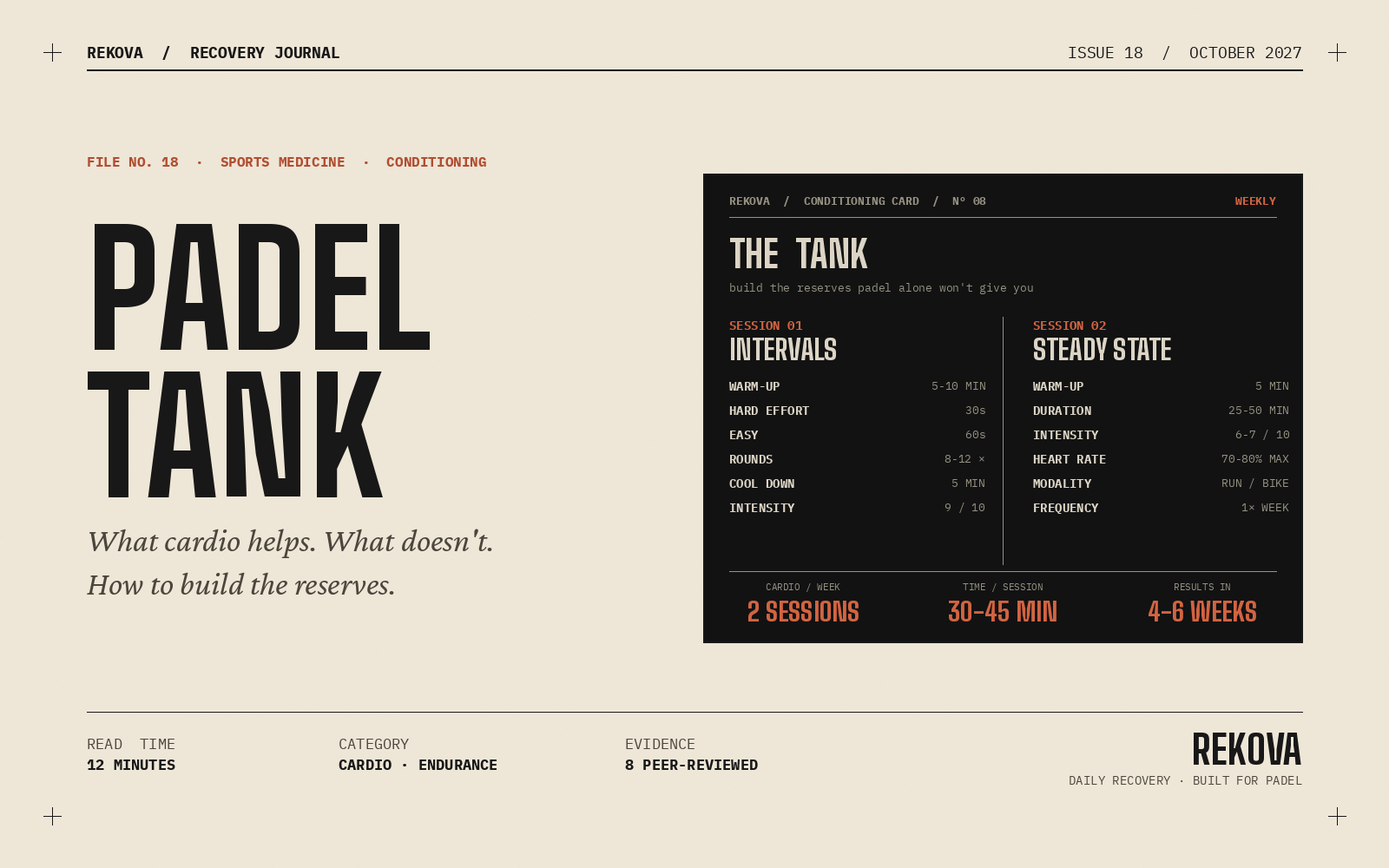
For my own routine, I do two cardio sessions per week. One interval session (about 30 minutes total including warm-up). One longer steady state session (40 to 50 minutes). Plus 3 padel sessions and 2 strength sessions. 7 days of structured activity total.
Two cardio sessions per week beyond your padel produces meaningful results.
Three cardio sessions per week produces good results if you have the time.
One cardio session per week is significantly better than zero but insufficient for substantial improvement.
More than four cardio sessions per week tends to interfere with padel recovery and strength training. Diminishing returns set in.
Each session 25 to 45 minutes. Less than 20 minutes is rarely enough. More than 60 minutes adds fatigue without much additional benefit for padel-specific goals.
Total weekly conditioning time. 60 to 90 minutes. That's it. The myth that you need hours of running every week to be fit is wrong for padel.
For my own routine, I do two cardio sessions per week. One interval session (about 30 minutes total including warm-up). One longer steady state session (40 to 50 minutes). Plus 3 padel sessions and 2 strength sessions. 7 days of structured activity total.
Interval training: the high-leverage method
For padel specifically, interval training delivers more performance benefit per minute than any other cardio approach.
Why intervals work. They build VO2 max faster than steady state. They develop repeated sprint ability directly. They produce metabolic adaptations that show up in matches.
The basic protocol. After 5 to 10 minutes warm-up. 30 seconds hard. 60 seconds easy. Repeat 8 to 12 times. Cool down 5 minutes. Total session 25 to 35 minutes.
Hard means roughly 90 percent of your max effort. Should be unable to talk in full sentences. Easy means active recovery, walking pace or light jogging.
Modality. Running, cycling, rowing, swimming, elliptical all work. The transferable adaptation is the cardiovascular system, not the specific muscles. Pick what you enjoy enough to stick with.
Frequency. One interval session per week is the minimum. Two is better. Three is too much for most amateurs combining this with padel.
Progression. Start with 6 to 8 intervals. Add one or two per session every couple of weeks until you reach 12. Then increase work interval to 40 seconds or shorten rest interval. Don't try to do 20 intervals in week one.
The 4 by 4 protocol. Alternative format. 4 minutes hard, 3 minutes easy, repeated 4 times. Plus warm-up and cool-down. Total session 35 to 40 minutes. Excellent for VO2 max development. Brutal in a good way.
Why intervals work. They build VO2 max faster than steady state. They develop repeated sprint ability directly. They produce metabolic adaptations that show up in matches.
The basic protocol. After 5 to 10 minutes warm-up. 30 seconds hard. 60 seconds easy. Repeat 8 to 12 times. Cool down 5 minutes. Total session 25 to 35 minutes.
Hard means roughly 90 percent of your max effort. Should be unable to talk in full sentences. Easy means active recovery, walking pace or light jogging.
Modality. Running, cycling, rowing, swimming, elliptical all work. The transferable adaptation is the cardiovascular system, not the specific muscles. Pick what you enjoy enough to stick with.
Frequency. One interval session per week is the minimum. Two is better. Three is too much for most amateurs combining this with padel.
Progression. Start with 6 to 8 intervals. Add one or two per session every couple of weeks until you reach 12. Then increase work interval to 40 seconds or shorten rest interval. Don't try to do 20 intervals in week one.
The 4 by 4 protocol. Alternative format. 4 minutes hard, 3 minutes easy, repeated 4 times. Plus warm-up and cool-down. Total session 35 to 40 minutes. Excellent for VO2 max development. Brutal in a good way.
Steady state training: the foundation
Longer, slower work at lower intensities builds the aerobic base that intervals work on top of.
What steady state means. 25 to 50 minutes at a pace where you could maintain conversation, but not comfortably. Roughly 70 to 80 percent of your max heart rate. About 6 to 7 out of 10 perceived exertion.
Why it matters. Builds capillary density in muscles. Increases mitochondrial density. Improves fat utilization. Reduces resting heart rate over time. Provides recovery for harder sessions.
Modality. Running at a conversational pace. Cycling at moderate effort. Rowing at moderate effort. Brisk hiking. Whatever you'll actually do.
Frequency. One session per week minimum. Two is better. More than three steady state sessions per week leads to diminishing returns.
Duration. Start at 25 minutes if untrained. Build to 40 to 50 minutes over months. Going beyond 60 minutes per session offers limited additional benefit for padel.
The combination. Most amateur padel players benefit from one interval session plus one steady state session per week. Different physiological adaptations. Both useful.
What steady state means. 25 to 50 minutes at a pace where you could maintain conversation, but not comfortably. Roughly 70 to 80 percent of your max heart rate. About 6 to 7 out of 10 perceived exertion.
Why it matters. Builds capillary density in muscles. Increases mitochondrial density. Improves fat utilization. Reduces resting heart rate over time. Provides recovery for harder sessions.
Modality. Running at a conversational pace. Cycling at moderate effort. Rowing at moderate effort. Brisk hiking. Whatever you'll actually do.
Frequency. One session per week minimum. Two is better. More than three steady state sessions per week leads to diminishing returns.
Duration. Start at 25 minutes if untrained. Build to 40 to 50 minutes over months. Going beyond 60 minutes per session offers limited additional benefit for padel.
The combination. Most amateur padel players benefit from one interval session plus one steady state session per week. Different physiological adaptations. Both useful.
What doesn't work as well
A few patterns common in amateur conditioning that aren't optimal for padel.
Long slow distance only. Pure marathon-style training (60-plus minute easy runs) builds endurance for marathon-style efforts. Padel isn't a marathon-style effort. Lots of slow miles don't translate well.
Crossfit-style mixed metabolic conditioning. Can work but the variety often means inconsistent stimulus. The repeated sprint ability and VO2 max improvements come from focused interval work, not random mixed sessions.
HIIT classes at gyms. Many HIIT classes are too short on rest periods and too long on workout duration to produce the right adaptations. Often more like circuit training than true interval work.
Yoga or pilates as cardio. Both have benefits but neither builds cardiovascular fitness meaningfully. Don't count yoga sessions as conditioning.
Walking. Useful for general health and recovery. Not adequate as cardio for serious padel preparation.
Padel matches as cardio. As established above, padel itself doesn't build the cardiovascular base that supports better padel.
What works. Structured cardio sessions of appropriate intensity, frequency, and duration, distinct from padel time, sustained over months.
Long slow distance only. Pure marathon-style training (60-plus minute easy runs) builds endurance for marathon-style efforts. Padel isn't a marathon-style effort. Lots of slow miles don't translate well.
Crossfit-style mixed metabolic conditioning. Can work but the variety often means inconsistent stimulus. The repeated sprint ability and VO2 max improvements come from focused interval work, not random mixed sessions.
HIIT classes at gyms. Many HIIT classes are too short on rest periods and too long on workout duration to produce the right adaptations. Often more like circuit training than true interval work.
Yoga or pilates as cardio. Both have benefits but neither builds cardiovascular fitness meaningfully. Don't count yoga sessions as conditioning.
Walking. Useful for general health and recovery. Not adequate as cardio for serious padel preparation.
Padel matches as cardio. As established above, padel itself doesn't build the cardiovascular base that supports better padel.
What works. Structured cardio sessions of appropriate intensity, frequency, and duration, distinct from padel time, sustained over months.
Equipment for off-court cardio
You don't need a gym. You don't need expensive equipment. A few options.
Running. Cheapest entry. Requires only shoes. Outdoor running has weather constraints. Treadmill running indoors is fine.
Cycling. Outdoor or indoor stationary. Lower joint impact than running, useful for older players or those with knee issues. Stationary bikes work fine for intervals.
Rowing. Excellent full-body cardio. Indoor rowing machine costs 300 to 1000 euros, worth it if you'll use it. Rowing is particularly good for upper body cardiovascular work that running misses.
Swimming. Low impact, full body. Requires pool access. Excellent variety from other land-based activities.
Stationary equipment. Air bikes, elliptical machines, ski erg machines all work. Choose what you'll actually use.
Heart rate monitor. Useful but not essential. Watch-based heart rate sensors work for general purposes. Chest strap monitors are more accurate.
Your tracker preferences are personal. The main thing is consistency in your routine, not the specific equipment.
Running. Cheapest entry. Requires only shoes. Outdoor running has weather constraints. Treadmill running indoors is fine.
Cycling. Outdoor or indoor stationary. Lower joint impact than running, useful for older players or those with knee issues. Stationary bikes work fine for intervals.
Rowing. Excellent full-body cardio. Indoor rowing machine costs 300 to 1000 euros, worth it if you'll use it. Rowing is particularly good for upper body cardiovascular work that running misses.
Swimming. Low impact, full body. Requires pool access. Excellent variety from other land-based activities.
Stationary equipment. Air bikes, elliptical machines, ski erg machines all work. Choose what you'll actually use.
Heart rate monitor. Useful but not essential. Watch-based heart rate sensors work for general purposes. Chest strap monitors are more accurate.
Your tracker preferences are personal. The main thing is consistency in your routine, not the specific equipment.
When and how to fit cardio with padel
Scheduling matters. Doing cardio at the wrong time relative to padel hurts both.
Cardio on padel days. Generally don't do hard cardio on padel days. If you must, separate by at least 6 hours and do the lower-intensity activity second.
Cardio on rest-from-padel days. Ideal scheduling. Hard interval session on a non-padel day. Steady state on another non-padel day.
Cardio relative to strength training. Strength training and cardio in the same session is fine if needed. Strength first, then cardio. The reverse compromises strength quality.
Sample weekly schedule for amateur padel player.
Monday: strength (lower body focus). Tuesday: padel. Wednesday: interval cardio. Thursday: strength (upper body focus). Friday: padel. Saturday: padel. Sunday: steady state cardio or rest.
This gives 2 strength sessions, 3 padel sessions, 2 cardio sessions, 0 to 1 rest days per week. Sustainable for most reasonably healthy adults.
For my 52-year-old doubles partner who plays competitively, the routine has been similar for years. Two cardio sessions per week have made him able to outlast players 20 years younger in the third set. The compound effect over time is significant.
Cardio on padel days. Generally don't do hard cardio on padel days. If you must, separate by at least 6 hours and do the lower-intensity activity second.
Cardio on rest-from-padel days. Ideal scheduling. Hard interval session on a non-padel day. Steady state on another non-padel day.
Cardio relative to strength training. Strength training and cardio in the same session is fine if needed. Strength first, then cardio. The reverse compromises strength quality.
Sample weekly schedule for amateur padel player.
Monday: strength (lower body focus). Tuesday: padel. Wednesday: interval cardio. Thursday: strength (upper body focus). Friday: padel. Saturday: padel. Sunday: steady state cardio or rest.
This gives 2 strength sessions, 3 padel sessions, 2 cardio sessions, 0 to 1 rest days per week. Sustainable for most reasonably healthy adults.
For my 52-year-old doubles partner who plays competitively, the routine has been similar for years. Two cardio sessions per week have made him able to outlast players 20 years younger in the third set. The compound effect over time is significant.
Where Rekova fits
Brief.
Cardio training increases your daily nutritional needs. More water needed. More electrolytes lost through sweat. Higher demands on B vitamins for energy metabolism.
EFSA confirms B vitamins contribute to normal energy yielding metabolism. EFSA confirms magnesium contributes to electrolyte balance and reduction of tiredness and fatigue. EFSA confirms vitamin C contributes to reduction of tiredness and fatigue.
The daily Rekova formula covers the baseline. The cardio sessions on top of padel make this baseline matter more.
Cardio training increases your daily nutritional needs. More water needed. More electrolytes lost through sweat. Higher demands on B vitamins for energy metabolism.
EFSA confirms B vitamins contribute to normal energy yielding metabolism. EFSA confirms magnesium contributes to electrolyte balance and reduction of tiredness and fatigue. EFSA confirms vitamin C contributes to reduction of tiredness and fatigue.
The daily Rekova formula covers the baseline. The cardio sessions on top of padel make this baseline matter more.
FAQ: questions about conditioning for padel
Do I really need cardio if I play padel 4 times a week? Yes if you want to play your best in long matches and second matches of tournament days. The padel cardio gap is real.
How long until I notice improvements? Cardiovascular adaptations begin in 2 to 3 weeks. Noticeable padel benefits typically appear in 4 to 6 weeks of consistent training.
Is running bad for my knees? Done with reasonable progression and good shoes, running is fine for most adults. Knee problems from running usually come from sudden volume increases or poor form. If you have existing knee issues, cycling or rowing are gentler options.
Should I do fasted cardio? Personal preference. Has small benefits for fat utilization. No meaningful performance benefit for amateurs. Most amateurs do better with light fuel before cardio sessions.
What about marathon training while playing padel? Difficult combination. Marathon training is so cardiovascularly demanding it tends to interfere with everything else. If marathon is the goal, pause padel during the training block. Or accept reduced padel quality.
Can I substitute interval cardio for steady state? Some yes. The recommended combination has both because they produce different adaptations. Pure intervals work shorter term. Adding steady state work makes the intervals more effective.
How do I know I'm working hard enough? Heart rate monitoring helps. Talk test works (intervals: should be unable to talk; steady state: could maintain short sentences). Perceived effort scale (interval should be 8 to 9 out of 10; steady state 6 to 7).
Should I do cardio sick or tired? No. Skip the session. Recovery comes first. One missed session doesn't matter. Pushing through illness extends it.
What about HIIT apps and structured programs? Useful for guidance. Pick one and stick with it for 8 to 12 weeks before judging. Many amateur programs are too random.
Is heart rate variability worth tracking? For serious players, yes. HRV trends indicate recovery state better than how you feel. Multiple consumer wearables now measure HRV reasonably. Use trends, not absolute numbers.
How long until I notice improvements? Cardiovascular adaptations begin in 2 to 3 weeks. Noticeable padel benefits typically appear in 4 to 6 weeks of consistent training.
Is running bad for my knees? Done with reasonable progression and good shoes, running is fine for most adults. Knee problems from running usually come from sudden volume increases or poor form. If you have existing knee issues, cycling or rowing are gentler options.
Should I do fasted cardio? Personal preference. Has small benefits for fat utilization. No meaningful performance benefit for amateurs. Most amateurs do better with light fuel before cardio sessions.
What about marathon training while playing padel? Difficult combination. Marathon training is so cardiovascularly demanding it tends to interfere with everything else. If marathon is the goal, pause padel during the training block. Or accept reduced padel quality.
Can I substitute interval cardio for steady state? Some yes. The recommended combination has both because they produce different adaptations. Pure intervals work shorter term. Adding steady state work makes the intervals more effective.
How do I know I'm working hard enough? Heart rate monitoring helps. Talk test works (intervals: should be unable to talk; steady state: could maintain short sentences). Perceived effort scale (interval should be 8 to 9 out of 10; steady state 6 to 7).
Should I do cardio sick or tired? No. Skip the session. Recovery comes first. One missed session doesn't matter. Pushing through illness extends it.
What about HIIT apps and structured programs? Useful for guidance. Pick one and stick with it for 8 to 12 weeks before judging. Many amateur programs are too random.
Is heart rate variability worth tracking? For serious players, yes. HRV trends indicate recovery state better than how you feel. Multiple consumer wearables now measure HRV reasonably. Use trends, not absolute numbers.
The short version
Padel alone doesn't build the cardiovascular base that supports better padel. Adding 2 cardio sessions per week (one interval, one steady state) produces meaningful results within 4 to 6 weeks. Intervals build VO2 max and repeated sprint ability fastest. Steady state builds the aerobic foundation. Pick whatever modality (running, cycling, rowing, swimming) you'll actually do. Don't compete cardio with hard padel sessions. Total weekly cardio time of 60 to 90 minutes is enough for most amateurs. Better cardiovascular fitness shows up most in late-match quality and second-match-of-the-day performance.
The boring fundamentals beat fancy padel-specific training nine times out of ten.
The boring fundamentals beat fancy padel-specific training nine times out of ten.
Sources
Marcos Rivero B. et al. Evolution of Physiological Responses and Fatigue Analysis in Padel Matches According to Match Outcome and Playing Position. Sensors. August 2025.
Buchheit M et al. High-intensity interval training, solutions to the programming puzzle. Sports Medicine. Multiple parts, updated 2024.
Helgerud J et al. Aerobic high-intensity intervals improve VO2max more than moderate training. Medicine and Science in Sports and Exercise. 2007, replication studies through 2024.
Bishop D et al. Repeated-sprint ability: a review. Sports Medicine. 2024 update.
International Society of Sports Nutrition. Position stand on protein and energy in conditioning. JISSN. 2024.
ACSM. Position stand on quantity and quality of exercise for healthy adults. 2024.
Smith Palacio E. Epidemiologia de las lesiones en padel y recomendaciones preventivas. Ciencia y Deporte. 2024.
EFSA. Scientific Opinions on the substantiation of health claims related to B vitamins, magnesium, and vitamin C. EFSA Journal, various years.
This article shares my own experience and general guidance on cardiovascular training. It is not medical advice. If you have any cardiovascular condition, heart rhythm issues, or have not exercised in a long time, please consult your doctor before starting an interval training program. High-intensity intervals are demanding and can reveal underlying conditions that need medical attention.
Rekova does not replace proper conditioning or nutrition. It is a daily functional drink with electrolytes, magnesium, hydrolyzed collagen, B vitamins, vitamin C, CoQ10, Acetyl-L-Carnitine, and supporting nutrients, formulated as nutritional support for people who play padel regularly.
Buchheit M et al. High-intensity interval training, solutions to the programming puzzle. Sports Medicine. Multiple parts, updated 2024.
Helgerud J et al. Aerobic high-intensity intervals improve VO2max more than moderate training. Medicine and Science in Sports and Exercise. 2007, replication studies through 2024.
Bishop D et al. Repeated-sprint ability: a review. Sports Medicine. 2024 update.
International Society of Sports Nutrition. Position stand on protein and energy in conditioning. JISSN. 2024.
ACSM. Position stand on quantity and quality of exercise for healthy adults. 2024.
Smith Palacio E. Epidemiologia de las lesiones en padel y recomendaciones preventivas. Ciencia y Deporte. 2024.
EFSA. Scientific Opinions on the substantiation of health claims related to B vitamins, magnesium, and vitamin C. EFSA Journal, various years.
This article shares my own experience and general guidance on cardiovascular training. It is not medical advice. If you have any cardiovascular condition, heart rhythm issues, or have not exercised in a long time, please consult your doctor before starting an interval training program. High-intensity intervals are demanding and can reveal underlying conditions that need medical attention.
Rekova does not replace proper conditioning or nutrition. It is a daily functional drink with electrolytes, magnesium, hydrolyzed collagen, B vitamins, vitamin C, CoQ10, Acetyl-L-Carnitine, and supporting nutrients, formulated as nutritional support for people who play padel regularly.
